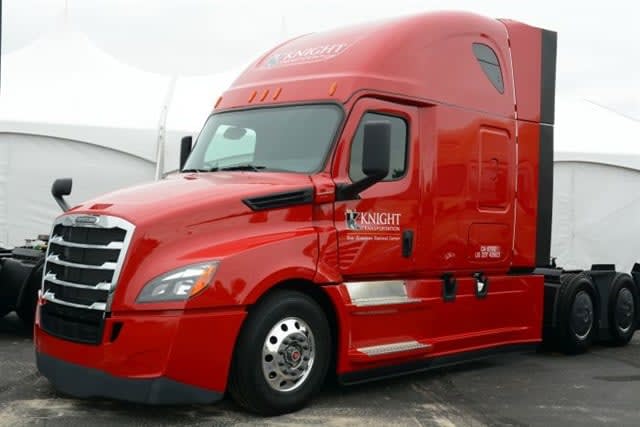
From the November Issue of Heavy Duty Trucking magazine, equipment editor Jim Park test drives the new Freightliner Cascadia. Daimler loaded up this truck with some amazing technology and created an environment drivers will love.
The 2018 “new” Cascadia is worthy of the name and will, I think, be widely embraced by drivers.
9 min to read
The 2018 “new” Cascadia is worthy of the name and will, I think, be widely embraced by drivers.
I have driven a number of Freightliner Cascadia tractors over the years and found them all to be more than satisfactory. The first was a pre-release model I took out for a two-day, 408-mile drive in 2007, three weeks after the official unveiling. It had a Caterpillar C15 ACERT engine, as that was prior to the launch of the Detroit DD15. I drove one of those for the first time in October of the same year, in a Cascadia naturally, a month before it was officially unveiled.
Ad Loading...
I have driven Cascadias in many configurations since then, from day cabs to natural gas powered, and even the Evolution model. I’ve witnessed the launch of several powertrain components and various bits of technology from the left seat of a Cascadia. I’ve also driven a few older units with more than 500,000 miles on them, and even in middle age, they were still pretty solid trucks.
Ten model years will have passed between the time Cascadia first appeared and when the initial production run of the next-generation version announced in September starts rolling off dealer lots in January as model year 2018 trucks. Many evolutionary changes took place along the way, but the basic hood and cab appearance have hardly changed from the first to the current Cascadia. With some added aero trim, the Evolution model took on a fresh outside look, but the cab remained much the same inside and out, at least to the eye.
Ad Loading...
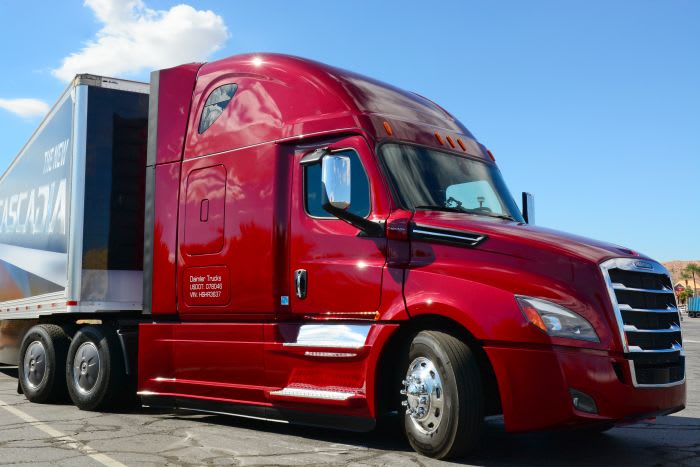
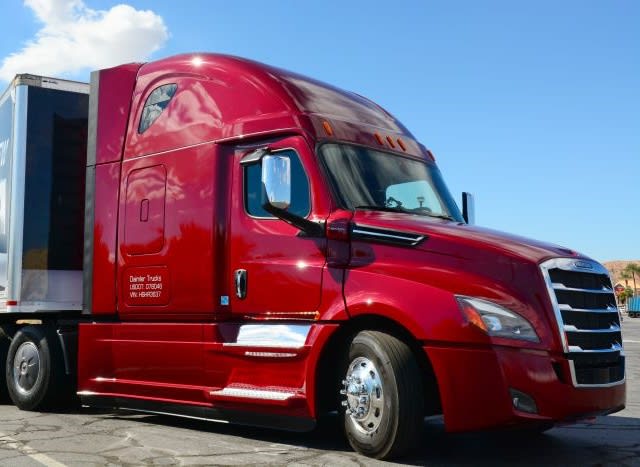
The new Cascadia retains nearly the same cab/sleeper structure, with only a few small external changes, like the aero sculpting on the doors. The hood and the frontal profile of the new truck, however, are quite different. Almost everything inside the cab has changed. And there’s even more going on deep down that you’ll never see – but you will certainly notice – including the latest electronic uptime and safety features, onboard diagnostics and more.
Designed into the new Cascadia as the standard aero package are a new hood and grille, a bumper with an integrated air deflector, an upper door seal to improve air flow over the cab, and integrated radio and CB antennae. The truck we drove came with the mid-range aero package, called the Aero Package. This added 20-inch cab side extenders, drive wheel covers and full chassis fairings over and above the standard package.
The fancier Cascadia with the full AeroX package and the deluxe interior were on static display at the American Trucking Associations’ Management Conference and Exposition, held at the same time as the test drives.
During the Cascadia reveal event in September, Daimler Trucks North America president and CEO Martin Daum said the new Cascadia is 19% more fuel efficient than the current base-model Cascadia, and 8% better than the current Evolution model. Some of those gains could be attributed to the more refined aero elements, the balance from a more efficient driveline and latest version of what Daimler calls Integrated Powertrain Management 4 (IPM4).
IPM4 includes about 100 lb-ft more torque than you’d expect from a 400-hp engine to help keep the truck in top gear as much as possible at highway cruise. GPS-based predictive cruise control helps anticipate upcoming terrain, which helps the engine determine a fueling strategy appropriate for the conditions. During a discussion with DTNA technical sales manager, Mike Stricker, after the test drive, I learned there are several such strategies baked into the system that are invisible to the driver (more on this later).
Ad Loading...
Mechanically, the transmission and rear axles contribute to overall driveline efficiency with reduced friction losses, thanks to a new manufacturing process that provides super-fine polishing of the gear faces. That helps reduce friction between the gear teeth and allows for the use of low-viscosity lube oil. An optional Axle Lubrication Management system (ALM) actively regulates oil levels at the ring gear and pinion bearings to further reduce churning losses.
Automotive styling reigns up front. The command position is very comfortable and the ergonomics are first rate.
In the cab
With recruiting and retention front of mind, Freightliner has created a driving environment that will be in high demand come 2017. The company says the interior of the new Cascadia received more design attention than any previous Freightliner truck.
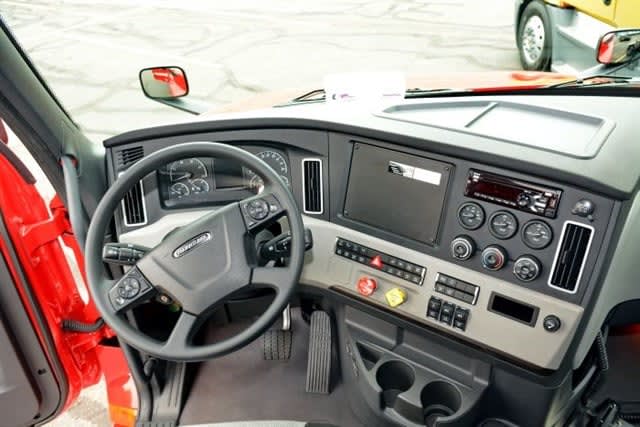
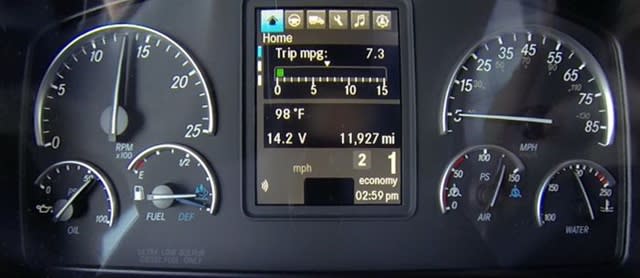
Gone are the trucky-looking gauges on the dashboard A-panel, replaced by a decidedly more automotive arrangement. Between the tach and the speedo is a 5-inch LCD display where drivers can get trip and operational information, including fuel economy trends, real-time fuel economy readouts, etc. Also displayed here are the various warnings from the onboard safety systems such as Detroit Assurance collision mitigation, Active Brake Assist, lane departure warnings and more. It’s a compact and unobtrusive display (except when it needs to be, such as when the bright yellow alerts appear) with many layers of info drivers can scroll through.
The 5-inch LCD is clear and easy to read, and not too detailed for an easy understanding on a cursory glance. There are a few symbols displayed there that may require some explanation.
Controls on the main section of the B-panel are mostly lighting, along with traction control and engine shutdown over-ride. Three more switches on the lower right are for the fifth-wheel slider, suspension air pressure dump and the differential lock (6x4 only). They are within easy reach, but will seldom be used. The more prominent feature on the B-panel is a port for a tablet, presumably for an electronic logging device. There’s an AM/FM/CD radio tucked up near the top of the panel. It looks rather quaint in its more modern setting, but I like it. A driver shouldn’t have to scroll through a bunch of menus to change the radio station while driving.
This Cascadia gets top marks for driving ergonomics, as have past models. The driving position, access to the controls and the sense of being a part of the truck are all very good. I found the placement of the brake and throttle pedal to be quite to my taste, but I didn’t like the throttle pedal itself. First, I found the amount of pedal travel between idle and full seemed to be less than in other brands. I have never measured pedal travel in inches in other trucks, so this observation has to be considered less than scientific. I also found the throttle pedal a little too close to vertical. I like to drive up close to the wheel, so I wasn’t able to rest my heel comfortably on the floor while using the pedal.
Ad Loading...
Our sleeper was the single bunk version called the Driver’s Lounge with a 40-inch lower bunk. There was a larger-than-usual microwave compartment and a swing mount for a flat screen TV up to 26 inches. There was a fridge and a desk as well as a nice assortment of cupboard and closet space. The interior lighting is all LED, but it’s a nice warm light and it’s dimmable, which adds a little ambience to the sleeper compartment. I didn’t have the time to spend a night in the sleeper, but I found the environment warm and inviting and quite functional.
Cascadia’s full AeroX package includes a low-clearance bumper with a flexible air dam to redirect airflow under the vehicle, 24-inch side extenders and proprietary drive axle wheel fairings from FlowBelow.
On the road
Daimler said it had designed a truck that drivers would really want to drive, and the new Cascadia lives up the billing.
First, it’s very quiet inside. With automated transmissions, drivers no longer have to hear the engine to time their shifts, so Daimler made the noise go away. A new cab insulation material, 3M’s Thinsulate, is at least partially responsible for the absence of noise. Contributing to the improvement are new engine mounts, very good door seals and the overall aero shape of the front of the cab. Wind noise is all but eliminated.
The steering is positive at highway speed and nice and firm, but not so firm that it requires some effort at maneuvering speed. It still feels like you’re driving a tractor-trailer without the constant reminders. Very nicely engineered.
While DTNA claims the windshield wiper coverage is 12% better compared to the current model, thus improving the forward visibility in inclement weather, I found the right-hand side mirror placement awkward. From where I sat, the sightlines put the mirror and the A-pillar side-by-side, creating a significant blind spot while looking 90 degrees to the right at traffic approaching at right angles to the truck. Drivers will have to look two or three times in that direction to ensure nothing was obscured by the mirror and the post before proceeding through an intersection. Maybe it would be different with some other seating position.
Ad Loading...
The cruise control system (IPM4) had me flummoxed, I have to say. When you press the set button on the steering wheel, one expects certain things to happen, i.e., the truck will maintain a certain speed. And there are certain things that you don’t expect to happen, like that it drops out of gear (eCoast) but then doesn’t re-engage at or below a certain speed.
The system is available with a closed architecture where a fleet could define bunch of parameters, such as the droop over and under the set speed at which the engine brake comes on, or at which it goes into eCoast, for example. These settings would be invisible to drivers of such trucks. The customer programmable options, however, allow the drivers to set their own speed as well, in the case of an owner-operator. Once these options were set, the truck would behave in a more predictable manner – most of the time.
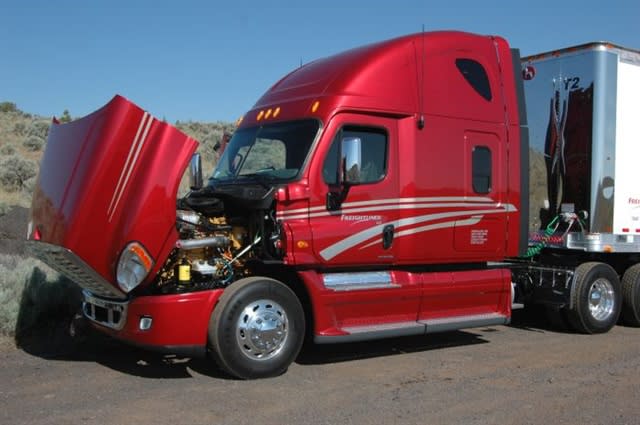
This 2008 Cascadia was the first of the generation. The similarities run only skin deep. The new Cascadia is loaded with safety and fuel-saving technology that was just a twinkle in an engineer’s eye back then.
I learned during my conversation with Stricker that there are three major “cruise control” modes that the truck itself will choose depending on the circumstances, and they remain undefined to the driver – that is, there’s no indication on the display as to what the truck is doing or which mode it’s in. This gives rise to the potentially unexpected behavior.
For example, as part of the fuel-saving strategy, the truck will switch into eCoast on some slight downgrades, but will remain in gear on others. Swicker told me that eCoast requires some fuel input to keep the engine idling, so staying in gear allows the ECU to almost completely cut off the fuel flow to the engine, saving that much more fuel.
I think this rather complex level of control afforded to the engine/transmission ECUs will, counter-intuitively, require a higher degree of driver training so drivers will have some idea of what the truck is doing. I found the behavior disconcerting, but I had no training on it prior to the test drive.
Ad Loading...
My final word on the new Cascadia is “wow.” It’s truly deserving of such an accolade. It’s a terrific driving truck for ride and handling and the work and leisure environments are as good as they come. I like the new interior styling, even if it’s a bit less trucky than its predecessor. There are several maintenance items on the new truck that I didn’t touch on here that will save fleets some downtime and make drivers’ lives a little easier too. Overall, one has to wonder where Daimler will take the next version of the truck, but that’s a question I asked myself last time, too. It’s all about innovation, and the new Cascadia offers no shortage of that.
Jim Park holds a commercial driver’s license and was a driver and owner-operator for 20 years. He not only does test drives, but also writes about equipment, driver issues and other topics.
Volvo’s updated D13 promises lower emissions without sacrificing performance or fuel economy. Take a closer look at what changed inside the engine in this HDT Spotlight video.
The Michelin X Multi Energy D2 is a regional haul drive tire engineered to help fleets improve fuel efficiency, durability and traction in demanding stop-and-go operations.
ZF is expanding its North American commercial-vehicle presence with new transmission applications, electrification, trailer technology and autonomous-driving systems.
Could Tesla’s camera-only autonomous driving technology work on an 80,000-pound Semi? In this commentary, HDT's Deborah Lockridge takes a look at Tesla, Cybercab, and how autonomous trucks see the road.
The U.S. Department of Transportation issued a new automated-vehicle strategy that outlines plans for driverless-truck regulations, cross-state freight corridors, and federal safety standards.
The Port Authority of New York and New Jersey announced millions in incentives for zero-emission drayage trucks, yard tractors, and new charging hubs near the port.
The National Highway Traffic Safety Administration says it lacks authority to regulate medium- and heavy-duty truck engines separately from complete vehicles, but the existing standards have not yet been eliminated.
Detroit isn’t starting from scratch to meet EPA 2027 diesel emissions standards. Its Gen 6 DD13 and DD15 engines keep much of today’s platform while updating the fuel and aftertreatment systems.