





Related: Fuel-Saving Engine Calibration Software Offered for Transit Van
Test Drive: Ford Transit Van
A dual-turbo V-6 makes Ford’s new Euro-style cargo van fast, while the large unibody provides a lot of cargo space.
August 27, 2015
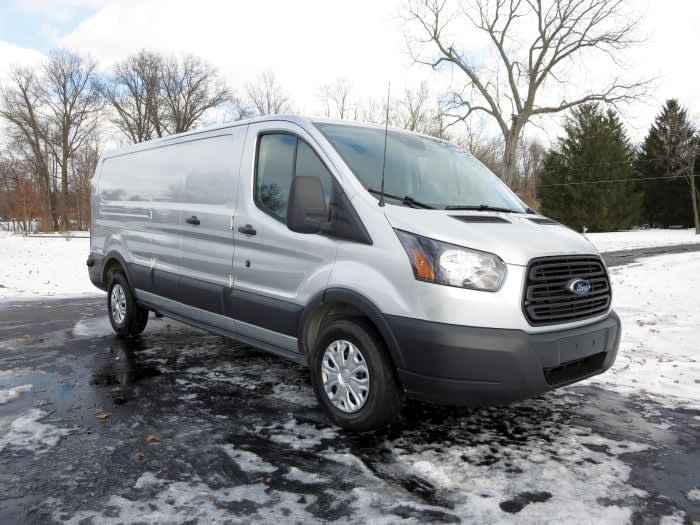
The black grille and lower body trim nicely complement the silver paint, and smooth lines suggest speed. The van had plenty of it, thanks to a double-turbo V-6. Photos: Tom Berg
6 min to read
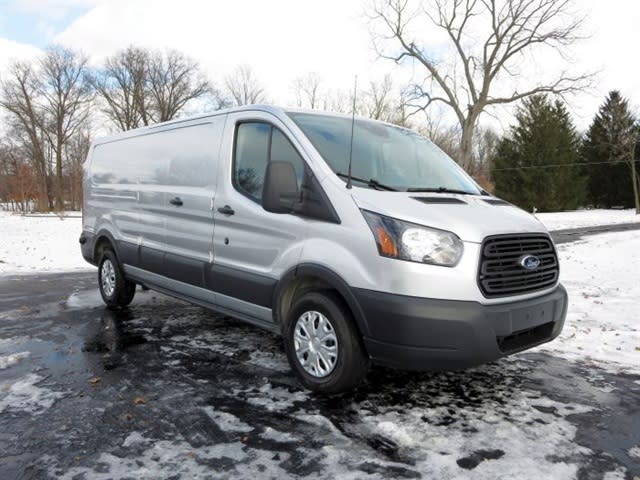
The black grille and lower body trim nicely complement the silver paint, and smooth lines suggest speed. The van had plenty of it, thanks to a double-turbo V-6. Photos: Tom Berg
Since the early 1960s, Ford’s Econoline vans were hot sellers, and got hotter as they morphed into the larger E-series that, along with competitors, did away with pickup chassis-based panel trucks. As it approached the end of its production run, the E-series van continued to take more than half of all sales of full-size cargo vans, year after year. Even so, it became increasingly dated — a heavy body-on-frame design powered by thirsty, big-displacement engines.
Ford had the answer in Europe: the large but lighter-weight Transit unibody van with smaller, more economical powertrains. Engineers and designers Americanized the vehicle, and the company retooled a plant in Kansas City to assemble it in seven versions, counting two wheelbases, two body lengths and three roof heights. Production began last summer. Meanwhile, Ford phased out the E-series van (though cutaway and cab-chassis versions remain in the lineup).
Some saw this as a gamble, but Daimler’s success with the Sprinter Euro-style van, first sold here in 2001, reassured the Ford planners who figured the Transit would go over well.
And it has. Transit has quickly become the largest-selling cargo van as it competes with the Sprinter, Fiat Chrysler’s Ram ProMaster and Nissan’s NV. Ford seems to have priced the Transit right and equipped it to do some serious hauling. And it rapidly gets goods to market or tools and supplies to a worksite, if the van’s got the 3.5-liter EcoBoost V-6.
Taking it for a ride
That was the engine in the van I had for a week last winter. I ran local errands around home in central Ohio and took it to south-central Michigan on a reporting assignment, easily cruising at 70 to 75 mph. Handling at all speeds was secure, with a firm but comfortable ride and precise power steering, and maneuverability was usefully nimble.
The engine had only 214 cubic inches, but double turbochargers more than made up for small displacement and provided a magic boot in the back whenever I got a little heavy footed. The engine’s rated at 310 hp and 400 lb-ft, and gadzooks, did it make this truck go! If I owned it, I’d call it “Silver Streak” for its color and… did I mention it was fast?
That was on dry pavement, though. The ice in my driveway almost stopped the truck cold before it got started. It’s front-engine, rear-drive, so there’s not much sitting on the back wheels except for the weight of the steel body and axle and, of course, whatever payload is put aboard. At that moment there wasn’t anything in it. So I used my grew-up-in-Wisconsin winter driving experience to rock the truck a little and its tires got some grip and I was off. The roads quickly dried up as I headed for “that state up north,” as Ohio State Buckeye fans call Michigan.
I went easy on the gas as darkness fell and I encountered fluffy white snow. A few times the rear wheels spun but caught as the “TC” light blinked on the dash. I decided to see how good that electronic traction control is.
On an empty side street I mashed the gas pedal and cut the wheel, trying to make the light-tailed van fishtail in the snow. It refused. The traction control cut power, the brakes seemed to apply momentarily and the vehicle stayed in a straight line. I never laid any rubber on concrete or asphalt while powering away from traffic lights, either. God bless TC, I’d say if I were a fleet boss.
In fact, if I were a fleet boss I might not buy the 3.5 EcoBoost V-6 because it’d be just too much fun for the drivers. I’d get the standard non-turbo 3.7 V-6. Both are EPA-rated at 14/19/16 mpg city/highway/combined. A 3.2-liter I-5 diesel is also available.
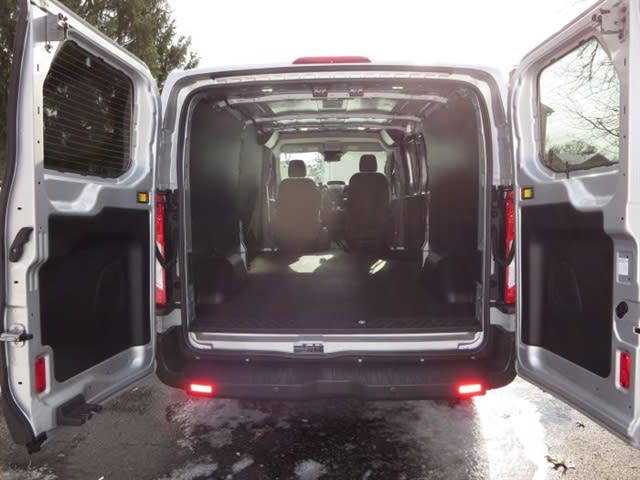
Rear doors swing open as far as 270 degrees for easy loading and unloading. Even the short roof allows near-standup room for many people.
In the back
I couldn’t find anything to haul to truly test the cargo area, and I didn’t have the ambition to empty out our living room to see how much furniture I could push aboard and stack up.
This was the long-wheelbase, short-roof version of the Transit; six other configurations are available, some with dual rear wheels.
Even though it had the short roof, I could walk around almost standing up (in my work boots I’m maybe 5 feet, 9 inches). Try that in an E-series van. Ford says the smallest Transit is bigger than the largest E-van, yet, thanks to high-strength steel, weighs about 600 pounds less. That’s one reason smaller engines can be used. Another is gearing. A 6-speed automatic with 5th and 6th overdrive is the standard and only transmission available.
The van’s rear barn doors and wide side doors allowed easy access to the cargo compartment, where there was lots of room. It had D-ring tie-down points on the floor, so if I had wanted to start dragging furniture out of the house, I could’ve dug out my collection of friction-tightened canvas straps from the shed and properly secured everything. Upfitters have many shelf, bin, rack, bulkhead and other storage equipment available.
In the cab
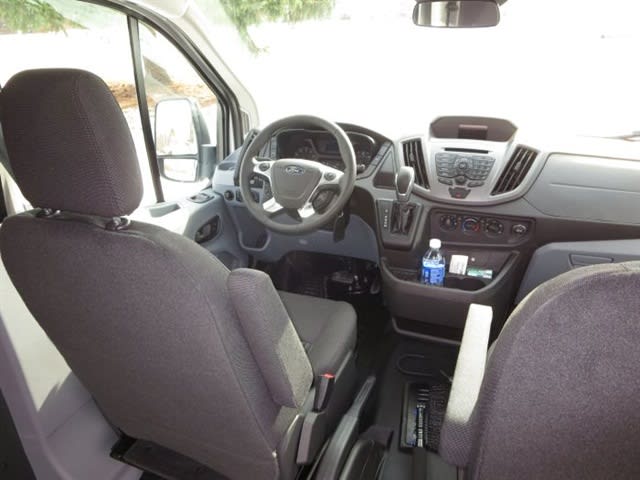
Let’s go up to the cab. Like an E-van, you climb up and into a Transit. That isn’t difficult because you can grab onto the steering wheel, but it would be steadier if they’d put a grab handle on the A-pillar, as the passenger side had. To get out, instead of trying to use the narrow lower step, drivers may just turn to the left and hop off the seat and onto the ground. Inside, you settle into a nicely contoured bucket-like seat and observe that everything’s laid out more like an F-150 pickup. There’s no big engine cover cramping your legs. Gauges are few and a little small but are in plain view, and all switches fall readily to hand. HVAC controls are three sensible rotary switches that are immediately understood and easily operated.
The infotainment system, on the other hand, had two dozen buttons, including a 1 to 0 keypad that might be able to calculate a trajectory and estimate an ETA to the Moon or Mars, or just a delivery destination. I figured out enough of the others to turn on and play the radio and even change stations, and it sounded nice. I think I could have connected my cell phone into the system via Bluetooth, but didn’t try. On the wide spokes of the steering wheel are two sets of buttons, each with four directional arrows and a central one labeled “OK.” They’re to scroll through a bunch of stuff on the small display screen directly ahead on the instrument panel.
More useful for my trip was another set of buttons below the right-hand spoke for the cruise control. For more than 400 miles I enjoyed the ride, and I ended up happy because I really liked this truck. Younger folks who appreciate “connectivity” will like the Transit even more.
Subscribe to Our Newsletter
More Equipment

How Volvo Updated Its D13 for EPA 2027 [Watch]
Volvo’s updated D13 promises lower emissions without sacrificing performance or fuel economy. Take a closer look at what changed inside the engine in this HDT Spotlight video.
Read More →
Michelin Tire Improves Efficiency and Durability for Regional Fleets
The Michelin X Multi Energy D2 is a regional haul drive tire engineered to help fleets improve fuel efficiency, durability and traction in demanding stop-and-go operations.
Read More →
ZF Expands Commercial Vehicle Push in North America
ZF is expanding its North American commercial-vehicle presence with new transmission applications, electrification, trailer technology and autonomous-driving systems.
Read More →
Tesla Wants a Self-Driving Semi. Are Cameras Enough?
Could Tesla’s camera-only autonomous driving technology work on an 80,000-pound Semi? In this commentary, HDT's Deborah Lockridge takes a look at Tesla, Cybercab, and how autonomous trucks see the road.
Read More →
Kodiak: Driverless Long-Haul Truck Launch on Track for 2026
Kodiak AI says its driverless long-haul safety case is 93% complete and it remains on track to begin commercial operations by year-end 2026.
Read More →
What DOT’s Automated Vehicle Strategy Means for Trucking
The U.S. Department of Transportation issued a new automated-vehicle strategy that outlines plans for driverless-truck regulations, cross-state freight corridors, and federal safety standards.
Read More →
East Coast Port Launches $45M Electric Truck Push
The Port Authority of New York and New Jersey announced millions in incentives for zero-emission drayage trucks, yard tractors, and new charging hubs near the port.
Read More →
PlusAI Going Public to Fund Autonomous Truck Launch
A SPAC deal could provide PlusAI with up to $300 million as it works toward a 2027 commercial launch of factory-built autonomous trucks.
Read More →
NHTSA Moves to Rewrite Truck Fuel-Economy Rules
The National Highway Traffic Safety Administration says it lacks authority to regulate medium- and heavy-duty truck engines separately from complete vehicles, but the existing standards have not yet been eliminated.
Read More →
Detroit Opens Orders for EPA 2027 Engines
Detroit isn’t starting from scratch to meet EPA 2027 diesel emissions standards. Its Gen 6 DD13 and DD15 engines keep much of today’s platform while updating the fuel and aftertreatment systems.
Read More →