




Spray and Splash and MPG
Water spray kicked up by heavy tractor-trailers blinds motorists, something that got a lot of attention in the early 1980s from government and industry

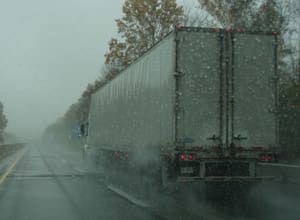
Fuel economy can be an added bonus for special anti-spray flaps. (Photo by Koneta Rubber)
Water spray kicked up by heavy tractor-trailers blinds motorists, something that got a lot of attention in the early 1980s from government and industry.
Congress looked at mandating special mudflaps and other devices to reduce spray, but they and safety authorities dropped the matter when studies found that spray wasn't quite the problem it once was. More travel was being done on Interstate highways, where extra lanes made passing easier, and aerodynamic tractors, which produced less spray, were catching on.
Now there's new interest in spray suppression devices, partly for safety but also for fuel economy. The American Trucking Associations' Technology and Maintenance Council has formed a Task Force to develop recommendations on what types of products to consider. Fuel savings from certain products can provide a quick payback, but better visibility for truck drivers can reduce accidents and save even more money, according to Sarah Stechman, sales manager for Koneta Rubber, who heads the task force.
One product, Eco-flaps from Anderson Flaps Inc., has gained a following from fleets whose managers say they save money in fuel as well as cut water spray. Another, SprayDown flaps from SprayDown Ltd. in the United Kingdom, is also looking to make its mark in the U.S.
SprayDown
SprayDown flaps answer regulations in the UK and the European Union that require spray suppressant devices. SprayDown is a molded plastic device with a series of slats that direct water downward until it drips onto the pavement. The company sponsored steady-speed track tests on a six-axle tractor-trailer typical of those running in the UK; the University of Strathclyde tests showed a reduction of "obscuration" of 27 percent at 40 mph and 43 percent at 56 mph with SprayDown flaps compared to a vehicle with standard flat flaps.
The slats also allow air to flow fairly freely past a tractor and trailer. Computational fluid dynamics determined that reduced air turbulence from SprayDowns was responsible for knocking down the spray. Company officials reasoned that smoother air flow would also reduce fuel consumption, and commissioned more track tests to confirm this. They were right.
Researchers measured fuel savings of 3.65 percent at 40 mph, and 3.8 percent at 52 mph (by law, truck speeds in Europe are lower than here). The testing organization, TRL Ltd., assigned a plus or minus 1 percent margin of error, meaning users could expect to save 2.65 to 4.80 percent in fuel at those speeds.
SprayDown's managing director, Steve Nesbitt, says customers include major fleets that enjoy an average of 4 percent better fuel economy compared to standard flat flaps. Some, however, use them for what he calls their "social responsibility" to improve safety.
SprayDown flaps were being marketed here by Koneta, but SprayDown is ending the agreement and will set up a distribution network of its own. And, Nesbitt adds, they'll be relocating the manufacture of the SprayDown product from its current locations in Poland and China to a manufacturing plant in Columbus, Ohio.
Eco-flaps
Eco-flaps are made in Chattanooga, Tenn. Their manufacturer says they saved 1.7 percent in fuel in a TMC/SAE Type II on-highway test. Fleets using Eco-flaps save even more fuel in everyday operations, and their drivers see reduced road spray. The product is screen-like, with fins that catch water and let gravity pull it back onto the road. Air passes through the flaps whether the pavement is wet or dry, so drag on the vehicle is reduced. Anderson guarantees at least 3 percent fuel economy betterment, and it's gaining sales from some major fleets that are seeing results.
Eco-flaps are molded of high-impact plastic and are tested to extreme temperatures, Anderson explains. They are guaranteed for one year.
We spoke with Harry Muhlschlegel, CEO of New Century Transportation and a former HDT Truck Fleet Innovator, about his experience with the Eco-flaps. His team ran tests using the same driver, route, truck, trailer, and load, and results varied between 1/10 and 5/10 per gallon improvement in fuel mileage.
"Now obviously a half mpg is not the norm," he cautioned; "it only happens under perfect test conditions." Even so, he said, the results were good enough to make them do a double-take.
"When we ran the tests on these flaps, we did them three times over the same course/route of about 100 miles. We did the runs with regular flaps, Eco-flaps and no flaps. We did not believe the initial results and then repeated the tests again a few weeks later. The first test showed 5/10 mpg better and the second was 2/10 - same truck, driver and mechanic riding in cab reading FSC [instrument data]."
So, Muhlschlegel says, he estimates the Eco-flaps give them 1/10 to 2/10s better fuel economy overall.
"You have to keep in mind under bad weather you will not receive any [fuel economy] benefit from the flaps," he said. "But hey, it's something, and it doesn't cost really any money at all. The flap is durable, won't break in cold weather and it does not cost any more than a quality mud flap, so why not use it?"
More spray options
Other spray suppressant products include some that have been offered since the early '80s. These include:
* Koneta's Anti-Spray Guard, available in rubber and a poly blend material, with thousands of finger-like projections that catch spray and channel the water down to the pavement.
* Rochling's Spray Guard flaps, whose artificial grass surface effectively catches water spray (Monsanto introduced them about 1980, and pushed for their mandating through Missouri's senator at the time, John Danforth), and Safe Pass flaps, a lower-cost alternative.
* Schlegel's 20-20, a wreath-like device (sometimes called a "hula hoop") that outlines wheel wells or the area immediately above wheels. United Parcel Service has long installed products like this on its trailers. The 20-20s are molded of polypropylene monofilaments that catch spray and wiggle to shed ice.
Although not required by federal rules, anti-spray equipment is mandated for long combination vehicles in Oregon. Special mud flaps, fenders and "side skirts" (including the hula devices) qualify heavy trucks to operate in inclement weather. Affected are any vehicles grossing more than 80,000 pounds and triple-trailer rigs of any weight, according to the state's rules. Technically the devices are needed only when it rains - but that happens a lot in Oregon.
From the May 2010 issue of Heavy Duty Trucking.
More Equipment

How Volvo Updated Its D13 for EPA 2027 [Watch]
Volvo’s updated D13 promises lower emissions without sacrificing performance or fuel economy. Take a closer look at what changed inside the engine in this HDT Spotlight video.
Read More →
Michelin Tire Improves Efficiency and Durability for Regional Fleets
The Michelin X Multi Energy D2 is a regional haul drive tire engineered to help fleets improve fuel efficiency, durability and traction in demanding stop-and-go operations.
Read More →
ZF Expands Commercial Vehicle Push in North America
ZF is expanding its North American commercial-vehicle presence with new transmission applications, electrification, trailer technology and autonomous-driving systems.
Read More →
Tesla Wants a Self-Driving Semi. Are Cameras Enough?
Could Tesla’s camera-only autonomous driving technology work on an 80,000-pound Semi? In this commentary, HDT's Deborah Lockridge takes a look at Tesla, Cybercab, and how autonomous trucks see the road.
Read More →
Kodiak: Driverless Long-Haul Truck Launch on Track for 2026
Kodiak AI says its driverless long-haul safety case is 93% complete and it remains on track to begin commercial operations by year-end 2026.
Read More →
What DOT’s Automated Vehicle Strategy Means for Trucking
The U.S. Department of Transportation issued a new automated-vehicle strategy that outlines plans for driverless-truck regulations, cross-state freight corridors, and federal safety standards.
Read More →
East Coast Port Launches $45M Electric Truck Push
The Port Authority of New York and New Jersey announced millions in incentives for zero-emission drayage trucks, yard tractors, and new charging hubs near the port.
Read More →
PlusAI Going Public to Fund Autonomous Truck Launch
A SPAC deal could provide PlusAI with up to $300 million as it works toward a 2027 commercial launch of factory-built autonomous trucks.
Read More →
NHTSA Moves to Rewrite Truck Fuel-Economy Rules
The National Highway Traffic Safety Administration says it lacks authority to regulate medium- and heavy-duty truck engines separately from complete vehicles, but the existing standards have not yet been eliminated.
Read More →
Detroit Opens Orders for EPA 2027 Engines
Detroit isn’t starting from scratch to meet EPA 2027 diesel emissions standards. Its Gen 6 DD13 and DD15 engines keep much of today’s platform while updating the fuel and aftertreatment systems.
Read More →