




Spec’ing Charging, Starting and Battery Systems
If you haven’t spec’d a truck in the past few years, you might be surprised by how much the truck’s electrical needs have changed.

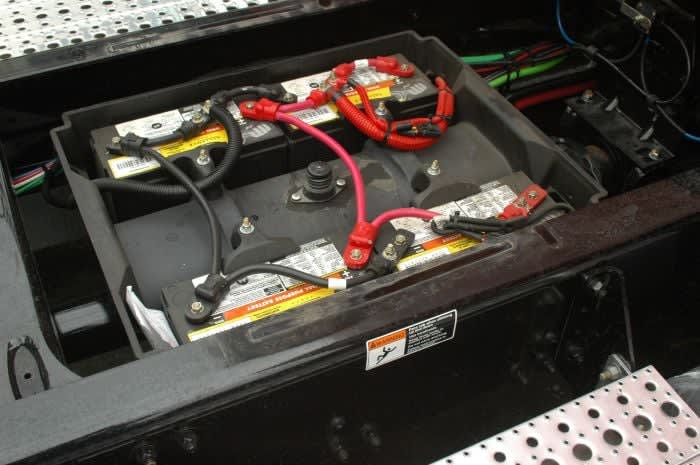
No matter what type of batteries you use, they need to be securely mounted to the truck to prevent damage from vibration.
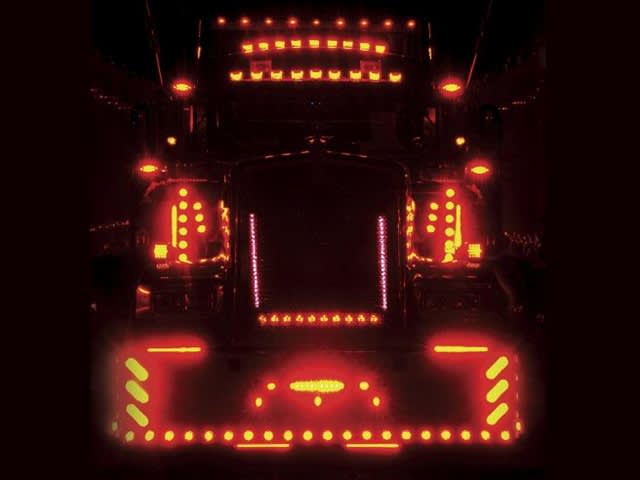
Heavy demands on an electrical system demand higher-output alternators. If the batteries can’t charge, you can’t haul. Photo: Jim Park
If you haven’t spec’d a truck in the past few years, you might be surprised by how much the truck’s electrical needs have changed. There are more sources of current draw onboard now, and you might need a beefier starting and charging system than you realize.
Telematics systems are one of the newest loads. They have been around a while, but they are becoming more commonplace. They typically draw current 24 hours a day, seven days a week, even when the key is off. Coupled with other electrical loads, like the various electronic control modules that constantly draw current, we’re hard-pressed now to keep enough reserve in the standard bunch of four group-31 starting batteries. If you run hotel loads, don’t idle, and have no readily available source of shore power, you definitely need to look at upgrading the electrical system.
According to Daniel Cox, technical sales manager at Midtronics, a maker of battery and electrical system diagnostic and testing tools, the focus with contemporary electrical systems is shifting toward the parasitic requirements rather than cranking requirements.
“You should probably think about doing an energy audit on the truck before you settle on a traditional electrical system spec,” he suggests. “If you’re running sleeper cabs, liftgates or reefer units, an energy audit will help paint the picture of what’s really needed.”
First, you have to take stock of what already exists in the power consumption area. How much energy are you using? How can you accommodate the requirements for the power? What battery do you need?
The last is the big question, Cox says. “Almost any quality battery you buy has been tested to ensure it meets its rating when new. But how will they perform under different loads, at different temperatures and at various duty cycles? With several different types of battery available, knowing what the demands are will help when it comes to choosing the right battery.”
The right battery
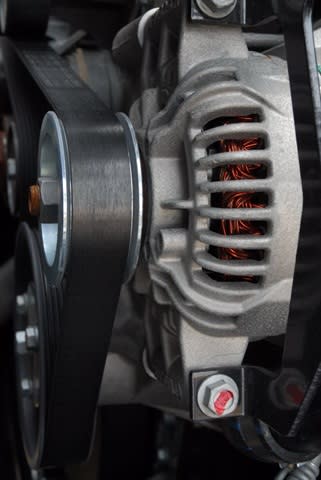
Alternators are coming in ever smaller packages and output is increasing.
Batteries are now purpose-built for specific applications, be it starting, lighting and ignition (SLI) or for long-term hotel loads and smaller but continuous parasitic draws. The SLI batteries are typically good at producing bursts of high-output over short timeframes, but they don’t respond well to deep-cycle discharging from hotel loads. Most deep-cycle batteries aren’t good at starting trucks because the lead plates inside the battery aren’t designed for high-current loads.
Bruce Essig, national sales manager for Odyssey Battery by EnerSys, says his company’s absorbed glass mat battery is a dual-purpose battery. The lead plates are very thin (rather than thick as with the plates found in a traditional flooded lead-acid battery), but they are covered with a thick lead oxide coating, and surrounded by an electrolyte-soaked sponge-like fiberglass pad. The multitude of thin lead plates provide the CCA (cold cranking amps), while the lead oxide coating provides the deep-cycle capability.
“The U.S. DOT classifies our Odyssey as a dry-cell battery because we saturate the pad to just 92% capacity,” Essig notes. “By definition, it’s called a starved electrolyte system. If you cut into one of our batteries, it would appear dry.”
AGM batteries have found a place in Class 8 trucks, particularly over-the-road trucks, because they can support hotel loads while supplying the cold cranking amps to get the truck started after a long period of slow discharge.
Selecting the right battery for the job requires more thought than just grabbing the battery with the highest CCA rating.
“You need to understand the application and your usage patterns so you can select the right battery capacity for your needs,” says Vicki Hall, director of quality assurance and technical services at Trojan Battery Co.
Hall says actual capacity delivered will depend on the age and temperature of the battery as well as the state of charge and the discharge rate. A 200 amp-hour battery, for example, will deliver 10 amps for 20 hours, 20 amps for 10 hours or 50 amps for four hours. But a typical new deep-cycle battery will not deliver its rated capacity until it has 75 to 150 discharge cycles under its belt. And as they age, their capacity will diminish.
“Comparatively speaking, a battery with a higher rated capacity will have a longer life than one with a lower rated capacity, everything else being equal,” Hall says. “The total number of cycles you will get depends on how you have used and maintained your batteries.”
The third, and newest, type of battery is called an ultra-capacitor. In fact, it’s technically not a battery at all. Ultra-capacitor systems store energy, rather than creating it through an electrochemical reaction like a battery does. They store relatively small amounts of energy but can release it very quickly, which is what you need to start the truck. They can also be fully recharged in a very short time.
“When comparing batteries to ultra-caps, with batteries it’s like pouring water out of a bottle,” explains Jeff Brakley, OEM/Distribution sales manager at Maxwell Technologies, a leading provider of ultra-capacitors. “With ultra-caps it’s like dumping water into a bucket. You’re dumping a lot of power really quickly, and then it also recharges very quickly.”
Brakley says ultra-capacitors, or Engine Starting Modules, as Maxwell calls them for this application, are absolutely no good at deep-cycle applications like hotel loads. “It’s for starting, and starting only,” he says. “So if you want the best of both worlds, use one ESM and three AGMs in your battery box.”
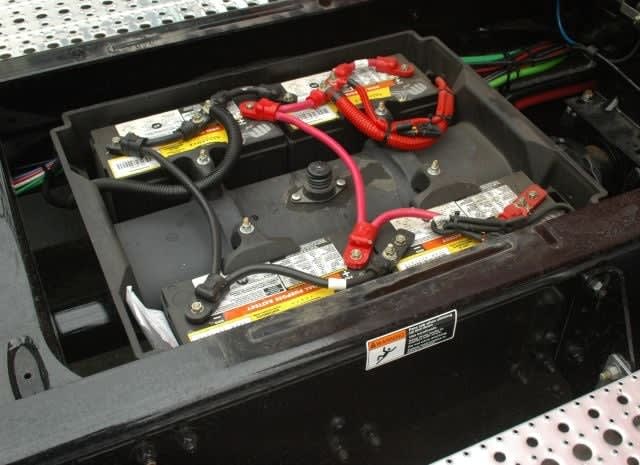
No matter what type of batteries you use, they need to be securely mounted to the truck to prevent damage from vibration.
Amping up for heavy loads
Last but certainly not least in the start/charge system spec is the source of all the power you’re going to need, the alternator.
Alternators have made vast leaps and bounds in efficiency in recent years, and they are far more reliable and efficient. New stator winding technology, using square wire rather than round, has allowed designers to cram a lot more wire into a much smaller space, producing way more energy.
“We have 12-volt alternators now putting out 455 amps,” says Bruce Purkey, president and chief creative engineer at Purkeys Fleet Electric. “In the early ’90s, a typical alternator on a new truck would be 135 amps. That went to 160 and now several OEs are spec’ing 230-amp output. The package size is essentially the same, but they are very different inside.”
So how do we optimize the alternator for the electrical loads we see today? Bob Jefferies, manager of fleet operations and services at Delco Remy, says alternator efficiency is a combination of load, temperature, friction and output. In general, the larger the alternator, the more efficient it is. Most alternators are only about 58% to 60% efficient because of losses due to belt friction, internal drag and load. He points to a relatively new strategy of over-sizing alternators to get them into a more efficient range.
“If you can keep it operating at 35 to 50% of its rated current, that puts it down into the efficiency sweet spot, which saves fuel,” he notes. “That original 85-amp total connected load is less of a draw on a larger alternator, which makes it more efficient. And when we do need higher output it’s available, so you cycle the batteries less.”
And, he notes, alternators running lighter loads tend last longer too. As a percentage of rated output, lighter loads are easier on the bearings, and the alternator will produce less heat, and so on.
But if you plan to upgrade the alternator, Purkey warns, the truck’s wiring must be up to the higher alternator output.
“Most fleet don’t realize this,” he says. “Let’s say the truck came with a 130-amp alternator. The OE wired the system for 130 amps. If you put a 200-amp alternator on there without upgrading the wiring, it’s like putting a 4-inch pump on a garden hose. You won’t get any more current through it. It probably won’t catch fire, but the wire will become brittle and risk a short or a break.”
Of course, if you want to follow some of these upgrade suggestions, you’ll be paying more up front. Premium components usually outperform the stock parts, and that can certainly be the case with starting, charging and battery systems. If you don’t think it’s all worth it, just remember how you felt the last time you heard that fatal click, click, click sound when you turned the key.
More Equipment

How Volvo Updated Its D13 for EPA 2027 [Watch]
Volvo’s updated D13 promises lower emissions without sacrificing performance or fuel economy. Take a closer look at what changed inside the engine in this HDT Spotlight video.
Read More →
Michelin Tire Improves Efficiency and Durability for Regional Fleets
The Michelin X Multi Energy D2 is a regional haul drive tire engineered to help fleets improve fuel efficiency, durability and traction in demanding stop-and-go operations.
Read More →
ZF Expands Commercial Vehicle Push in North America
ZF is expanding its North American commercial-vehicle presence with new transmission applications, electrification, trailer technology and autonomous-driving systems.
Read More →
Tesla Wants a Self-Driving Semi. Are Cameras Enough?
Could Tesla’s camera-only autonomous driving technology work on an 80,000-pound Semi? In this commentary, HDT's Deborah Lockridge takes a look at Tesla, Cybercab, and how autonomous trucks see the road.
Read More →
Kodiak: Driverless Long-Haul Truck Launch on Track for 2026
Kodiak AI says its driverless long-haul safety case is 93% complete and it remains on track to begin commercial operations by year-end 2026.
Read More →
What DOT’s Automated Vehicle Strategy Means for Trucking
The U.S. Department of Transportation issued a new automated-vehicle strategy that outlines plans for driverless-truck regulations, cross-state freight corridors, and federal safety standards.
Read More →
East Coast Port Launches $45M Electric Truck Push
The Port Authority of New York and New Jersey announced millions in incentives for zero-emission drayage trucks, yard tractors, and new charging hubs near the port.
Read More →
PlusAI Going Public to Fund Autonomous Truck Launch
A SPAC deal could provide PlusAI with up to $300 million as it works toward a 2027 commercial launch of factory-built autonomous trucks.
Read More →
NHTSA Moves to Rewrite Truck Fuel-Economy Rules
The National Highway Traffic Safety Administration says it lacks authority to regulate medium- and heavy-duty truck engines separately from complete vehicles, but the existing standards have not yet been eliminated.
Read More →
Detroit Opens Orders for EPA 2027 Engines
Detroit isn’t starting from scratch to meet EPA 2027 diesel emissions standards. Its Gen 6 DD13 and DD15 engines keep much of today’s platform while updating the fuel and aftertreatment systems.
Read More →