




Simulated Training
Taking a cue from the airlines and the military, trucking is looking at high-tech driver simulators to improve safety training.
A commercial truck driver may go his entire career without ever experiencing a steer tire blowout – but when it happens, it can be dangerous. A driver trained on a sophisticated driver simulator, however, can be prepared.
"With simulation, we can train on conditions, environment and situations that we can't safely replicate using traditional training methods," says Don Osterberg, vice president of driver training and safety for Schneider National. "In simulation, I can run through multiple (repetitions) of blown steer tires to begin to condition a response. I had a conversation with one of our drivers who, indeed had blown a steer tire, and he said fortunately he had learned to react and respond to that in simulation, and in his view saved him from a serious accident."
About a year ago, Schneider announced it would incorporate motion-based driver training simulators fleet-wide. In a pilot program of a new integrated training model that included the high-tech simulation, Schneider said it saw fewer accidents within the first five months.
COMPELLING RESULTS
The company's research into simulators was prompted by Osterberg, who as a retired Army officer had experienced how effective high-fidelity simulation could be. This kind of simulation is also used in the airline industry to train pilots.
"We went through a fairly exhaustive pilot, proving the effectiveness of simulation-based training," Osterberg says. The results were compelling, in Osterberg's words, including improved graduation rates, higher retention rates, and the ability to train drivers more quickly – and better – than the traditional training program.
"We have a skill qualification test, the last one we give them before we issue them a truck, and we had higher pass rates for drivers trained with simulation. Perhaps most exciting for me, we saw substantially better safety performance."
The company saw a 21-percent reduction in preventable accidents in drivers' first 90 days.
"We have found that one hour of training in the simulator is equivalent to three or four hours of training over the road," Osterberg says. Simulators allow new drivers to practice over and over again basic skills such as shifting. "We can put a driver on a simulator and run him through a 1-to-10 shift sequence 20 times in 30 minutes. That's nearly impossible to do over the road. (Before the simulators), typically we would spend the entire first day, and sometimes into the third day, training within the fence of our training academy, just driving around the parking lot. We've found we can put inexperienced drivers in the simulator for an hour and literally take one lap around our training course, and they're ready to go out on the road."
Following the success of the pilot, Schneider decided to put simulators into all six of its truck driver training academies, as well as at six high-throughput operating centers.
While the pilot focused on beginning truck driver training, Osterberg says the simulators have just as much potential, if not more, in continuing safety training and remedial/post-accident training of experienced drivers.
Schneider has started developing the training curriculum and modules to include simulators in what it calls sustainment training, which currently is required of all drivers twice a year.
"I believe in the future, simulators will allow us to do it more frequently – maybe quarterly or even monthly – because we can deliver it at a lower cost by putting simulators in all our operating centers," Osterberg says.
In the long run, he says, remedial training may be one of the most effective uses for simulation-based training.
"If a driver is involved in an accident, we can create virtually the identical scenario the driver encountered leading up to the accident, and find the training is enhanced when drivers can self-critique their performance. They can identify maybe where they made a bad decision, or that their lane change techniques or mirror scan weren't what they should be."
OTHER FLEETS
Manitoba, Canada-based Bison Transport, the grand prize winner of the Truckload Carriers Association's 2005 National Fleet Safety Award, implemented the use of high-tech simulators back in 2002. Since then, the annual accumulated safe driving miles for its fleet of 800 trucks have increased by nearly 50 percent.
"We have seen an 83 percent improvement in mean time between incidents after simulator training for preventable accidents," says Don Streuber, president and CEO of Bison Transport.
Bison uses the simulators in a course called Tatonka, covering such topics as space management, speed management, the seven-second rule and winter driving. It also encourages drivers interested in joining the company to come try out the full-motion simulator for a 15-minute "test drive."
Dart Transit is using a simulator on a much smaller scale, having recently purchased a mobile classroom featuring a full-motion simulator from the Texas Motor Transportation Association (TMTA).
"With that, we can simulate just about any driving condition," explains Elaine Briles, director of safety, compliance and fleet services. These include steer tire blowouts, winter driving, black ice, someone stopping suddenly in front of you, climbing mountains, congestion, city driving, rural driving, backing, jackknives, rollovers, and more. Dart leases the classroom and simulator (and the tractor-trailer driver trained to run the simulator) out to other trucking companies. It's also been popular at recruiting events, and the company even staged a driving championship using the simulator.
"I've had a lot of drivers who thought they didn't need it, who thought it was a game," Briles says. "Once they went through it, they were serious about it."
Because of previous commitments made by TMTA for other carriers to use the mobile classroom and simulator, Dart is now working on putting it into its regular training program for its owner-operators. Top on the list is getting new contractors to go through sessions on the simulator on areas Dart believes are very important, including backing, driving in ice and fog, and steer tire blowout.
"We like the fact that it's mobile," Briles says. "We can take it to any of facilities where we have drivers domiciled and have it available there."
THE BOTTOM LINE
So why hasn't the trucking industry embraced driving simulators? Cost. But that's changing.
"The earlier versions of heavy truck simulators were very expensive," Osterberg says. "The cost has come down. As they become more affordable, and people can point to people like us who have found it very effective, it'll be easier to do the cost-benefit analysis. It's often very difficult to quantify the value of the accident you didn't have. While our primary focus on moving to simulation-based training was to support public safety, we are in business. I've often said if you invested in every technology out there, you could be the safest company ever to file Chapter 11. This is one that I think more carriers will realize in time is a prudent investment to make."
Ray C. Greer, simulator group vice president for MPRI (a division of L-3 Communications), which appears to be a leader in providing high-fidelity simulators for commercial trucking fleets, says his company has done extensive research that shows fleets can see a return on their investment in less than four months.
"A simulator does save you money," he says. "It reduces accidents, it saves fuel and it improves reliability and wear and tear on your equipment. It also makes the trainers better trainers because they have a better tool.
"All the advantages that the airline industry and the military have used and known about for 50 years, we can bring it to trucking because the cost of technology has come down," Greer says.
The full-motion MPRI Mark III that Schneider is using is in the $300,000 range. Of greater interest to fleets, Greer says, is the company's new TranSim VS IV, which costs around $100,000. Both simulators provide the same software scenarios and project the simulations on three screens surrounding the driver. The Mark III uses a real Freightliner cab with "six degrees of freedom" motion base. The TranSim uses "force-loaded steering" to provide real-time feedback. It features a glass dashboard with touch screens, with the instrumentation, buttons, knobs and dials for specific truck models rendered – and easily updated – via computer software. This technology is the same type they use in Boeing 777 flight training simulators, Greer says.
While the TranSim may not have quite the gee-whiz appeal of the Mark III (Osterberg compared it to "an IMAX experience for trucking"), Greer says the motion added by the higher-end simulator "adds little, really, to the decision-making process of learning how to avoid accidents. When we train, we have them look at the situation, we have them scan it, and teach them correct decision-making processes. So we teach them how to avoid the situations that put you in an accident-prone situation and how to make the correct decision to get out of those situations, then we teach maneuvers after. Maneuvers are not as important as making the correct decision in the first place."
Bison Transport says it has had excellent results using a combination of the Mark III and TranSim VS simulators.
Osterberg predicts that in the future, simulator training will become part of truck driver training everywhere.
"The bottom line is, when you think about the airline industry, most people would be uncomfortable having a new pilot do on-the-job training actually flying an airplane," Osterberg says. "But in our industry that's what we've done for years."
More Fleet Management

What the U.S.-Canada Trade War Means for Trucking
Escalating U.S.-Canada tariffs could disrupt cross-border freight, reduce truck volumes, raise costs, and create new uncertainty for carriers on both sides of the border.
Read More →
What Are Trucking’s Top Concerns for 2026?
The American Transportation Research Institute wants to know what's worrying trucking fleet managers, drivers, and other stakeholders in its annual Industry Issues survey.
Read More →
American Trucking Associations Looks for a New Leader
ATA President and CEO Chris Spear abruptly left his job at the association on August 21, at a pivotal time for the trucking industry.
Read More →
Public Wi-Fi Cybersecurity Risks: How Truck Drivers and Fleets Can Protect Their Data
Public Wi-Fi can expose truck drivers and fleets to credential theft, malware, and other cyber threats. Here’s how to reduce the risk on the road.
Read More →
For Nicky Cupp, Fleet Innovation Starts With Frustration
HDT Truck Fleet Innovator Nicky Cupp turns everyday pain points at Fraley & Schilling into opportunities for better technology and smarter processes.
Read More →
Adam Buttgenbach’s Approach to Electric Trucks: Start With Where They Fit
HDT Truck Fleet Innovator Adam Buttgenbach helped PepsiCo build one of North America’s largest EV fleets by focusing on where electric trucks make operational sense.
Read More →
Deen Albert: Let Automation Do the Math, People Make the Decisions
HDT Truck Fleet Innovator Deen Albert makes sure people are still at the heart of operations at Grand Island Express, even while adopting artificial intelligence tools. AI-assisted dispatch helped boost revenue 25% with the same number of trucks.
Read More →
Trimble’s New AI Agent Takes Aim at Fleet Back-Office Busywork
Arc Agent works across Trimble TMS products to automate repetitive tasks such as freight orders, maintenance, invoices, fuel costs and more.
Read More →
How HDT’s 2026 Truck Fleet Innovators Are Rethinking Fleet Operations
Meet five trucking leaders who are challenging assumptions, solving operational problems, and putting innovative ideas to work.
Read More →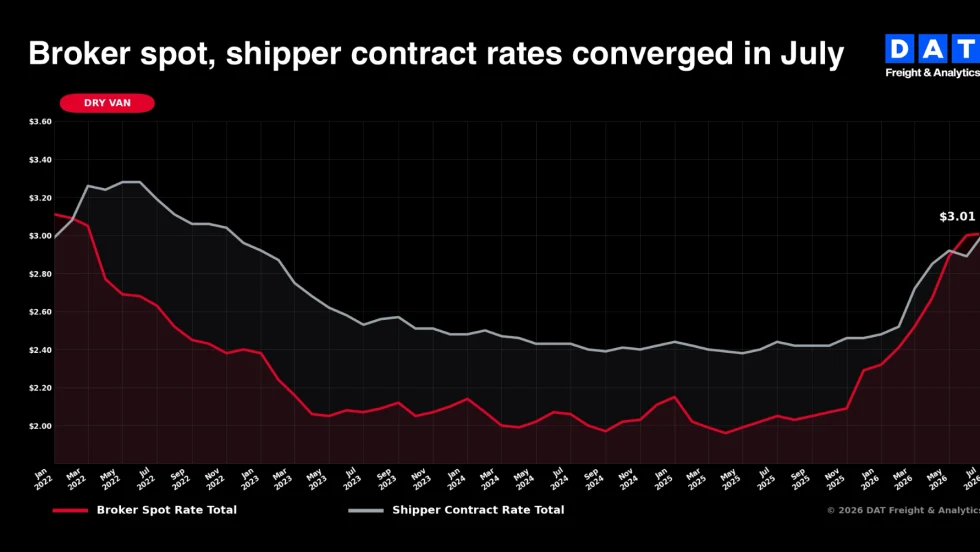
Tight Trucking Capacity Pushes Rates Higher Even as Freight Volumes Fall
“Spot rates moving ahead of contract rates have historically signaled a tightening market, but we haven’t seen a capacity-driven market quite like this one,” said DAT's Dean Croke.
Read More →