




Saving Amps & Money
Proper maintenance procedures for charging and storage will help extend the service life of heavy-duty batteries.



When the hood is up and you’re neck deep in the engine compartment, you want to find as few issues to resolve as possible. To minimize this amount, it is best to follow the proactive way of maintaining your truck, which can even begin with the battery.
“Today’s economy is forcing companies to watch their expenses very closely and cut costs where necessary,” says Brad Bisaillon, director of strategic accounts, North America and Europe, for Trojan Battery.
To keep your batteries in tip-top shape and running smooth, you need to take steps to guarantee they are running at their peak performance level.
Taking the proper steps
The first step, according to Bisaillon, is ensuring that your truck is outfitted with the right alternator to effectively charge the battery. If not, it could lead to frequent battery replacements. By upgrading a truck’s alternator and using a high-performance 500-cycle vs. 250-cycle battery, a fleet could extend the amount of time between battery replacements.
“Energy in needs to exceed energy out,” he says. “Batteries need adequate overcharge and must be provided the opportunity to charge sufficiently.”
Fleet operators must also ensure that their trucks are outfitted with a battery that has the proper capacity to handle the combined electrical loads. This is a simple fix to effectively power these demands. By reducing or managing the use of inverters to lower the depth of discharge, you can prolong the life of the battery, according to Bisaillon.
“Products are available on the market that will disable an inverter at a preset voltage level, whereas others will become disabled based on a pre-programmed timer that doesn’t reset until completing full charge cycle,” he says. While they may require a slightly larger up-front investment, they will pay for themselves in the long run.
Simple maintenance
After selecting and installing the right battery and pairing it with the correct alternator and inverter, the next step is keeping an eye on it.
“Proper battery maintenance is very important,” says Megan Vincent, marketing supervisor at Phillips Industries. “A corroded terminal can cause many problems. Just a few minutes of preventive maintenance can save all the headaches.”
One of most important — and simple — tasks is regularly inspecting your batteries by checking the terminals and posts for corrosion and residue buildup.
“Buildup of corrosion can result in lower voltage from the battery over time,” says Vincent.
If and when you find any buildup, removing it will keep your battery performing better. It’s important to use the proper tools and procedures when doing so. Vincent suggests starting by removing terminals — negative terminal first — and using a proper brush to clean residue and corrosion.
“You may also want to use a battery cleaner to neutralize acid, and for added protection, use a felt protective washer with corrosion inhibitors before reattaching the terminals, positive first,” she says.
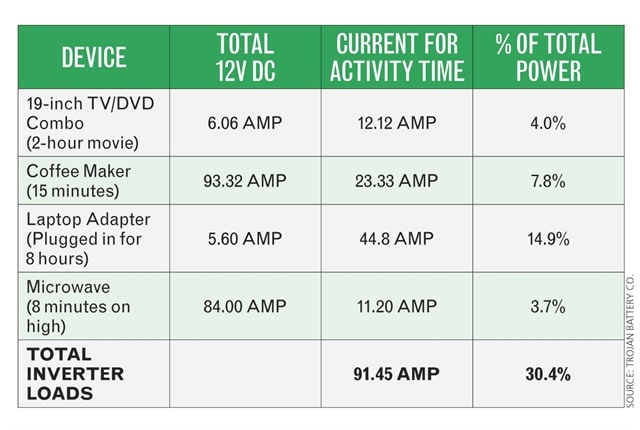
The chart gives examples of common appliances and technology used by drivers and how much current they draw from the batteries, assuming a 400-amp-hour battery bank.
Keeping it charged
According to Maria Orlando-Krick, marketing manager at EnerSys, proper charging of the battery is the single most important action in ensuring that the battery will last for its intended life. Sulfation, the formation of small sulfate crystals that can convert to a stable crystalline that deposits on the negative plates during prolonged charge deprivation, can cause batteries to eventually fail.
“Proper charging will break up the internal sulfation that builds up in the battery and extend its service life,” says Orlando-Krick, who suggest using a battery charger when necessary.
When storing a battery, she also recommends fully charging the battery first.
“Most conventional batteries that are only partially charged when put into storage could experience permanent damage and may not recover to their full capacity, even if they are charged prior to reinstallation,” she adds.
More Equipment

How Volvo Updated Its D13 for EPA 2027 [Watch]
Volvo’s updated D13 promises lower emissions without sacrificing performance or fuel economy. Take a closer look at what changed inside the engine in this HDT Spotlight video.
Read More →
Michelin Tire Improves Efficiency and Durability for Regional Fleets
The Michelin X Multi Energy D2 is a regional haul drive tire engineered to help fleets improve fuel efficiency, durability and traction in demanding stop-and-go operations.
Read More →
ZF Expands Commercial Vehicle Push in North America
ZF is expanding its North American commercial-vehicle presence with new transmission applications, electrification, trailer technology and autonomous-driving systems.
Read More →
Tesla Wants a Self-Driving Semi. Are Cameras Enough?
Could Tesla’s camera-only autonomous driving technology work on an 80,000-pound Semi? In this commentary, HDT's Deborah Lockridge takes a look at Tesla, Cybercab, and how autonomous trucks see the road.
Read More →
Kodiak: Driverless Long-Haul Truck Launch on Track for 2026
Kodiak AI says its driverless long-haul safety case is 93% complete and it remains on track to begin commercial operations by year-end 2026.
Read More →
What DOT’s Automated Vehicle Strategy Means for Trucking
The U.S. Department of Transportation issued a new automated-vehicle strategy that outlines plans for driverless-truck regulations, cross-state freight corridors, and federal safety standards.
Read More →
East Coast Port Launches $45M Electric Truck Push
The Port Authority of New York and New Jersey announced millions in incentives for zero-emission drayage trucks, yard tractors, and new charging hubs near the port.
Read More →
PlusAI Going Public to Fund Autonomous Truck Launch
A SPAC deal could provide PlusAI with up to $300 million as it works toward a 2027 commercial launch of factory-built autonomous trucks.
Read More →
NHTSA Moves to Rewrite Truck Fuel-Economy Rules
The National Highway Traffic Safety Administration says it lacks authority to regulate medium- and heavy-duty truck engines separately from complete vehicles, but the existing standards have not yet been eliminated.
Read More →
Detroit Opens Orders for EPA 2027 Engines
Detroit isn’t starting from scratch to meet EPA 2027 diesel emissions standards. Its Gen 6 DD13 and DD15 engines keep much of today’s platform while updating the fuel and aftertreatment systems.
Read More →