




Safety Specs: A Crash Course
Spec'ing truck components for the safest possible operation is the right thing to do, but it comes at a cost. But it may be a cost you cannot afford to avoid
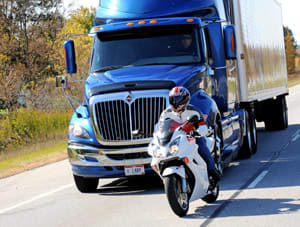
Spec'ing truck components for the safest possible operation is the right thing to do, but it comes at a cost. But it may be a cost you cannot afford to avoid.
A small fleet may be lucky in an accident situation or luckier yet, avoid accidents - or as Victor Malchesky, loss prevention manager at Phoenix-based Swift Transportation prefers, "crashes," for as he says, that's what they are: they have a cause. For any significant fleet, the exposure to a crash is high. If that crash moves into litigation - highly likely where the deepest pockets are the motor carrier's - then trial lawyers will be looking for any place a fleet may have been delinquent in addressing safety.
This is especially fraught if a decision is made to optionally delete a safety item such as stability control or standard disc brakes on a vehicle subsequently involved in a serious accident. It probably wouldn't even matter if the system in question could have prevented the crash; the fact that the fleet had opted to put cost before safety could well argue against it in court.
Spec'ing for safety encompasses trucks, truck systems, driver aids and so on. We can also look at it from the perspective of primary safety, where the accident is made more avoidable; and secondary safety, where the consequences are mitigated. Some technologies span both fields, such as adaptive cruise control with active braking. In many cases the system can avoid a crash altogether. In the worst case, the active braking will slow the truck so the collision with a second vehicle is at a much slower speed and thus more survivable and with less damage.
There also are areas where a crash does not happen, but a driver's safety is impacted. Call these OSHA-related accidents like slips and falls, where some spec'ing decisions can mean fewer claims and thus less risk exposure.
Braking and stability control
Bendix and ArvinMeritor, both major suppliers of the air and braking systems, are heavily involved in integrating their safety systems into what ArvinMeritor calls the Pyramid of Safety and Bendix charts as a building-block progression. Both offer stability control and collision avoidance, available only with a new truck and not through the aftermarket.
Each consists of similar elements, with the systems built on antilock braking and its electronic controls.
The addition of an accelerometer makes the ABS into a simple roll monitor and controller. Rollover can be prevented by activating braking, first the engine retarder then service brakes if a truck gets near to a rollover event. The addition of a yaw sensor and steering input sensor adds additional functionality and makes the anti-roll safety system into a stability system that keeps the truck going in the direction determined by the driver's input into the steering.
Completing the suite of safety building blocks is the addition of adaptive cruise technology to turn the stability and safety system into a collision-avoidance system. Adaptive cruise control maintains a consistent following distance regardless of the speed of the vehicle ahead. If that drops to zero, the system senses an impending accident. It may be able to distinguish a stopped vehicle in the roadway by this following distance calculation. In this case the service brakes are applied up to a percentage of full application. The idea is to catch the driver's attention and have the service brakes already applied when he gets harder on the brakes. Even if the truck is going too fast to avoid the crash, it slows significantly before impact, mitigating the consequences.
Both Meritor and Bendix are working on the next component: visual recognition of the situation ahead. Today's radar based-collision avoidance systems are not able to recognize the stationary object in all cases. Visual recognition through video will provide an additional safeguard and full brake application when needed.
The response that is generated automatically by these systems will obviously be dependent on the total amount of braking available - the more brake, the shorter the stopping distance. This is set to get a major boost with the reduced heavy truck stopping distances mandated in the latest FMVSS121 standard set to hit in 2012. These standards set a 30 percent reduction in stopping distance down from 355 feet to 250 feet for three-axle tractors first, then a year later for two-axle units. The result will be bigger brakes for the front axles, and they will definitely help the collision avoidance in a following-vehicle crash.
Whether those brakes will be bigger drums or disc brakes is unclear. Disc brakes for the steer axle are being offered in most data books now, and Peterbilt has announced that its new 587 will be offered with front discs as standard. Air discs have the advantage of not only pulling up harder with no fade, but also there's no self-energizing that can lead to pulling to one side in a panic stop.
Driver control aids
There's been discussion over what sort of safety systems should get subsidies through tax incentives. Don Osterberg, Schneider's vice president of safety and security and a recognized industry safety expert, thinks a major safety technology gets overlooked in these discussions: the automated mechanical transmission. His company is committed to them, because drivers can be more concerned with getting the truck safely down the road than trying to shift gears.
Another driving aid that has gotten rave reviews from industry leaders, such as Steve Williams of Maverick Transportation, is lane departure warning. Williams has the numbers that support the contention that warning a driver when a truck is heading off the roadway is a definite safety move. Maverick uses the Iteris product, as do most other fleets that have embraced the technology. Prime, for example, has seen a 62 percent reduction in lane-departure-related accidents.
This is a camera-based system that reads the road markings - particularly the white lane marking lines - and issues an audible warning similar to a rumble strip. According to Iteris North American Sales Director Bill Patrolia, this warning also can be tied in to the on-board communication system, so if a driver repeatedly strays off the road, dispatch can be alerted.
The Iteris LDW is not alone in the ability to report on the driver's activities in real time. The Meritor and Bendix collision avoidance and stability control systems also post events to the Qualcomm or PeopleNet communications systems, and safety departments get real-time warnings of drivers' close calls. Swift's Malchesky says this has been a huge help in weeding out problem drivers before they become crash statistics.
But it doesn't have to take a stick to make a driver safe. Camera vision systems and even additional mirrors can help fill in the inevitable blind spots. Both International's ProStar and Freightliner's Cascadia have engineered mirror systems that attach to the forward sides of the hood, much more integrated-looking designs than the tripod-mounted wide angle aftermarket mirrors. Either way, though, these have the advantage of showing a little more in the usual hard-to-see area down by the front wheels - especially on the passenger side of a wide-cab truck. Vision systems such as the ASA Electronics Voyager provide a higher-tech solution that doesn't hang another flat surface out in the wind.
Some of the engineering changes to doors and windows - like the Kenworth DayLite Doors and the latest Peterbilt sloping side glass and elimination of the wing window - also contribute to general visibility to the side and rear. And cowl-mounted mirrors mean a driver can see to the rear as he opens the door, avoiding stepping out into oncoming traffic from the rear.
In heavy rain, the spray from the truck's tires can prove difficult to see through, both for the car driver overtaking and for the truck driver seeing to the rear. Severa
More Safety & Compliance

FMCSA Pauses Biennial-Update Enforcement Amid Motus Transition
Carriers whose updates were due on or after June 1 have more time, while FMCSA works to stabilize its new registration system and warns of phishing sites impersonating its new carrier registration system, Motus.
Read More →
ZF Expands Commercial Vehicle Push in North America
ZF is expanding its North American commercial-vehicle presence with new transmission applications, electrification, trailer technology and autonomous-driving systems.
Read More →
Truck Drivers Need More Than Another Alert
Fleets have more visibility into truck health, safety events, and driver activity than ever. The next challenge is turning all that information into useful guidance for the person who has to decide what to do next.
Read More →
Tesla Wants a Self-Driving Semi. Are Cameras Enough?
Could Tesla’s camera-only autonomous driving technology work on an 80,000-pound Semi? In this commentary, HDT's Deborah Lockridge takes a look at Tesla, Cybercab, and how autonomous trucks see the road.
Read More →
What DOT’s Automated Vehicle Strategy Means for Trucking
The U.S. Department of Transportation issued a new automated-vehicle strategy that outlines plans for driverless-truck regulations, cross-state freight corridors, and federal safety standards.
Read More →
NYC Expands Speed, Pedestrian Safety Tech Across Fleet
New York City is expanding intelligent speed assistance and pedestrian-alert systems across its municipal fleet, moving the technologies from pilot programs into vehicle procurement and retrofit requirements.
Read More →
FMCSA Removes 110 Truck Driver Training Schools from Certified ELDT List
Federal regulators also are targeting more than 160 additional training providers and launching a nationwide audit of third-party CDL skills testers as part of a broader crackdown on trucking fraud.
Read More →
Beyond DOT Compliance: What Makes a Trucking Fleet Truly Safe?
A trucking fleet can follow every rule and still make unsafe decisions. The real test comes when safety conflicts with freight, productivity, or cost.
Read More →
Hours of Service Pilot Programs: FMCSA Readies for 2027 Rollout
Two pilot programs could eventually reshape hours-of-service rules, giving truck drivers options to pause their 14-hour clock or use longer split sleeper rest periods.
Read More →
New Guide Offers Pet Safety Tips for Truck Drivers
Hundreds of thousands of pets travel in truck cabs. A new safety guide from Volvo Trucks and the Center for Pet Safety offers practical advice for truck drivers who bring dogs and cats along for the ride.
Read More →