




Return To Limbo
A federal court's rejection of key provisions of driver hours of service rule throws the trucking industry into a too familiar regulatory quagmire.
For the second time in three years, the U.S. Court of Appeals for the D.C. Circuit rejected the rule that governs the working life of truck drivers. In 2003, a three-judge panel of the court sent the entire rule back to the Federal Motor Carrier Safety Administration on grounds that it did not take driver health into account as required by federal law. Now a separate panel has vacated two key provisions of the corrected version of the rule.
FMCSA and the trucking industry had until Sept. 14 to come up with a way to fix the situation, or see the 11-hour limit on daily driving time probably scaled back to 10 hours, and the 34-hour restart provision disappear altogether.
The American Trucking Associations plans to file a motion to either stay the court's decision or remand it back to FMCSA for further rulemaking. In a letter to Transportation Secretary Mary Peters, ATA President and CEO Bill Graves asked DOT to also request a stay or remand.
"There is no compelling safety reason for these two elements of the rule to be vacated," Graves wrote. "Just a week ago your department issued its final truck-involved fatality figures for 2006 – the first full year of the industry operating under these new HOS rules – and fatalities declined by 4.7 percent, the largest drop in 14 years.
"If these provisions are vacated in mid-September, there will be disruptions in the supply chain, our economy will suffer, and the highway safety implications become an unreasoned variable."
Graves also asked Peters to encourage FMCSA to begin an expedited review of the issues that caused the court to reject the provisions.
The court sided with the safety advocacy group Public Citizen and the Teamsters union, which complained that FMCSA violated procedural requirements when it failed to disclose the method it used to justify the rule in time for the public to comment.
"The failure (of FMCSA) to provide an opportunity for comment on (the method) constitutes a violation of the Administrative Procedures Act notice-and-comment requirements," the court said.
The court also found that FMCSA used a mathematical fatigue model that did not account for cumulative fatigue due to increased weekly driving and work hours permitted by the 34-hour restart provision. The agency failed to explain itself and did not even reply to Public Citizen's argument on this point, the court said.
In his letter to Peters, Graves said that the agency needs to give a better explanation of the methodology in the fatigue model, but contended that these flaws are procedural, and that the fundamental policy is sound.
Graves acknowledged concern that the two provisions might not be salvaged. "Any time you're looking at the possibility of losing, what, 9 percent on your productive driving day you, have something to be concerned about," he said in a discussion with reporters about the HOS decision.
The loss of an hour of driving and the 34-hour restart would have a significant impact, said Dave Osiecki, ATA Vice President of Safety and Operations. He said carriers would have to change their operations – move drivers from one location to another, reengineer their networks, renegotiate contracts in order to adjust service commitments.
"Not every trucking company uses the 11th hour, and not every driver uses the 11th hour," Osiecki said. "But some do."
Loss of the 34-hour restart would create problems as well, particularly for drivers, he said. "We've heard from many, many drivers that that's what they enjoy about these new rules. Should they go away, frankly I feel sorry for the driver population."
Graves added, "We think there is a justifiable case to be made (for the provisions). Remember that along with that additional hour of driving was a requirement for addition rest time." The current rule requires 10 hours of daily rest, up from the eight hours required under the old rule.
It is difficult to handicap the chances for a petition to stay or remand the decision. Ken Siegel, a veteran transportation attorney with the Washington firm Strasburger & Price, explained that while it makes sense to argue that the loss of these provisions would create a huge business disruption, the court does not have to consider that factor.
Another option would be to petition for review by the Supreme Court, but Siegel does not think much of that idea. It would trigger a stay pending the high court's determination of whether or not it would review the case, but the court probably would not grant a review, he said. "You have to show that there's a good chance of winning. And on the law, I think the (appeals court) decision is right."
The strongest possibility is the one ATA is pursuing, he said: Encourage FMCSA to ask for a stay in order to issue a proposal to revisit the procedural issues.
As HDT went to press it was not clear what precisely would happen to the 11-hour limit if ATA's bid for a stay or a remand failed. While some observers contend that the rule would automatically revert to the old 10-hour limit, Osiecki said he believes the agency would have to take administrative action to put the 10-hour limit in place.
Also in question is the effect the decision would have on the states. Osiecki explained that about half of the states simply change their rules when the federal government changes its rule. But among the rest of the states there are some that would have to take administrative action and others that would have to rewrite their laws.
The effect will be uncertainty and the possibility that, for a time at least, two neighboring states could have two different driving time limits, Osiecki said.
Graves was confident, however, that FMCSA Administrator John Hill will make sure that enforcement personnel will have clear instructions. "I don't have any doubt that that will be considered and covered."
Meanwhile, other trucking interests are waiting to see what the safety agency is going to do. Todd Spencer, executive vice president of the Owner-Operator Independent Drivers Association, said his organization has looked at several options, including appealing the decision, but for the moment will wait for the agency to play its hand. "We're optimistic that this is not the last word," he said.
OOIDA was a party to the suit on separate issues. The group contended that FMCSA did not address the issue of fatigue caused by cargo loading and unloading, but the court found that the agency did, in fact do so. The court also said the agency did justify the 14-hour daily work rule and the sleeper-berth provisions, both of which OOIDA wanted changed.
The Commercial Vehicle Safety Alliance, which represents the enforcement community, is waiting on FMCSA, as well, said executive director Stephen Campbell. He also noted the enforcement community's concern that a change in the rules would require a "troublesome" effort to retrain police and inspectors. "That is not productive from an enforcement or compliance perspective," he said.
THE FLEETS REACT
Fleets we spoke with say it goes without saying they will adapt to any changes in the hours of service rules that arise from the court ruling. But in many cases it will lead to lost productivity and a big disruption in the lives of many drivers. And some argue that 2006 was their best safety year ever, saying they believe the new hours of service regulations contributed to that.
"I think the current rules we're under is a darn good compromise that worked out to keep the industry productive while protecting the safety of our drivers," says Doug Duncan, president and CEO of FedEx Freight. "There was sound science that went into the development [of these rules], and I'm still very hopeful that science will stand up – no one has offered any other science that says it's wrong. Research by the American Transportation Research Institute says the drivers do think it's improving not only their safety, but their work/life issues."
Several companies said they believe the challenged rules lead to increased safety.
"We had one of the best years we've ever had on DOT reportable accidents last year," says Don Lacy, director of safety for Prime Inc. in Springfield, Mo., and he says he's heard the same from many other companies.
"2006 was probably one of our safest years ever," says Gary Volkman, vice president for safety at Dart Transit. "So how does that make what we're doing [with hours of service] bad?"
The impact of the new rules varies, depending on the type of operation. For instance, FedEx Freight's Duncan says for his company, the rules shift will only affect a small number of runs. For those drivers, who have been meeting in the middle and switching trucks with another driver so they can head back to their point of origin and spend the night in their own beds, now they will have to do a "laydown" – spend the night in a hotel. And rarely does someone actually get better rest in a hotel than they do at home.
At Con-way, the truckload side will be more affected than the less-than-truckload operations. "On the LTL side, our bricks-and-mortar network was well-established based on the 10 hours of driving time before we went to 11," says Randy Mullet, vice president of government affairs. "While we were able to take advantage of 11 hours in some instances, we really do expect the operational significance to be very minor on the LTL group."
On the truckload side, however, "it's going to be a pretty significant impact on productivity." While it won't affect the sleeper teams much, in the singles operation, he says, that's about a 9 percent reduction in the hours available. "It's going to impact their pay, it'll impact our revenue per truck in our equipment utilization, and it will certainly require more units to do the same amount of work."
The 34-hour restart provision seems to be a major concern. The provision helped address issues of truckers being stuck far away from home when they ran out of allowable hours for the week.
"We hope particularly we can get the 34-hour restart back," says Prime's Lacy. "If you're not totally rejuvenated at the end of 34 hours, there's something wrong with you."
Gary Volkman, vice president for safety at Dart Transit, notes that the 34-hour restart has provided a significant productivity gain for the industry. He also notes that the change would mean a significant pay cut for drivers.
"Obviously we're trying to take a hard look at our freight and freight patterns and determine which lanes are going to be impacted," Volkman says. "It's going to impact some loads that used to be one-day loads."
There was much concern about the impact on drivers. All this back-and-forth is frustrating, says Con-way's Mullet, "much more so on the part of the drivers than on the part of the companies. We can adapt our work practices to adjust to any rules, and though they're inconvenient or they cost money, they are what they are. Drivers don't have that same flexibility. When you start talking about [hours of service changes], you're interfering not only with their work schedule but also their life schedule."
Drivers aren't happy about the ruling, Dick Metzler, chief commercial officer for Greatwide Logistics, "because it's patently obvious that it's going to mean less earnings potential for them."
"A lot of drivers really like the 34-hour restart, and we hate to see that [go]," says Prime's Lacy. "I've got new people calling me who have just been driving a year or so that are probably the most upset, because they've only been in on the 11 hours and 34-hour restart, and they seem to be in the biggest dilemma. The old hands, they're kind of philosophical about it, like 'What are they going to do now? I never needed the government to tell me when to sleep anyway.'"
Dart's Volkman notes that the back-and-forth on the rules causes confusion among drivers as well as enforcement officials, many of whom are still trying to fully grasp all the nuances of the existing hours of service rules.
"I think the government believes somehow you wave a magic wand and everyone takes an hours of service pill," he says. " We've got a huge educational effort ahead of us as an industry to reprogram operations, computers, driver thinking, all that stuff has to change – yet again. And that's our hurdle as an industry. An equally large hurdle is the roadside inspector. We're still going through scenarios with roadside inspectors where there's a misunderstanding of the hours of service as they exist today.
"Whatever they do, there's going to be an unsettling time for several years while everyone readjusts and recalibrates and does all those things. It's not like you just snap your fingers and it happens."
If the 11-hour driving rule and 34-hour restart provision go away, "it's obviously not good news for anybody," says Greatwide's Metzler. "It's not good news for trucking companies, because we get less productivity out of our existing drivers and rigs. It's not good news for the shipper, although they're not going to feel the impact as severely right away because capacity is more abundant at the moment. I think it'll exacerbate the coming driver shortage early next year, and just make it that much tougher on capacity, which ultimately affects prices to the shipper. I don't think anybody really wins in this, and ... it's hard to see it would make a material difference in safety."
More Fleet Management

New Independent Contractor Rule Gives Trucking More Clarity
The Labor Department is once again changing how it determines who's an independent contractor. This time, the rule includes specific examples addressing trucking safety requirements, CDLs, and lease-purchase agreements.
Read More →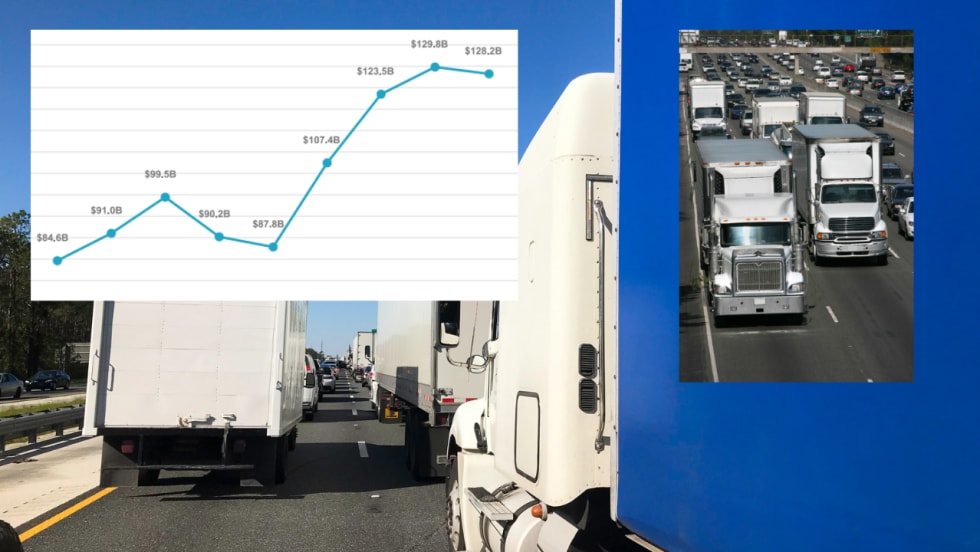
Trucking's Annual Congestion Costs Reach $128.2 Billion
That's the average cost, according to new ATRI research. And the wasted time and diesel are staggering.
Read More →
How to Modernize Your TMS Without Replacing It [Podcast]
Before investing in a new transportation management system, take a closer look at what you've already got. AI, cloud technology and better integrations may offer ways to improve your trucking operations without starting over.
Read More →
Could Your Truck's Connected Devices Be a Cybersecurity Risk?
ELDs, telematics systems and driver tablets help fleets operate more efficiently. But every connected device needs protection against cyberattacks.
Read More →
Holiday Freight Meets a Tight Trucking Market
There's no freight boom, but truckload carriers are finding themselves in a stronger position to negotiate rates. And holiday shipping demand could tighten the market further.
Read More →
What Trucking Events are Happening in 2027?
Looking for trucking-related conventions, expos, and other events? Heavy Duty Trucking has developed this list of national and larger regional trucking shows and events.
Read More →
Does Your Trucking Fleet Need a New TMS?
Artificial intelligence and better integrations promise less busywork and more useful data. Can your TMS help your company solve problems? Do you need additional vendors or an upgrade? Or is it time to look for a new platform?
Read More →
Fleet Costs Shape ACT Expo 2027 Agenda
With diesel prices high and operating expenses under pressure, ACT Expo's 2027 agenda emphasizes fuel efficiency, AI, safety and the return on fleet technology investments.
Read More →
Does Your Trucking Fleet Need a New TMS? [Video]
Cloud technology, AI and new integrations are changing what transportation management systems can do. But does taking advantage of those advances mean replacing your existing TMS?
Read More →
Road Ready Becomes Saegic, Launches New Trailer Telematics Gateway
Clarience Technologies is rolling out new hardware and expanding its plans for connecting trailer telematics, maintenance data, and video.
Read More →