





Frequently Asked Questions About the Drug and Alcohol Clearinghouse
What Should Motor Carriers Do When They Get a Drug and Alcohol Clearinghouse Alert?
What do motor carriers need to do if they get a notice that a driver’s Drug and Alcohol Clearinghouse record has changed?
September 1, 2023

Photo Courtesy J.J. Keller
3 min to read
The Federal Motor Carrier Safety Administration is now notifying motor carriers if a driver’s Drug and Alcohol Clearinghouse record changes within 12 months after their last query.
Previously there was a loophole in the Clearinghouse system where a driver could have a drug or alcohol violation reported after a pre-employment query, but if another carrier went to hire that driver before their next annual Clearinghouse check, they wouldn't necessarily know about the prior violation.
Previously, such alerts were limited to 30 days following pre-employment queries. This change should help carriers identify violations occurring under another motor carrier’s drug or alcohol testing program.
Employers are now notified by email when a driver with a query has new information placed on his or her record. Changes in a driver’s Clearinghouse record that might prompt an alert from the FMCSA include:
A new violation (failed test, actual knowledge, or a refusal to test);
An entry from a substance abuse professional (SAP);
A negative return-to-duty test; or
A completed follow-up testing program.
When a motor carrier receives an alert that a driver’s record has changed, it should:
Request a full query within 24 hours, and
Verify the driver’s status (prohibited or not prohibited).
Motor carriers must pull the driver from safety-sensitive functions if an unresolved testing violation is discovered.
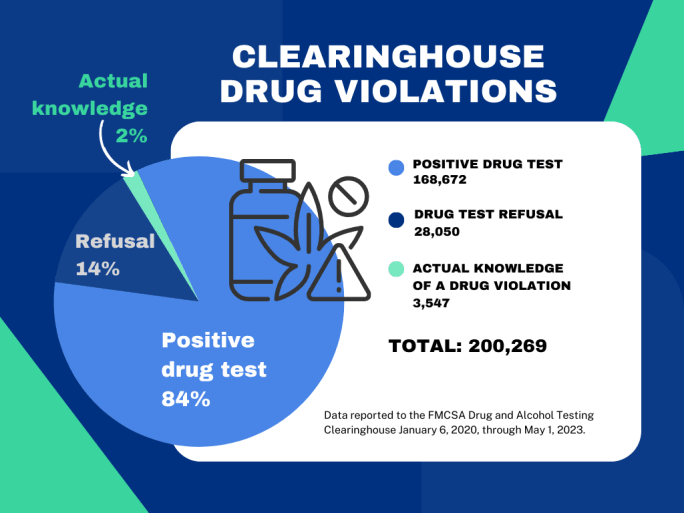
The vast majority of drug and alcohol violations are found via testing.
Credit:
HDT Canva graphic from FMCSA Clearinghouse data
1. Request a follow-on query
Motor carriers should request a full (follow-on) query within 24 hours of Clearinghouse notifications.
A full query requires that the driver provide consent through a personal Clearinghouse account. If a driver does not have an account, one must be created quickly.
Once a query request is made, the driver must give consent. If the driver fails to create an account or refuses to consent, the driver cannot return to safety-sensitive functions until the issue is resolved.
If the full query shows an unresolved testing violation, the driver cannot return to safety-sensitive functions until the necessary return-to-duty steps are completed and submitted to the Clearinghouse.
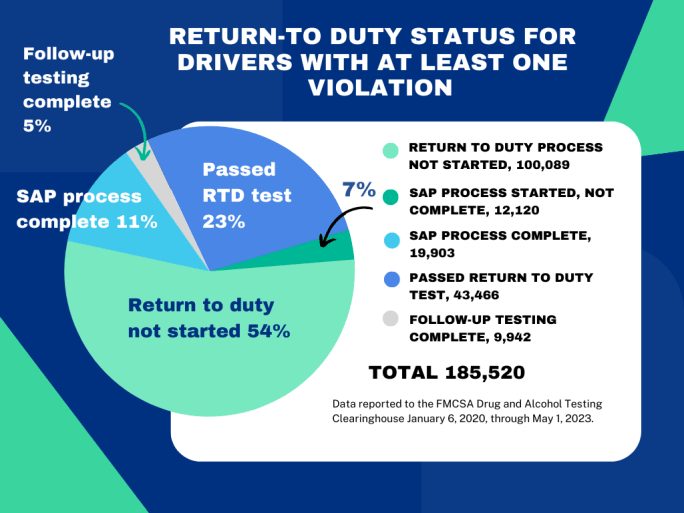
A prohibited status means the driver has not completed the necessary steps to return to duty, including a substance abuse professional (SAP) evaluation, treatment, and a negative drug and/or alcohol test.
Credit:
HDT Canva graphic from FMCSA Clearinghouse data
If the change to the record was the result of the completion of a follow-up testing program or the entry of a negative return-to-duty test (Not Prohibited status), the driver can continue perform safety-sensitive functions.
2. Change annual query rotation
Once every 365-day period, motor carriers must request an annual Clearinghouse query on drivers in positions requiring a commercial drivers license. Requesting a Clearinghouse query before the 12 months resets the rotation.
That means a follow-on Clearinghouse query:
Satisfies the annual query requirement, and
Allows motor carriers to change their annual rotation schedule based on the follow-on report date.
When a motor carrier receives notification that a driver’s Clearinghouse record contains new information, a follow-on query should be requested within 24 hours to confirm the driver is not prohibited from operating a commercial motor vehicle.
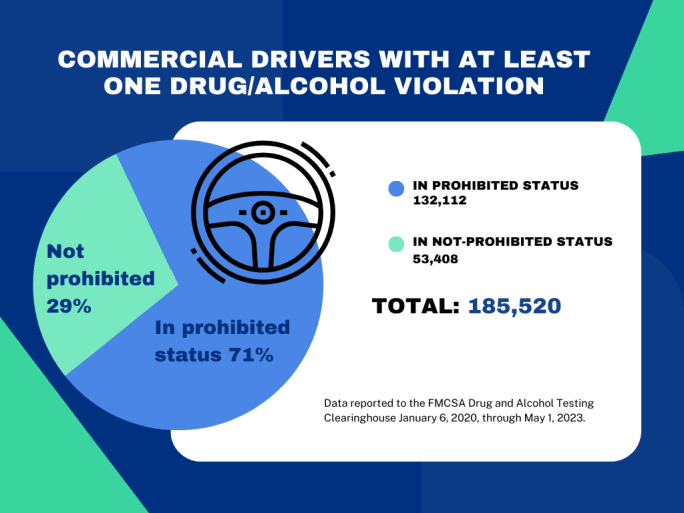
Since the launch of the CDL Drug and Alcohol Clearinghouse on January 6, 2020, through May 1, 2023, 71% of drivers with at least one reported violation remain in a “prohibited status.”
Credit:
HDT Canva graphic from FMCSA Clearinghouse data
A version of this article appears in HDT's September 2023 print edition.
Kathy Close is editor of transport safety with J.J. Keller & Associates. She has a background in driver qualification file auditing, reviewing client compliance with 49 CFR Part 391, and as a third-party administrator of DOT drug and alcohol testing programs for motor carriers. Her areas of expertise include transportation security, DOT drug and alcohol testing, driver qualification, and the Compliance, Safety, Accountability (CSA) enforcement model.
This article was authored and edited according to Heavy Duty Trucking’s editorial standards and style to provide useful information to our readers. Opinions expressed may not reflect those of HDT.
Subscribe to Our Newsletter
More Drivers

Truck Drivers Need More Than Another Alert
Fleets have more visibility into truck health, safety events, and driver activity than ever. The next challenge is turning all that information into useful guidance for the person who has to decide what to do next.
Read More →
FMCSA Removes 110 Truck Driver Training Schools from Certified ELDT List
Federal regulators also are targeting more than 160 additional training providers and launching a nationwide audit of third-party CDL skills testers as part of a broader crackdown on trucking fraud.
Read More →
Hours of Service Pilot Programs: FMCSA Readies for 2027 Rollout
Two pilot programs could eventually reshape hours-of-service rules, giving truck drivers options to pause their 14-hour clock or use longer split sleeper rest periods.
Read More →
Medical Cards, English Proficiency Reshape Roadcheck Violations
Medical-card violations jumped to the top of the driver out-of-service list during CVSA’s 2026 International Roadcheck, while English-language proficiency violations appeared among the leading violations for the first time.
Read More →
Driver Trust Can Make or Break the Success of Fleet Safety Technology
New Teletrac Navman research suggests that onboarding, transparency about driver data, and positive feedback can play a significant role in how commercial drivers respond to safety and coaching technology.
Read More →
EEOC Sues KLLM Over Alleged Sex Discrimination in Driver Training
KLLM is facing a federal sex-discrimination lawsuit over policies the EEOC alleges put female truck driver trainees at a disadvantage.
Read More →
FMCSA Moves to Codify English Language Requirements for Commercial Drivers
By changing regulations on English-language proficiency requirements for commercial drivers, rather than relying on a guidance memo, the FMCSA said future administrations won't be able to walk back the Trump administration's stricter enforcement with just a memo.
Read More →
Drivers Put Western Star Trucks to the Test at Star Nation Experience
Watch to get an inside look at the Western Star trucks, technology, and community behind the Star Nation Experience 2026!
Read More →
Trump Administration Looks to Put More Veterans Behind the Wheel
The Freedom Haulers program pulls together existing and expanded programs at several federal agencies to recruit veterans to drive commercial heavy-duty trucks and cut the red tape for them to get a CDL, training, and employment.
Read More →
Putting Mack’s Command Steer to the Test
A test drive of Mack’s Command Steer active steering system evaluates how it can make truck driving easier and less tiring.
Read More →