





Related: Trading Diesel for Kilowatts
QuickSpin: Transpower's Electric Heavy-Duty Tractor
The totally electric ElecTruck could change the way we view electric vehicles in the Class 8 space.
February 26, 2016
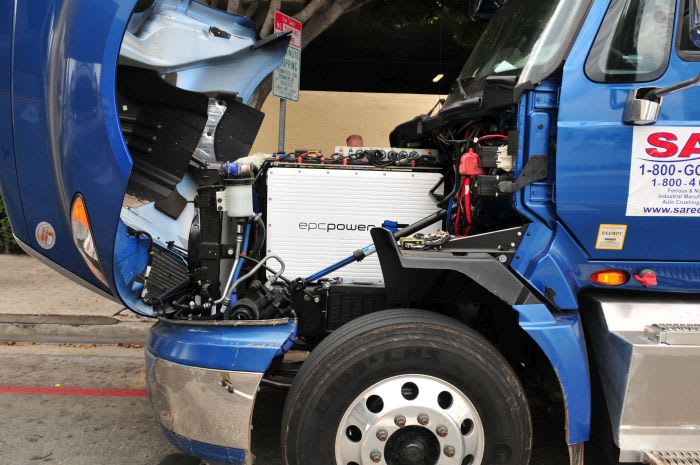
TransPower’s ElecTruck could change the way we view electric trucks.
5 min to read
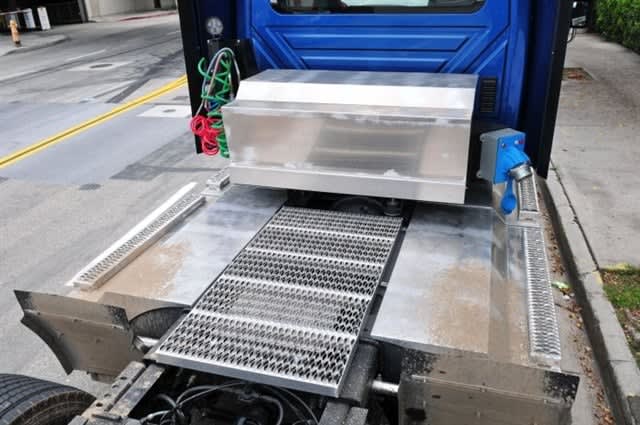
Batteries are mounted on the frame in the space usually occupied by fuel tanks and atop the frame behind the cab.
You may be close to being able to order an electrically powered Class 8 tractor. TransPower’s Class 8 ElecTruck is completely battery powered and thus produces no emissions of any kind.
The developer, Poway, Calif.-based TransPower, offered us a drive of one of its 11 in-service Class 8 trucks last summer. We were bobtailing, but the results of the company’s five years of engineering testing were impressive.
The electric battery and propulsion system were built into an off-the-shelf International ProStar daycab tractor, purchased through the usual dealer channels. TransPower replaced the engine, drivetrain and most of the other electrical components with proprietary systems designed for Class 8 on-road tractors capable of running 80,000-lb.-GVW applications.
Joshua Goldman, vice president of business development at Transpower, told me Peterbilt Motors recently agreed to supply the company with glider kits, and he is currently negotiating similar supply arrangements with other OEMs for other types of vehicles such as yard tractors and school buses.
The truck has five battery storage modules. Two are mounted on the side of the truck replacing the fuel tanks; another sits behind the cab. Each holds up to 48 large-format, 300 amp-hour lithium-ion cells providing a total of 215 kilowatt-hours of energy storage. It takes less than three hours to charge the batteries from 20% to 95%. Goldman says a 45-minute fast-charge any time before the batteries are depleted will add a couple more hours of run time.
The truck has a 400-hp or 300-kilowatt drive system, consisting of two 200-hp Fisker JJE motors originally developed for the Fisker Karma hybrid passenger car. These are mounted in series and mated to a cleverly modified Eaton Fuller 10-speed automated manual transmission.
TransPower has developed proprietary AMT software that manages the shift strategies based on continuous calculations of electric motor speed and the vehicle‘s torque requirements. There‘s no clutch, no synchronizers — and no reverse gear because the motors can run in either direction.
The drive axles are original as supplied by International and just like those you‘d find on any Class 8 tractor spec‘d for urban service.
The drive system operates at 400 volts and so requires a 400- to 14-volt DC-to-DC convertor to power the truck‘s regular electrical system, such as lighting, heater fans, ECUs, relays, ABS, and so on. Components such as the power steering pump, AC compressor and air compressor are electrically driven off a 230-volt AC accessory inverter. Except for the power steering pump, these systems cycle on only when needed.
Space constraints prevent us from going deep into the power management system, which is really the key to making this truck work. TransPower has developed and/or integrated several systems from global suppliers that optimize power output and battery management in ways it says have not been achieved in the past. Despite its complexity, it‘s a very clean-looking installation that has been designed to be delivered in kit form to other truck manufacturers so they can assemble the power system on their own assembly lines.
Behind the wheel
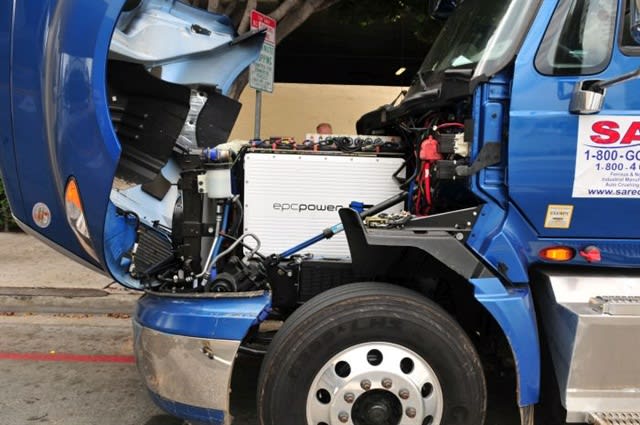
TransPower’s ElecTruck could change the way we view electric trucks.
To the untrained eye, the truck is nearly identical inside and out to any other ProStar daycab. There are no fuel tanks, of course, and no exhaust stack. The battery modules don‘t immediately stand out as different because they are aluminum and look much like fuel tanks.
Inside, TransPower repurposed most of the instrumentation to display information relative to the electrical system. The volt meter shows whether the 400- to 14-volt DC convertor is working; the fuel gauge shows the battery charge level; the water temperature gauge show the electric motor temp; and the oil temp gauge shows the battery temperature. Other than the charge and ready indicators on the dash, and the high-voltage disconnect switch, the panel is indistinguishable from a ProStar diesel.
The oddest thing about driving it is the absence of engine noise. There‘s a faint whine, which Goldman says is not the electric motors but gear noise from the transmission. Also, the rattles and squeaks normally masked by the sound of the diesel are more prominent.
Electric motors are different from diesels in that they deliver 100% of their torque output almost immediately and constantly through the drive cycle. Consequently, it takes off with some vigor. And there‘s practically no lag between the gears, because TransPower‘s proprietary transmission programming slows the motors very quickly to synchronize with the transmission. It really feels like there‘s constant torque going to the drive wheels all the way up through the gears.
There is also a regenerative braking system built into the propulsion system that provides a modest amount of retarding power while providing a charge to the batteries.
I can‘t say how it performed under load, but TransPower says it performs like a similarly powered diesel. Test results supplied by TransPower say it will accelerate to freeway speeds as rapidly as conventional trucks, pull solidly on steep grades and provide full power at all times, even if the battery is low.
The truck I drove can pull 80,000-pound loads a distance of about 70 to 100 miles on a single battery charge, Goldman says. That‘s obviously not enough for long-distance application, but it‘s ideal for local work — like the port drayage operations in which it has been undergoing trials, and now in-service, revenue-producing work.
Goldman says the next generation is expected to go up to 150 miles on a charge and will likely weigh about 2,000 to 4,000 pounds less than this one, which tips the scale at about 22,000 pounds.
As to the cost of the truck, Goldman says they are commercially viable and offer a payback in 150,000 to 200,000 miles. He says the company offers truck and battery leasing programs that can make the ElecTruck‘s lifecycle costs lower than a diesel.
TransPower is now working with Peterbilt Motors for next generation all electric short haul Class 8 tractors and refuse trucks. The company hopes to eventually install the electric propulsion system into the cab-and-chassis right on the assembly line. TransPower is also working with other bus and yard tractor OEMs for a similar arrangement. The company has also been developing purchase and lease deals that customers will find attractive. These are expected to be announced soon.
Subscribe to Our Newsletter
More Fuel Smarts

How Volvo Updated Its D13 for EPA 2027 [Watch]
Volvo’s updated D13 promises lower emissions without sacrificing performance or fuel economy. Take a closer look at what changed inside the engine in this HDT Spotlight video.
Read More →
Diesel Price Spike Shortens Payback for Natural Gas Trucks, Report Says
Energy Vision estimates fleets could recover the higher purchase price of an RNG-fueled Class 8 tractor in 1.3 to 2.8 years under current fuel-price scenarios.
Read More →
Calstart Becomes Catalyst Mobility, Reflecting Broader Focus
Calstart is now Catalyst Mobility, reflecting the nonprofit’s growing national role in clean transportation, including zero-emission trucks, infrastructure and incentive programs.
Read More →

Record Diesel Prices Squeeze Trucking Fleets
Average U.S. diesel prices have climbed to nearly $6 a gallon, surpassing the 2022 record as tight refinery capacity and Middle East disruptions keep fuel costs elevated.
Read More →
Sponsored•September 9, 2026
How Fuel Delivery Shapes Engine Performance
Fuel delivery depends on more than what happens at the injector. For fleet, maintenance and technical professionals, looking at the full path from pump to injector can provide useful context for understanding engine performance.
Read More →
East Coast Port Launches $45M Electric Truck Push
The Port Authority of New York and New Jersey announced millions in incentives for zero-emission drayage trucks, yard tractors, and new charging hubs near the port.
Read More →
California Bill Could Shed Light on Electric Truck Prices
Why do battery-electric Class 8 trucks remain so expensive? A California bill headed to Gov. Gavin Newsom would give fleets and state agencies more visibility into what manufacturers charge.
Read More →
Detroit Opens Orders for EPA 2027 Engines
Detroit isn’t starting from scratch to meet EPA 2027 diesel emissions standards. Its Gen 6 DD13 and DD15 engines keep much of today’s platform while updating the fuel and aftertreatment systems.
Read More →
Zero-Emission Truck Corridor Planned for West Coast
California, Oregon, Washington, British Columbia and Baja California are coordinating plans for truck charging and hydrogen fueling from Canada to Mexico.
Read More →
A Closer Look at Kenworth’s Electric T880E Vocational Truck [Video]
Learn more about Kenworth's T880E battery-electric vocational truck at the Paccar Technical Center, including its range, applications, upfitting considerations, and PTO options, in this HDT Spotlight video.
Read More →