




Q&A: Torc CEO Talks Autonomous-Truck Development
"This idea that we’re just going to keep adding sensor after sensor to these trucks without eventually reinventing the chassis from the ground up doesn’t make any sense." Find out why in this HDT interview with Torc Robotics CEO Michael Fleming about autonomous-truck development.
November 24, 2021

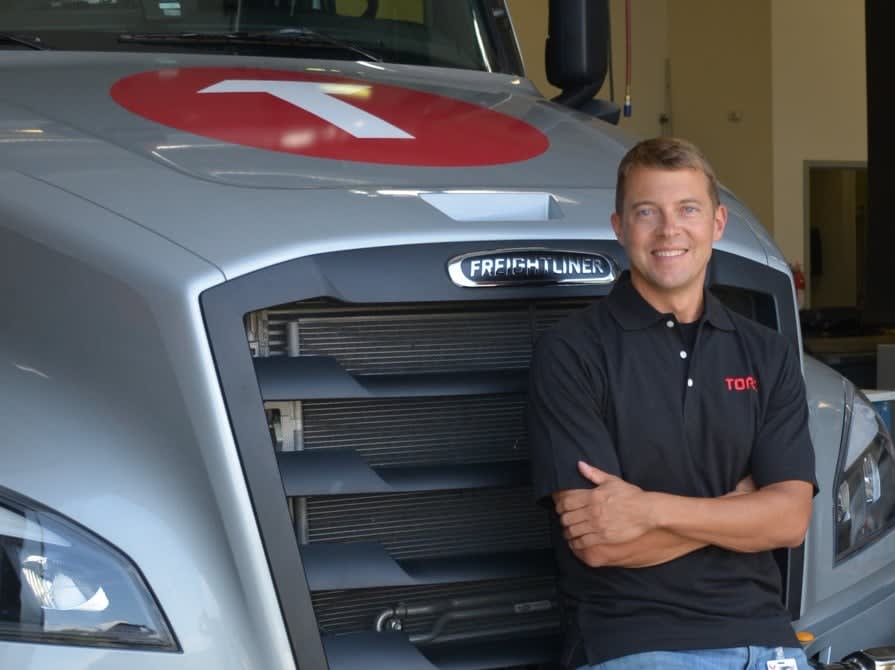
Torc CEO Michael Fleming says the deployment of autonomous trucks will likely happen in the American Southwest first, then incrementally expand into other markets nationwide.
Photo: Torc Robotics
6 min to read
Following a morning ride out of Albuquerque in one of Torc Robotics' autonomous trucks, HDT senior contributing editor Jack Roberts sat down with CEO Michael Fleming at the company’s autonomous test center for a wide-ranging discussion on the current state of development for autonomous trucks and the impact they will have on society when they finally arrive in real-world fleet operations.
HDT: We had a very impressive — and noneventful — drive today in one of your trucks. I’m guessing that’s exactly the message you wanted to send by inviting us out here.
Fleming: It is. I agree with you that autonomous trucks are going to be incredibly transformative for our industry and our society when they arrive. And I like that word: transformative, instead of “disruptive,” which seems to be the word we hear most these days when talking about this technology. We’re not looking to “disrupt” anyone or anything. But we are looking to transform the way we move freight. And what we wanted to show you today is that we are well on our way to doing that.
But this is not going to be a technology that suddenly throws everything into chaos. We are building sensible, logical, predictable vehicle control systems. Our goal is to have those systems perform as well as the best human drivers out there, on the best days of their lives, every single minute of every single day. And that means a ride that is, as you put it, “uneventful.” We don’t want eventful drives here. So, we’re happy to hear to say that.
HDT: Your work seems to be progressing nicely. Do you still feel that trucking will be the next big arena for autonomous vehicles?
Fleming: Yes. More so than ever, in fact. In 2017, Andrew [Culhane, chief strategy office, Torc Robotics] and I both felt that the next big business case for autonomous vehicles was going to be on-highway trucking. Torc, partnering with Caterpillar, had already been successful with automated mining operations in Australia. The business case there was similar: a severe shortage of operators in remote regions of the country. And we’d completed several successful autonomation projects with the U.S. Department of Defense. At the time, the buzz surrounding autonomous tech was focused on self-driving taxis. But as we looked on the human factor in trucking — the driver shortage that continues, and is getting worse today — it seemed apparent to both of us that trucking would be the next big business case for autonomous. We felt that even with limited initial deployment of autonomous trucks, we had the ability to add significant capacity to middle-mile applications, which would then allow fleets to reallocate local and regional driver pools to build quality on routes still served by human drivers. And we still believe that.
HDT: You are on record as saying this will be a measured deployment, correct? It’s not like we’re going to throw a light switch and autonomous trucks will be everywhere all at once.
Fleming: Right. The commercialization of autonomous trucks will go a lot like cell phones did 20 years ago. You know, at first you only saw them in large urban areas where there was infrastructure and a ready market of potential customers. Then, as the technology and infrastructure gradually improved, they started expanding outward to other, less populated urban areas and, then, eventually, rural areas.
My belief is that the first autonomous trucks will likely go to work here in the American Southwest. Partly that’s due to the weather, which is better suited for autonomous trucks at the moment. And the length of the hauls — say Albuquerque to Dallas, or Phoenix to Los Angeles, for example — are ideal. Then, as we gain real-world experience in those operations, we will expand incrementally into other markets.
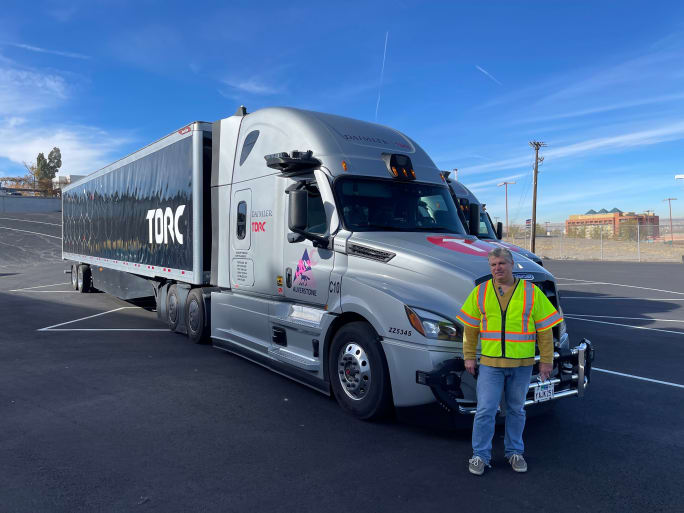
HDT Senior Contributing Editor Jack Roberts prepares for a ride-along in one of Torc's autonomous Freightliner Cascadia trucks.
Photo: Torc Robotics
HDT: How is your relationship with Daimler progressing almost three years after it acquired Torc?
Fleming: It’s going very well. After we made the decision to make trucking the focus of our next autonomous efforts, we realized — this was in 2017 — that you cannot commercialize self-driving truck technology without having a heavy-duty trucking OEM on board to help you in that effort. That seems kind of obvious now. But that’s why we insisted on a majority stake when we were negotiating with Daimler to complete the acquisition. I saw it as vital that they be the lead in terms of how our technology would be applied to make sure that the business case for fleets always came first. And that partnership is working well and already bearing fruit.
HDT: Can you give us some examples beyond the technology we saw this morning?
Fleming: What you saw here in Albuquerque this morning is really just the tip of the iceberg in terms of the relationship between Daimler and Torc. I believe that today, the trucking industry is underestimating the complexity of the chassis requirements needed to support autonomous technology. We’re talking deep, deep, levels of integration here. And again, that’s why I insisted on having Daimler as the majority partner in this relationship. I wanted full transparency between our two companies — not an arrangement where there’s one round of funding and a project is finished and then another round of funding to take things a bit further along. That’s kind of the standard state of play in the industry right now.
But Daimler engineers around the globe, right now, are working hard on completely redesigning and engineering the next generation of commercial trucks from the chassis up to be fully integrated with the autonomous technology we’re developing at Torc. Every single aspect and component on the next generation of trucks from Daimler — from the wheel-ends, to the hubs, to the axles, all the way up to engines and powertrain — are being completely redesigned from scratch to work with our technology on a deeply integrated level.
This idea that we’re just going to keep adding sensor after sensor to these trucks without eventually reinventing the chassis from the ground up doesn’t make any sense. This is a whole new way of operating trucks, whether you have a human driver on board or not. When you think of all the sensors already on trucks, and all the failure modes that already exist… I just feel like the level of complexity we’re talking about here is very underestimated.
HDT: So, when do you think we’ll start seeing all of these changes?
Fleming: On the Daimler chassis now, we’re generally working with Generation 2 autonomous trucks, and starting to move toward Generation 3 models. And we’re always going to newer generations of trucks as we go through our test/build/learn cycles with this technology. But what our ultimate goal is — and again, this is completely focused on safety first — is to build redundancy into the chassis from the ground up. Every single system and component on a dedicated autonomous truck will have some form of redundant system in place as a critical safety measure.
So, we’ve got a lot on our plate. And it’s going take some time to get there. But, that said, we’re still comfortable with our previous public statements saying that we believe we’ll be ready to go to market with this next generation of all-new autonomous trucks by the end of this decade.
Subscribe to Our Newsletter
More Equipment

How Volvo Updated Its D13 for EPA 2027 [Watch]
Volvo’s updated D13 promises lower emissions without sacrificing performance or fuel economy. Take a closer look at what changed inside the engine in this HDT Spotlight video.
Read More →
Michelin Tire Improves Efficiency and Durability for Regional Fleets
The Michelin X Multi Energy D2 is a regional haul drive tire engineered to help fleets improve fuel efficiency, durability and traction in demanding stop-and-go operations.
Read More →
ZF Expands Commercial Vehicle Push in North America
ZF is expanding its North American commercial-vehicle presence with new transmission applications, electrification, trailer technology and autonomous-driving systems.
Read More →
Tesla Wants a Self-Driving Semi. Are Cameras Enough?
Could Tesla’s camera-only autonomous driving technology work on an 80,000-pound Semi? In this commentary, HDT's Deborah Lockridge takes a look at Tesla, Cybercab, and how autonomous trucks see the road.
Read More →
Kodiak: Driverless Long-Haul Truck Launch on Track for 2026
Kodiak AI says its driverless long-haul safety case is 93% complete and it remains on track to begin commercial operations by year-end 2026.
Read More →
What DOT’s Automated Vehicle Strategy Means for Trucking
The U.S. Department of Transportation issued a new automated-vehicle strategy that outlines plans for driverless-truck regulations, cross-state freight corridors, and federal safety standards.
Read More →
East Coast Port Launches $45M Electric Truck Push
The Port Authority of New York and New Jersey announced millions in incentives for zero-emission drayage trucks, yard tractors, and new charging hubs near the port.
Read More →
PlusAI Going Public to Fund Autonomous Truck Launch
A SPAC deal could provide PlusAI with up to $300 million as it works toward a 2027 commercial launch of factory-built autonomous trucks.
Read More →
NHTSA Moves to Rewrite Truck Fuel-Economy Rules
The National Highway Traffic Safety Administration says it lacks authority to regulate medium- and heavy-duty truck engines separately from complete vehicles, but the existing standards have not yet been eliminated.
Read More →
Detroit Opens Orders for EPA 2027 Engines
Detroit isn’t starting from scratch to meet EPA 2027 diesel emissions standards. Its Gen 6 DD13 and DD15 engines keep much of today’s platform while updating the fuel and aftertreatment systems.
Read More →