





Related: Trends in Class 8 Trucks
Q&A: Navistar Marketing VP Diane Hames on Class 8 Trends
Navistar's vice president of marketing talks trends in Class 8 trucks, production slowdowns and electric vehicles, among other things.
December 27, 2021
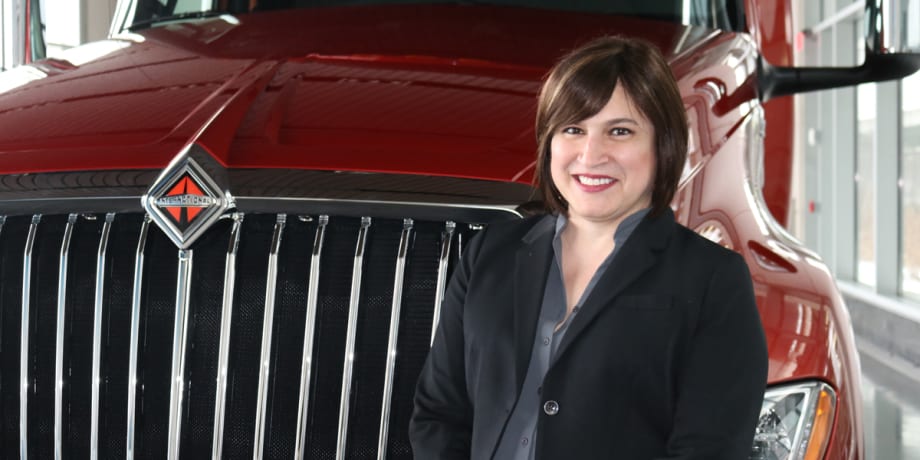
Navistar Vice President of Marketing Diane Hames discussed Class 8 trends, production slowdowns, electric vehicles, and more.
Photo: Navistar
5 min to read
Navistar Vice President of Marketing Diane Hames discussed with Heavy Duty Trucking the latest trends driving the Class 8 market. Hames oversee all marketing activities for International Truck, IC Bus, and Navistar’s aftersales brands, including product strategy and planning, channel marketing, strategic pricing, and brand marketing communications. Her remarks here are more extensive than those included in a recent HDT article on trends in Class 8.
HDT: Any update on resolving production slowdowns due to shortages of microchips and other components?
Hames: We are managing this global supply chain issue best we can. It’s a dynamic situation and Navistar is taking extreme measures to manage the situation and remains focused on maximizing production so we can deliver more units to our customers.
HDT: Has the rollout of Phase 2 GHG standards developed by EPA and NHTSA had any sizable impact on the design and performance— and thus the market acceptance— of on-highway and/or vocational trucks of model years 2021-2022?
Hames: Yes. The recent updates to the International A26 engine (2021 GHG) highlight Navistar’s commitment to continued fuel efficiency improvements driven by federal regulations.
HDT: Where do you stand with electric vehicle offerings, those now available? Any other electric models or model expansions planned for introduction in 2022? Are there any programs you have to help fleets integrate electric trucks and/or add charging solutions at domiciles or over the road? And how high do you gauge the general interest of fleet buyers for electric?
Hames: Navistar currently has two electric vehicles available – the IC Bus Electric CE Series and the International eMV Series. Navistar’s Next eMobility Solutions group guides customers through the entire, complex zero emissions ecosystem, providing electrified solutions for the entire lifespan of a vehicle. The team approaches each customer with a holistic ecosystem – the 5 Cs – to assist customers in seamlessly integrating electric vehicles into their fleets.
The consulting process includes evaluation of battery electric vehicle (BEV) and fuel cell electric vehicle (FCEV) requirements and efficiencies and route simulation to determine the optimal powertrain and charging mix for individual application, as well as education on all available funding sources, grants and tax incentives.
Next supports charging or refueling solutions that guarantee vehicle uptime though site planning and engineering, complete electric vehicle charging kits for both AC and DC charger installations, installation and site management, EV charging equipment certification with vehicles and infrastructure financing. Data is used to create a more connected network between fleets, dealers, charging/refueling and customers that enables a best-in-class ownership experience.
Navistar’s BEV and FCEV vehicles are constructed by Navistar’s manufacturing ensuring quality and reliability. End-of-life battery solutions include: Recycling materials for use in new batteries or other applications; repurposing batteries in stationary power backup solutions, and remanufacturing/refurbishing batteries for use in other vehicle applications
HDT: What about hydrogen fuel-cell power? Will trucks using it be available next year? At another possible future date? Once available, in what applications might hydrogen fuel-cell be preferred over BEV power?
Hames: In collaboration with General Motors and OneH2, Navistar is working on a complete solution for customer implementation of a zero-emission long-haul system utilizing hydrogen fuel cell technology, which will be initially piloted by J.B. Hunt.
FCEV may be preferred over BEV power in applications requiring a higher density of energy, fast refueling and additional range. FCEVs are ideally suited for operations that include:
Long haul routes of 300+ miles
Routes where maximum payload is important
Rapid refueling is necessary to maintain uptime
Zero tailpipe emissions are important
Areas where hydrogen use has been incentivized
HDT: Any new developments in advanced safety assistance systems and other improvements designed to reduce accidents and better protect truck drivers?
Hames: Navistar maintains a focus on safety. The International LT Series includes standard Bendix Wingman Fusion system with collision mitigation technology, adaptive cruise control, lane departure warning, over-speed alert, and stationary vehicle braking. Customers can also select from a number of proven standalone safety systems to meet their specific needs. Bendix Wingman Advanced and Wabco OnGaurd Active are also available.
HDT: Any new developments in your post-sale service support (dealers, telematic offerings, etc.) offerings? Are fleets in general responding well to these initiatives?
Hames: All International LT Series come equipped with OnCommand Connection telematics and a free two-year subscription to our Advanced Remote Diagnostics solution. OnCommand Connection is designed to keep vehicles moving through powerful features such as interactive mapping, engineer-designed action plans and access to fleet health information through the International portal or customized reporting to a preferred email inbox.
International 360 is a ground-breaking service communication and fleet management platform that helps fleets manage their entire portfolio of assets with ease while enabling streamlined, transparent communication with dealerships and more efficient fleet operations. International 360 is built to transform the service process and revolutionize how assets are managed:
Seamless communications with dealers and up-to-date repair status visibility
Complete VIN-based information – asset specs, complete parts catalog, available service information, even remote diagnostics and health data
Instant online service request initiation and estimate approvals
Complete service history, up-to-date campaign information, and engine calibration status
HDT: Regarding driver comfort and lifestyle, any new specs or options that specifically address improving the driver environment?
Hames: The International LT Series is designed with the driver in mind. With more intuitive controls, enhanced visibility, a quieter cab, critical information at the driver’s fingertips and dozens of other smart features that help keep a driver comfortable and in control over the long haul. International also utilizes premium soft touch vinyl interior panels throughout the vehicle, which minimizes the need for hard to clean, odor and moisture trapping woven panels.
Every detail inside the LT Series cab has been carefully designed, measured and clinic-tested to optimally benefit the driver. The gauges received numerous tests and refinements to optimize their readability, usability and positioning so key information and alerts are precisely where they need to be to view without distraction. The standard premium gauge cluster features a customizable digital display that lets drivers intuitively select the information they prefer in a variety of situations.
HDT: Can you provide an update on your progress toward autonomous trucks, denoting by SAE autonomy levels?
Hames: In July 2020, Navistar and TuSimple announced a partnership to co-develop autonomous International LT Series trucks, which will be manufactured by Navistar and operated using TuSimple’s automated vehicle technologies. The goal of the partnership is to introduce SAE Level 4 automated heavy-duty trucks to market in the 2024/2025 timeframe to provide customers a safe, reliable and cost-effective solutions fully integrated with their fleets.
Subscribe to Our Newsletter
More Equipment

How Volvo Updated Its D13 for EPA 2027 [Watch]
Volvo’s updated D13 promises lower emissions without sacrificing performance or fuel economy. Take a closer look at what changed inside the engine in this HDT Spotlight video.
Read More →
Michelin Tire Improves Efficiency and Durability for Regional Fleets
The Michelin X Multi Energy D2 is a regional haul drive tire engineered to help fleets improve fuel efficiency, durability and traction in demanding stop-and-go operations.
Read More →
ZF Expands Commercial Vehicle Push in North America
ZF is expanding its North American commercial-vehicle presence with new transmission applications, electrification, trailer technology and autonomous-driving systems.
Read More →
Tesla Wants a Self-Driving Semi. Are Cameras Enough?
Could Tesla’s camera-only autonomous driving technology work on an 80,000-pound Semi? In this commentary, HDT's Deborah Lockridge takes a look at Tesla, Cybercab, and how autonomous trucks see the road.
Read More →
Kodiak: Driverless Long-Haul Truck Launch on Track for 2026
Kodiak AI says its driverless long-haul safety case is 93% complete and it remains on track to begin commercial operations by year-end 2026.
Read More →
What DOT’s Automated Vehicle Strategy Means for Trucking
The U.S. Department of Transportation issued a new automated-vehicle strategy that outlines plans for driverless-truck regulations, cross-state freight corridors, and federal safety standards.
Read More →
East Coast Port Launches $45M Electric Truck Push
The Port Authority of New York and New Jersey announced millions in incentives for zero-emission drayage trucks, yard tractors, and new charging hubs near the port.
Read More →
PlusAI Going Public to Fund Autonomous Truck Launch
A SPAC deal could provide PlusAI with up to $300 million as it works toward a 2027 commercial launch of factory-built autonomous trucks.
Read More →
NHTSA Moves to Rewrite Truck Fuel-Economy Rules
The National Highway Traffic Safety Administration says it lacks authority to regulate medium- and heavy-duty truck engines separately from complete vehicles, but the existing standards have not yet been eliminated.
Read More →
Detroit Opens Orders for EPA 2027 Engines
Detroit isn’t starting from scratch to meet EPA 2027 diesel emissions standards. Its Gen 6 DD13 and DD15 engines keep much of today’s platform while updating the fuel and aftertreatment systems.
Read More →