





From the Archives: Meritor CEO Predicts Electrified Future (2017)
Q&A: Meritor's Villavarayan on Electrification, Air Disc Brakes
Meritor's Chris Villavarayan talks to HDT about how disruption and globalization contributed to its latest raft of new products.
November 11, 2019
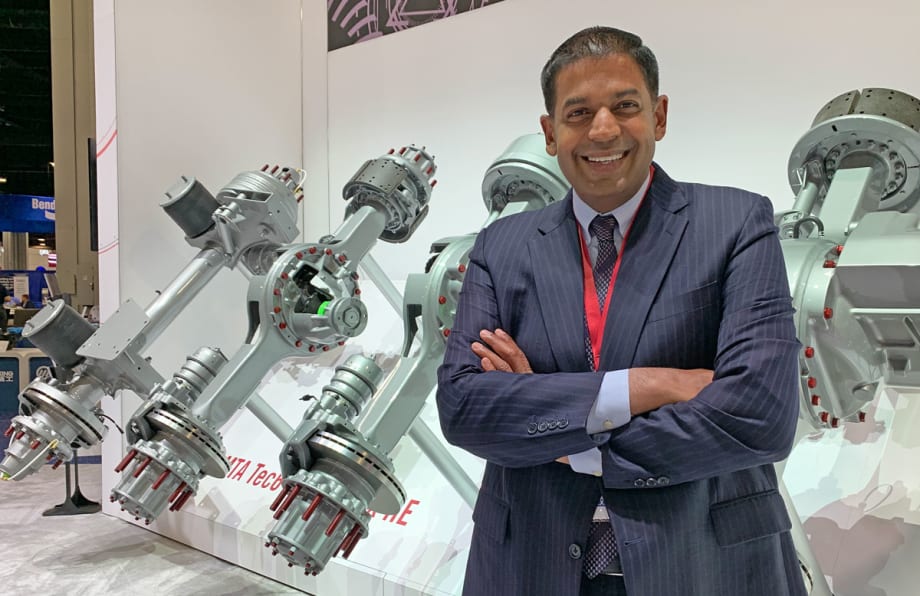
Chris Villavarayan, Meritor's senior vice president and president of Global Truck, with the new Meritor axles on display at the North American Commercial Vehicle show.
Photo by Deborah Lockridge
7 min to read
Meritor announced a raft of new products at the North American Commercial Vehicle Show in Atlanta in late October, including the expansion of its Blue Horizons portfolio of e-drive products with the addition of the 12Xe powertrain for Class 4-7 trucks and the 17Xe powertrain for heavy-duty 4x2 and 6x2 trucks; drive axles to help OEs meet new greenhouse gas fuel efficiency regulations; a 14,000-pound capacity front non-drive steer axle it says is the lightest such axle available in North America for linehaul and vocational applications; and a new air disc brake designed specifically for the on-highway line-haul market.
We sat down following the press conference with Meritor's Chris Villavarayan, senior vice president and president of global truck. (This interview has been lightly edited for length and clarity.)
HDT: So how’s the show been?
Villavarayan: Excellent, excellent. I think it’s been a while since we’ve had something new to announce on every side, in every segment of our business. I think it’s one of our longest press conferences we’ve ever had.
HDT: Any that you’re more excited about than the others?
Villavarayan: The brake and the electrification [announcements] are the top two.
The brake has been four years in the making, so I think that was very, very important. It has over a million miles of testing, testing in the field. Beyond that it was all the engineering testing, putting the capacity in place, the global reach of the engineering behind it between Europe and north America in developing that brake – that was just an enormous feat.
And on top of that, the electrification side. The last time [at NACV in 2017] we brought out the 14E. Then this year, to come out with the 12XE and the 17XE, I think those were phenomenal with how quickly the business and engineering teams worked through in developing those.
HDT: You've mentioned the speed with bringing the brakes and electrification products to market, and leveraging the global abilities of the organization. It seems that is something we’re seeing not just at Meritor, but at many companies; tell us a little more about what’s driving that.
Villavarayan: Good question. You know, if you go back maybe 10 years, 20 years ago, and you’re standing in a point in time and you’re looking [at the development of the iPod, the iPhone, the iPad], you always feel that technology is changing. I think we’re going through even more rapid change at this point in time, and when you look at transportation… everything that’s coming... whether it’s electrification, or the utilization of transportation with the Uberization of transportation, to autonomous, it’s always these three or four main themes that is completely changing what we are used to.
I think that’s driving all of us to rapidly kind of disrupt ourselves and change, because we have to. So I think that’s what you’re seeing, not only from us but from everyone, is trying to find a way to continually disrupt ourselves and change.
In a sense it’s a great thing to be in. But the one thing, when I look at our booth, and I’m standing outside and I’m looking in, the one thing that I don’t want us to lose sight of is 90% of the world still runs on what’s conventional. You’ve got to manage both of those, and the efficiency of diesel is still driving, it’s absolutely still core. As I’m walking through these booths, sometimes you get driven to where you see the entire world is changing to this, and I think we need to be cognizant of it’s not happened yet. But you need to be driving to this for a portion of your business.
HDT: It seems we’ve gone from years of OEs moving toward vertical integration on conventional powertrains, but on the electrification side we see a lot more partnering, more looking to suppliers to do some of that work. How does a supplier like Meritor engage with OEMs on electrification?
Villavarayan: OEs have in the past I think vertically integrated. I think this is so new to everybody that all of us are learning. So the more partnerships, the better. And I think if you really look at it, we’re all keeping our options open. I think we have to. It’s changing so rapidly, that you kind of have to be willing to not say,' Hey, this is my thing and I’m going to start developing it,' because you have no idea what tomorrow’s going to hold. And you don't know if battery technology will change from lithium ion to something else, and you’re going to move from low voltage to high voltage or high voltage to low voltage. You have no idea. Do you need battery cooling or don’t you, do you need thermal cooling or don’t you? There’s so many decisions that have to be made, that I think it’s important that we kind of keep this all open, and drive to learn as much as we can from as many partnerships, and I see OEs doing that.
Also on the topic of electric vehicles and partnerships, tell us more about this deal with Brazil. You recently announced that Meritor joined the Volkswagen Caminhões e Ônibus e-Consortium to collaborate in the development of electric commercial vehicles in Brazil, beginning with the launch of the OEM's 11-ton e-Delivery truck, equipped with Meritor's 12X drive axle with eOptimized gearing, in 2020.
Villavarayan: We’ve been with Volkswagen and MAN in Resende, Brazil, it’s been almost 25 years. We did that as a consortium of seven suppliers, and within their facility we work with Volkswagen and MAN to build the truck. And so Roberto Cortes, who is the CEO of Volkswagen Caminhões e Ônibus, decided to build a new e-consortium to focus on electrified vehicles. He opened it up for suppliers, and we are the only one supplier that’s on the old consortium as well as the new consortium. And one of the great things about it is in the new e-consortium we’re surrounded with some great partners, like Siemens, Bosch; it’s a great bunch of new suppliers who are part of this.
Volkswagen Caminhões e Ônibus already has one of the world’s largest orders for electrified trucks for their e-delivery truck, so they have 1,600 trucks that start in 2020 that they have to build for Ambev. So, it’s a great opportunity for us. We’re going to start off by providing our conventional axle and then going to go to the 12XE. That’s something we’re very proud of. And the thing about it is, that’s just one customer. There’s tons of opportunity. It’s a small inner city e-delivery truck so ideally there's lots of opportunity to grow from there.
HDT: The other thing you talked about was the new brake. What’s special about it? Are we seeing air disc brakes growing in popularity?
Villavarayan: Conceptually, air disc brakes, it’s more about North America slowly catching up to what’s done in Europe. If you think about an air disc brake, maintenance wise, it’s much better, there's less change of pads and so from a maintenance standpoint. So it's a better scenario when you think about an air disc brake and also a benefit from the standpoint of stopping distance.
We’ve always had a dual piston brake, [but with the new lightweight, single-piston EX+ LS air disc brake] we’re going to a single-piston brake. We specifically designed this brake for the linehaul Class 8 market. We’ve spent a million miles to make sure we got it right. The whole objective of getting down to a single piston brake was to get it closer to the cost of a drum brake, so the value proposition with the maintenance makes sense for folks to switch. So that was one of our key drivers.
And it’s the lightest brake we have in Meritor, 71 pounds. We’re driving the weight down, we’re improving the maintenance, making the cost point better. You put all that together and specifically design a brake for line haul, and I think that’s something to be proud of. It’s also got positive pad retraction so you don’t have it clamped so you can improve the fuel efficiency.
We’ve also got this with an exclusive or proprietary friction that meets the copper standards for 2030, so that’s another thing that we’re very proud of.
Subscribe to Our Newsletter
More Equipment

How Volvo Updated Its D13 for EPA 2027 [Watch]
Volvo’s updated D13 promises lower emissions without sacrificing performance or fuel economy. Take a closer look at what changed inside the engine in this HDT Spotlight video.
Read More →
Michelin Tire Improves Efficiency and Durability for Regional Fleets
The Michelin X Multi Energy D2 is a regional haul drive tire engineered to help fleets improve fuel efficiency, durability and traction in demanding stop-and-go operations.
Read More →
ZF Expands Commercial Vehicle Push in North America
ZF is expanding its North American commercial-vehicle presence with new transmission applications, electrification, trailer technology and autonomous-driving systems.
Read More →
Tesla Wants a Self-Driving Semi. Are Cameras Enough?
Could Tesla’s camera-only autonomous driving technology work on an 80,000-pound Semi? In this commentary, HDT's Deborah Lockridge takes a look at Tesla, Cybercab, and how autonomous trucks see the road.
Read More →
Kodiak: Driverless Long-Haul Truck Launch on Track for 2026
Kodiak AI says its driverless long-haul safety case is 93% complete and it remains on track to begin commercial operations by year-end 2026.
Read More →
What DOT’s Automated Vehicle Strategy Means for Trucking
The U.S. Department of Transportation issued a new automated-vehicle strategy that outlines plans for driverless-truck regulations, cross-state freight corridors, and federal safety standards.
Read More →
East Coast Port Launches $45M Electric Truck Push
The Port Authority of New York and New Jersey announced millions in incentives for zero-emission drayage trucks, yard tractors, and new charging hubs near the port.
Read More →
PlusAI Going Public to Fund Autonomous Truck Launch
A SPAC deal could provide PlusAI with up to $300 million as it works toward a 2027 commercial launch of factory-built autonomous trucks.
Read More →
NHTSA Moves to Rewrite Truck Fuel-Economy Rules
The National Highway Traffic Safety Administration says it lacks authority to regulate medium- and heavy-duty truck engines separately from complete vehicles, but the existing standards have not yet been eliminated.
Read More →
Detroit Opens Orders for EPA 2027 Engines
Detroit isn’t starting from scratch to meet EPA 2027 diesel emissions standards. Its Gen 6 DD13 and DD15 engines keep much of today’s platform while updating the fuel and aftertreatment systems.
Read More →