




Q&A: Kelley Platt on Taking the Reins at Western Star
Western Star's new chief talks about how Western Star and school bus customers are alike, getting her CDL, the reaction to the 5700EX and more.

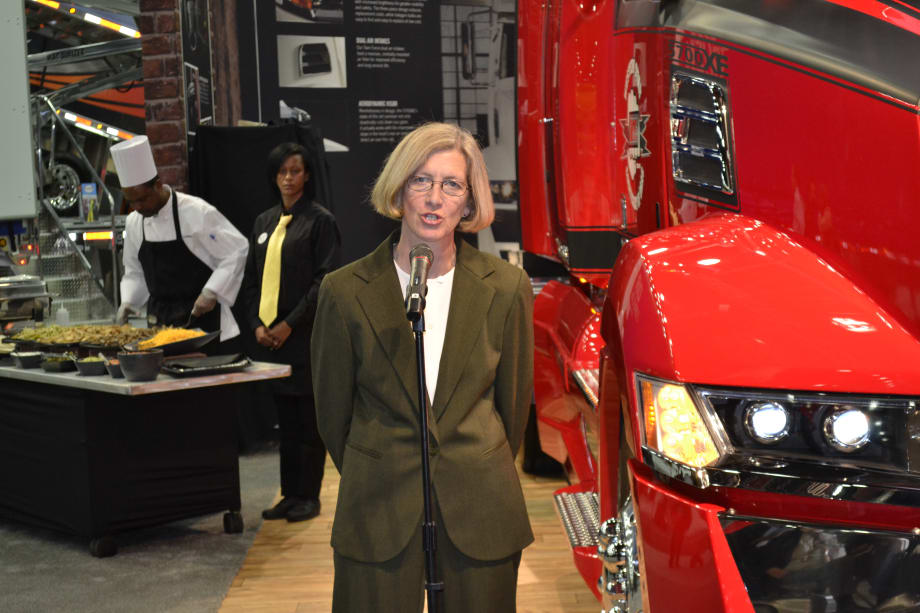
Kelley Platt speaks to the trucking press at the Mid-America Trucking Show in Louisville, Ky., in late March. Photo: Stephane Babcock
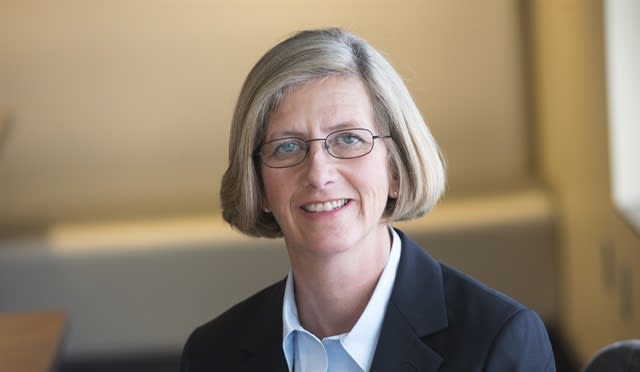
Kelley Platt now heads up Western Star Trucks .Photo: Daimler Trucks North America
Kelley Platt this year succeeded Michael Jackson as the general manager of Western Star, making her the first woman to head up a major truck brand, according to Daimler Trucks North America.
Platt most recently was president and CEO of Thomas Built Buses. She joined DTNA in 1989 as Freightliner manager of treasury services. We spoke with Platt after she'd been officially on the job for about six weeks.
HDT: You got into this business from the finance and economics side. Did you ever think you'd be the chief executive at a truck maker?
Platt: I have to admit that building trucks never ever crossed my mind, but it's really not probably any more out of the mainstream than when I wrote my thesis in graduate school on building submarines. I compared the two submarine manufacturers and their different styles of construction. So you might say I got into very different things early on in my career.
Q: You played a crucial role in the acquisition of both Thomas Built Buses, which you most recently headed up, as well as Western Star. Tell us a little about those acquisitions.
A: Back in the 1990s when we brought both of these companies into the Daimler fold, I was corporate treasurer and did a lot of the background and due diligence work on the various organizations we looked at. Really there was one basic principle Daimler was looking at: the size of truck market in North America and how to best approach that market. First they looked at medium duty and said school buses are about a third of that market so we probably need a school bus manufacturer. We were already building a chassis that was used for some school buses, so we found a good fit in terms of a body manufacturer, and that gives Daimler more access to the chassis market, as well.
Western Star had a very unique, premium segment of the market, a specific vocational segment. They were a large player in Canada, and it was kind of a natural fit because it didn't really overlap with much of what the current Daimler product line was. It was a chance to get into new markets without having to develop whole new product lines. So when we brought Western Star into the family in 2000, it was a nice addition to what Daimler products were already doing.
Kelley Platt speaks to the trucking press at the Mid-America Trucking Show in Louisville, Ky., in late March. Photo: Stephane Babcock
Q: How has the strategy for Western Star changed since the acquisition? How do you limit overlap with Freightliner products as that brand has increased its vocational presence?
A: Obviously over time you get a little overlap between brands, and people just choose to use one piece or the other depending on personal preference. We worked very hard to establish Western Star as a really premium brand in the marketplace. We are not the truck for everybody, but we are the truck for very specific applications and very specific owners. Our vocational products are unique. They're highly customizable, they are extremely rugged, they are very dependable and they have a very particular part to play. These are vehicles people are going to own and operate well for a long time, and they can depend on them in off road, off highway situations a long way from anywhere else.
Our on-highway products are really more of a premium product in the marketplace. Again, very strong, very sturdy, very dependable, but also with the kind of amenities that make you very proud to own them. A lot of our owners and drivers have a great deal of pride in their Western Star vehicles and what they look like and the image they provide.
Q: How would you say a Western Star customer differs from a Freightliner customer?
A: In general, a Western Star customer is going to own fewer vehicles and own those vehicles for a longer period of time. It's amazing how if you can get someone into a Western Star, you can never get them out of it. They are very attached to those vehicles.
Q: On the surface, customers who buy school buses and customers who buy Western Star trucks might not seem to have a lot in common. But are there actually some commonalities?
A: There actually are a surprising number of similarities between building school buses and custom highway vehicles. Most people don't know that not only are there federal regulations regarding school buses, but there are also state and district regulations determining the specifications of the vehicle. A school bus you build for Virginia you can't sell in Maryland. In much the same way but unique to each owner, Western Stars can be customized for a specific vocational application, or you can pick the amount and location of chrome trim, interior options … it really gives you a chance to make it your vehicle.
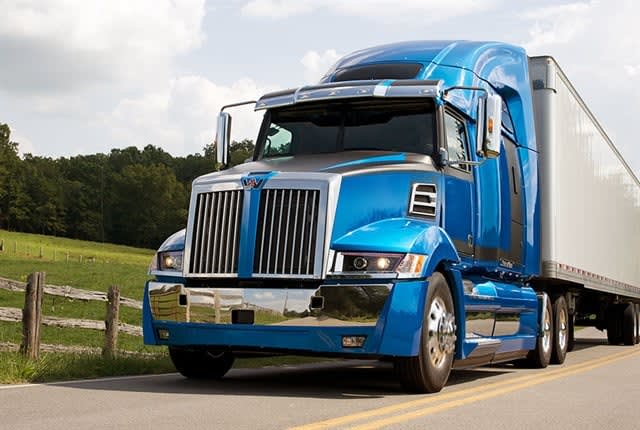
The new 5700XE has an 'edgy' look that's still aerodynamic, Platt says.Photo: Western Star
Q: At the Mid-America Trucking Show in March, Western Star showcased its first new model in a long time, the more fuel efficient 5700XE. What was the reaction at the show?
A: The response we've gotten to the 5700XE has been phenomenal. It is an on-highway product, so it's aerodynamic, but still very edgy. It's very customizable. You can put a lot of chrome on it. It has the Daimler powertrain and the way it's designed as a result it's very fuel efficient. This gives every driver the ability to have the latest technology in terms of fuel efficiency and yet still have a vehicle that is one of a kind.
Q: It seems people either love it or hate it, at least at first glance.
A: It is a very edgy look. It's got a lot of sharp lines to it, it obviously looks a little bit like its parent was Optimus prime from the Transformers, so it has some of that edginess and sharp lines, and yet a lot of those sharp lines are there for aerodynamics. They allow it to be a little more rugged looking and yet still maintain fantastic fuel economy.
Q: What have you been doing to transition to your new role?
A: The very first thing I did was get my commercial driver's license, because I think it's important that I understand what our customers are actually experiencing, both in our and competitive products. I spend a lot of time talking with customers, dealers, spending time in our manufacturing facilities, watching the vehicles go together and really trying to understand what makes a Western Star a Western Star.
Q: What are your priorities for your first year?
A: Western Star is growing very rapidly at this point, so I am very concerned to make sure that … we continue on that growth trajectory but at the same time we continue to provide quality vehicles and the responsiveness Western Star customers have come to depend on. We want to do this very smartly.
It's a very niche piece of the market, but we're out there to sell absolutely as many as we can. We think we'll see some small but measurable market share growth this year; obviously the overall market is growing as well. It's a challenge to see how many we can build and quite honestly I don't think there's a top end to it. We're not constrained from a manufacturing perspective, so we're going to sell absolutely as many of them as we can this year.
Q: Western Star trucks are known for their hand-built nature. Does that make it harder to ramp up production?
A: It's not easy, but we have experienced people from our Portland Truck Manufacturing Plant who are teaching the new folks at the Cleveland (North Carolina) plant who are learning to build Western Stars for the first time. We do have extra attention to detail and quality checks as we are ramping up to make sure the vehicles meet our specifications and our standards, and for launching the new 5700XE we have an independent process to make sure all of the vehicles that come off the assembly line really do meet our specifications.
Q: What do you hope to accomplish longer-term?
A: We want to see Western Star grow as a brand and as a solution for our customers for some of their more challenging transportation needs.
Q: What are the biggest challenges in the way of that goal?
A: It's always hard when you're the small guy. We're clearly the smallest player in the industry, and we have a long ways to go to make sure people know who we are, the value of what we sell, that they're willing to try to little guy and see what he new kid on the block has to offer.
Q: What are Western Star's biggest strengths?
A: : I think the biggest strength we've got is the quality of our vehicles. Because once people get in them and them, they're sold on them. And they very quickly become our advocates.
Q: Trucking is still a male-dominated industry. What message do you hope to communicate to other women?
A: I'm very excited about this opportunity, and I think that our environment, the whole transportation business is changing, so whether you're a transportation company looking for drivers, whether you're an OEM looking for people to help you design and build vehicles… if you have both male and female employees, I think it's a great opportunity for people to see this as a way to expand their horizons, for women to find very fun and challenging careers. And it's just a great time to be part of this industry. Truck transportation is obviously key to our economy in North America, and so it's a great time to be a part of that.
Q: How would you characterize your management style and why do you believe it's a good fit for Western Star?
A: I really like to be involved in what it is we do. And I like to understand from every perspective our product and what we're trying to do. So that's why it's important to me to drive our trucks, to spend time with the [people who] build and design them and most importantly with our dealers and customers. There's no better way to understand the need for a really rugged vehicle unless you've driven one on somebody's jobsite and see what they have to go through every day.
Q: What kind of reaction do you get from customers when you go out to their jobsite and get behind the wheel?
A: They are absolutely thrilled. A little surprised, but I have gotten very positive response from folks that say 'I've always wanted someone from the factory to come experience this with me.' Not all truck salesmen know how to drive trucks. They're very eager to show you what their concerns are and what happens to them.
Q: Sounds like fun!
A: It is fun. Who wouldn't want to play in a great big truck?
Q: What was it like getting your CDL?
A: It was a lot of work. I have a great deal of appreciation now for someone who drives a truck full time. I really was not aware of how much physical energy it takes to drive a truck all day. And it also makes you appreciate the benefits that automated transmissions are bringing to the trucking industry. I have a great deal of respect for truck drivers, and when I hear about truck drivers who are multi million safe drivers I'm really amazed, because it takes a lot of skill.
Q: What's something about Western Star that most people probably don't know but you'd like them to?
A: I think most people don’t realize that the brand has been around for 48 years and that we are actually a significant player in the Canadian truck market, much more so than we are in the U.S., and that there are a number of trucking companies and truckers who have never owned anything other than a Western Star.
More Equipment
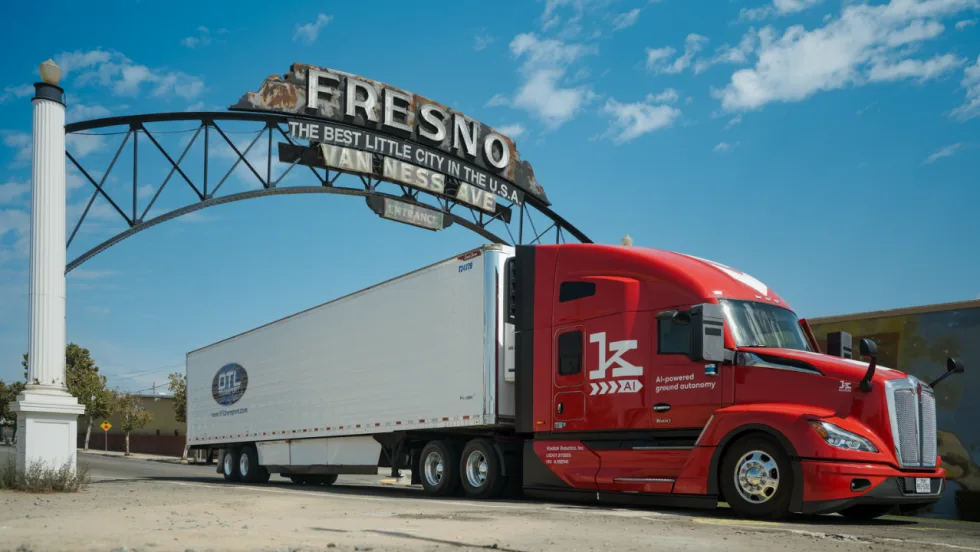
Kodiak Hauls Produce in California Autonomous Truck Pilot
Kodiak AI and DTL Transport have begun hauling produce between Fresno and Los Angeles under California’s new rules for testing heavy-duty autonomous trucks. A safety driver remains behind the wheel.
Read More →
Used-Truck Remarketing Math Is Changing
Used-truck value is no longer just a concern at trade-in. Decisions made throughout a truck’s first life can influence what it’s worth years later.
Read More →
How Volvo Updated Its D13 for EPA 2027 [Watch]
Volvo’s updated D13 promises lower emissions without sacrificing performance or fuel economy. Take a closer look at what changed inside the engine in this HDT Spotlight video.
Read More →
Michelin Tire Improves Efficiency and Durability for Regional Fleets
The Michelin X Multi Energy D2 is a regional haul drive tire engineered to help fleets improve fuel efficiency, durability and traction in demanding stop-and-go operations.
Read More →
ZF Expands Commercial Vehicle Push in North America
ZF is expanding its North American commercial-vehicle presence with new transmission applications, electrification, trailer technology and autonomous-driving systems.
Read More →
Tesla Wants a Self-Driving Semi. Are Cameras Enough?
Could Tesla’s camera-only autonomous driving technology work on an 80,000-pound Semi? In this commentary, HDT's Deborah Lockridge takes a look at Tesla, Cybercab, and how autonomous trucks see the road.
Read More →
Kodiak: Driverless Long-Haul Truck Launch on Track for 2026
Kodiak AI says its driverless long-haul safety case is 93% complete and it remains on track to begin commercial operations by year-end 2026.
Read More →
What DOT’s Automated Vehicle Strategy Means for Trucking
The U.S. Department of Transportation issued a new automated-vehicle strategy that outlines plans for driverless-truck regulations, cross-state freight corridors, and federal safety standards.
Read More →
East Coast Port Launches $45M Electric Truck Push
The Port Authority of New York and New Jersey announced millions in incentives for zero-emission drayage trucks, yard tractors, and new charging hubs near the port.
Read More →
PlusAI Going Public to Fund Autonomous Truck Launch
A SPAC deal could provide PlusAI with up to $300 million as it works toward a 2027 commercial launch of factory-built autonomous trucks.
Read More →