





Related: Why Not Propane?
Propane's Benefits Go Beyond Going Green
Autogas has been on trucking’s radar since long before alternative fuels were required, thanks to its various built-in advantages.
September 6, 2018
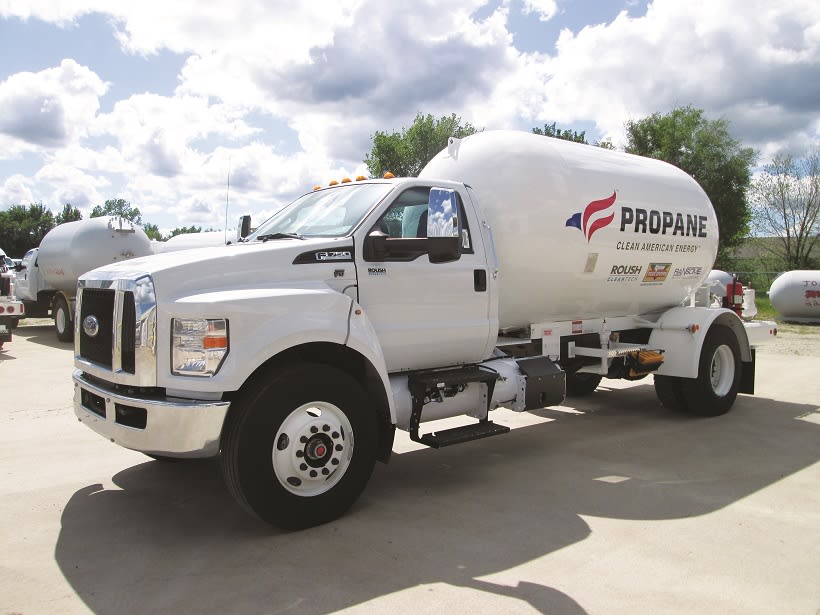
Propane, technically a type of liquefied petroleum gas, is increasingly being marketed as “autogas” when it’s used as a motor fuel. It’s regarded as a competitive fuel for light-, medium-, and even some heavy-duty operations.
Photos courtesy Roush CleanTech
5 min to read
In 1912, American chemist Walter O. Snelling discovered propane existed within gasoline as an evaporating gas that could be changed into liquid and stored at moderate pressure. Very soon after, marketers recognized that distinguished it as an easily transportable fuel.
The U.S. propane industry ramped up quickly during the 1920s, heating homes and finding its way into industrial applications. By 1950, propane-powered buses were appearing on city streets. By the 1960s, truck engines engineered to run on propane were becoming available.
So, it could be argued that propane is not so much an alternative truck fuel as it is the “other”— and long-available – fuel for trucks.
To be sure, though, it is propane’s green credentials that help explain its wider use by commercial fleets in recent years. It’s a low-carbon fuel that reduces greenhouse gas emissions by up to 25%, carbon monoxide emissions by up to 60%, and nitrogen oxide emissions by 20%, compared to gasoline.
Propane’s growth as a clean fuel was propelled largely by the Energy Policy Act of 1992 listing it as an alternative fuel. According to the Department of Energy, propane has a lower carbon content than gasoline and diesel fuel, and when used as a vehicle fuel, it offers life-cycle greenhouse emission reductions over conventional fuels, depending on vehicle type, age, and duty cycle.
Benefits beyond emissions
Nowadays, propane, which is technically a type of liquefied petroleum gas, is increasingly being marketed as “autogas” when it’s used as a motor fuel. By any moniker, it’s regarded as a competitive fuel for light-, medium-, and even some heavy-duty fleet operations.
Emissions aside, DOE points out that the “potential for lower maintenance costs is one reason behind propane’s popularity for use in light- and medium-duty vehicles, such as trucks and taxis, and for heavy-duty vehicles, such as school buses.” It also states that propane’s low carbon and low oil contamination characteristics may result in longer engine life, and that it performs well in cold weather climates because the fuel’s mixture (propane and air) is completely gaseous.
In addition, the agency says propane vehicles are similar to their gasoline counterparts with regard to power, acceleration, cruising speed, and driving range. Bi-fuel vehicles, which include a secondary fuel system and fuel supply, can provide greater range than dedicated propane or gasoline vehicles.
Propane is ideally suited for centrally fueled fleets or those that share refueling stations with other fleets, according to the Propane Education & Resource Center. PERC states that “autogas infrastructure beats conventional fuels and many alternative fuels” and that the fuel is “a non-contaminant of air, land, and water resources, reducing or even eliminating many EPA requirements for installing and maintaining diesel and gasoline infrastructure. For those who need to travel long distances, bi-fuel vehicles offer a gasoline backup to propane autogas.”
The council makes several other arguments for considering propane. Chief among these is that the cost of wholesale propane falls between the price of oil and natural gas, the fuel’s two sources, which means “propane is almost always less expensive than conventional fuels, even as fuel prices fluctuate.”
Also, compared to diesel engines, PERC contends that newer, lower-emissions diesel technology “comes with an added inconvenience: diesel emissions fluid to purchase, store, and change. This is on top of needing more oil by volume compared with propane. In cold temperatures, diesel vehicles also require anti-gelling agents to prevent clogging of fuel filters and lines.”
Thirdly, the council says that new diesel engines require diesel particulate filters that must be cleaned periodically, noting that excessive idling will accelerate cleaning intervals. “Either way, extra maintenance expenses are piled on top of additional lifecycle costs.”
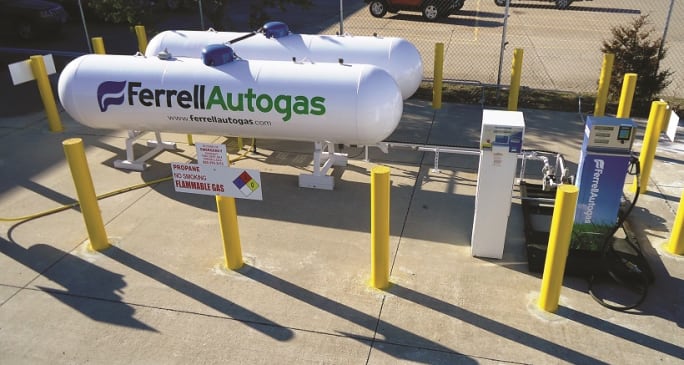
For on-site refueling, propane is transported to the site via a delivery truck and put into storage tanks, traditionally above ground. Propane is pumped into the vehicle under low pressure so it remains a liquid.
Moving into the mainstream
All of the above stated benefits support the view of Todd Mouw, president of Roush CleanTech, that “propane autogas is moving into the mainstream.” He says propane as a vehicle fuel is “absolutely seeing growth,” noting that the push toward Class 4 to 7 vehicles using autogas began in the school bus market, where range, torque and power output, and low-cost fueling are all requirements. Then interest moved to government and delivery truck fleets.
Aiming to further drive autogas growth, according to Mouw, Roush CleanTech recently became the first propane fuel system manufacturer to receive heavy-duty onboard diagnostics certification for all of its engines from both the Environmental Protection Agency and the California Air Resources Board. He says that until the 2018 model year, alternatively fueled vehicles had been exempt from this certification, but now they’re being held to the same requirements as gasoline vehicles.
“This HD-OBD certification applies to all vehicles over 14,000 GVWR,” Mouw explains. “The onboard monitors will now track and report out the continuing compliance of the emissions performance of a vehicle, as they have since 2016 for gas vehicles.”
All the company’s autogas-fueled vehicles using Ford 6.8L 2V and 3V engines, including for medium-duty fleet vehicles, are covered under the CARB HD-OBD certification. He also says that the 3V engine is the first and only propane autogas engine available in Class 4 to 7 vehicles certified to the optional low nitrogen oxide level of 0.05 g/bhp-hr.
Mouw says he has seen interest in propane accelerate over the past six to nine months in line with the uptick in both diesel and gasoline prices. He says the range of savings will vary by operation, “but it can run from 10 to 15 cents per mile; it really depends on the application vs. the cost of diesel.”
And when factoring propane costs vs. diesel or gasoline, keep in mind that many states continue to offer incentives to help fleets save on the upfront purchase of propane vehicles.
Also in the wind are the billions of dollars set aside by Volkswagen’s settlement with the federal government on emissions fraud charges.
The $2.7 billion Environmental Mitigation Trust is being allocated to states to incentivize fleets to swap older diesel vehicles with new, low-emissions vehicles. Fleets may want to contact state energy offices or their local Clean Cities coalition to see if their operations might qualify for any programs funded by the trust’s funds.
Subscribe to Our Newsletter
More Fuel Smarts

Cummins Adjusts 2027 Engine Rollout After EPA Proposal
The engine maker will gradually introduce its new Model Year 2027 diesel engines while continuing to offer current models during the transition, citing the EPA's proposed emissions rule changes.
Read More →
EPA Proposal Could Ease 2027 Truck Costs and Buying Uncertainty
The proposal doesn't change the tougher NOx standard, but it would revise key implementation requirements that manufacturers say have driven up costs and complicated fleet purchasing decisions.
Read More →
Cummins, Paccar Ease DEF Derates After EPA Guidance
Updated diesel engine software gives truck operators more time to address emissions-system issues while staying compliant with EPA emissions standards.
Read More →
Maintenance in the Messy Middle Part 3: Biodiesel
Biodiesel can reduce emissions, improve fuel-system lubricity and use existing diesel infrastructure. But NACFE’s Messy Middle maintenance report says fleets must actively manage storage, cold-weather operation, filters and oil drain intervals to avoid problems.
Read More →
Enhance Fleet Performance with High-Efficiency Auxiliary Power Units
Drive sustainable cost savings while increasing driver comfort during short- and long-haul logistics operations.
Read More →
Maintenance in the ‘Messy Middle’ Part 2: Renewable Diesel Fuel
NACFE's latest Messy Middle Powertrain Service & Maintenance report says renewable diesel gives fleets an opportunity to reduce carbon emissions without changing trucks, fueling infrastructure or maintenance practices. But technicians still need to understand several important operational differences.
Read More →
The Diesel Engine Enters NACFE’s ‘Messy Middle’
NACFE’s new Messy Middle Powertrain Service & Maintenance report says keeping modern diesel engines running now depends as much on software, diagnostics and data as traditional mechanical service.
Read More →
DTNA Software Update Gives Truckers More Time Before DEF Derates Take Effect
The changes reflect EPA guidance aimed at reducing downtime caused by emissions-system faults while maintaining compliance requirements.
Read More →
New Agentic Predictive Maintenance Report Demonstrates How Degraded Aftertreatment Systems Waste Fuel
Questar analyzed a large mixed-class fleet and discovered it was wasting as much as $30 in fuel per vehicle, per day, because of mechanically degraded aftertreatment systems.
Read More →
New York City's Microhub Project is Delivering Results
Trucking, last-mile delivery companies, and environmental advocates like what they are seeing so far with New York's microhub program.
Read More →