




PowerFleet's Chris Wolfe on Changing the Way Fleets Manage Assets, Cargo
Last year, I.D. Systems changed its name to PowerFleet, as two acquisitions broadened its scope and scale. We spoke with CEO Chris Wolfe about how the company has gone far beyond its trailer-tracking roots.

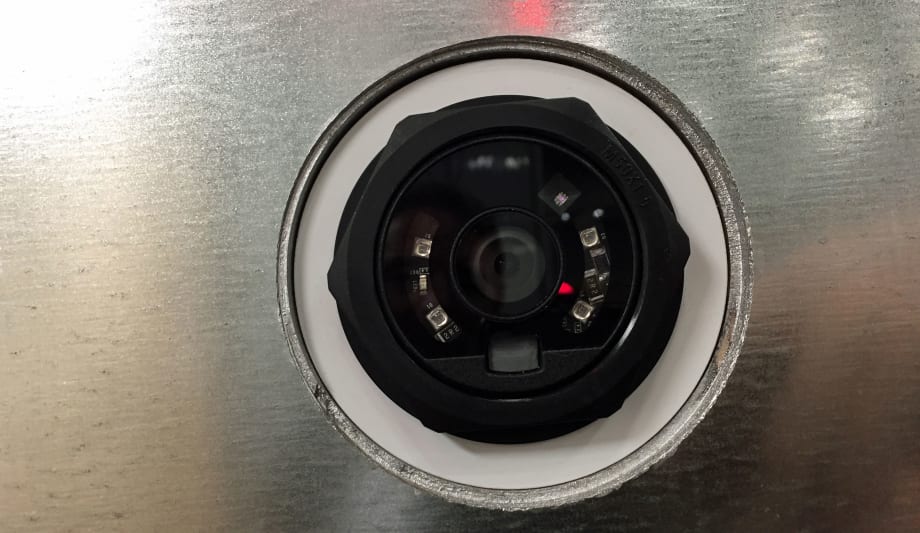
PowerFleet's cargo sensor is just one part of its logistics and Internet of Things offerings.
Photo: Deborah Lockridge
Last year, I.D. Systems changed its name to PowerFleet, as two acquisitions broadened its scope and scale. We spoke with CEO Chris Wolfe about how the company has gone far beyond its trailer-tracking roots.
I.D. Systems has been around for a while; back in 2005, we ran a brief item noting that I.D. Systems’ wireless trailer-tracking technology would be used by the U.S. Postal Service. Last year, we honored the company with a Top 20 Products award for its new LV Series camera-based sensor and asset-tracking suite.
About a year ago, I.D. Systems bought CarrierWeb, a provider of real-time in-cab mobile communications technology, electronic logging devices, two-way refrigerated command and control, and trailer tracking. The move allowed I.D. Systems to offer a complete, fully integrated logistics technology offering, the company said.
It followed up the CarrierWeb acquisition by buying Pointer Telocation Ltd., saying the move positioned the company as a provider of wireless Internet of Things (IoT) and Machine to Machine (M2M) technology for the logistics, industrial vehicle, and fleet management markets.
Its offerings now are grouped under PowerFleet for Logistics, PowerFleet for Industrial, and PowerFleet for Vehicles.

PowerFleet CEO Chris Wolfe
Photo: PowerFleet
We sat down last fall with Wolfe to talk about the changes. Wolfe was with Qualcomm for 12 years, including serving as president of Qualcomm Wireless Business Solutions, and before that he held senior technology management positions at Roadway and Leaseway Transportation (now Penske Logistics). So he’s no stranger to the industry. Following are some edited highlights from that interview.
HDT: Tell me about the Pointer acquisition.
Wolfe: We’ve been working with Pointer for three years. Size does matter. Scale matters. You can spread your costs over more customers and bring in more revenue. We have customers we never have had before.
Pointer has typically focused on the smaller vehicles. One of our larger customers, one of the largest retailers in the world, has our products on 30,000 trailers. They have 6,000 Class 5 and below – delivery trucks for home delivery of groceries, service trucks – and that’s what Pointer does is fleet management in that areas.
Now I can go into these large customers, like a railroad we’re talking to about doing refrigerated cars, and they have 8,000 vehicles, pickup trucks, service vehicles.
One thing they gave us, too, is not only financial scale but also market scale. We were in the U.S. primarily and Europe; Pointer runs operations in South Africa, Brazil, Israel, and Mexico, so it’s given us an opportunity to take our products and go global.
They were already working with Microsoft on predictive accidents. Our sensor now can tell you conditions, temperature, humidity about the weather; you add to that the location, which might be prone to accidents, and add driver behavior — you can predict [which drivers are most likely to be involved in accidents]. They’ve actually proven that out through their analytics program, so we’re looking at commercializing that, integrating that into trucking software.
HDT: What about the new name?
Wolfe: We had the [PowerFleet] name on some of our products, so we had the name and the rights. I’m a firm believer in the name tells people what we do. Our vision is simple. We’re not doing this just for one customer. It has to be something we can take broader. It can be industry changing if you can focus your employees, your customers, and the market on exactly what you do.
What we do is we can take our technologies and help you with any fleet. Avis Budget Group is a big customer, and they offer fleet management services to [companies] like Microsoft. Now I have a whole suite of fleet management products you can white label and take to your customer.
HDT: You say any fleet; sounds like trailer tracking’s just the tip of the iceberg.
Wolfe: Industrial trucks [forklifts etc.] are the second leading cause of death and maiming. The U.S. Postal Service in one year had 21 major accidents. Sometimes people hit something and just keep going. Just Google forklift accident and look at the videos. In one video it clips one of the racks and it’s like dominoes.
When they put our technology on, we make sure you’re a certified driver, we can govern how fast you can drive, and when the forks are up, and also an impact sensor. If you get in a major or severe impact it’ll slow the vehicle, and notify supervisor, maintenance, etc., and set off an alarm on the vehicle. Ultimately drivers learn to drive better because they know they’re being monitored.
One thing we do on the industrial truck side, forklifts in Toyota and GM and Ford plants, at P&G, Nestle, they all have Bluetooth tech and communicate – from bin to tines to trailer to tines to shelf and connect that dot.
HDT: So we’re not talking just about technology as it pertains to trucks on the road, but about warehousing and logistics as well.
Wolfe: [Editor’s note: The LV-710 combines a high-definition camera, image recognition processor, door sensor, and cargo-area’ environmental sensors.] If there’s a shift in transit because it wasn’t loaded correctly, whose fault is it? When you open the door, close the door, when there’s an event in transit, we take a photo.
You take that data back, and if you’re a logistics expert, you can see the image of the trailers coming inbound, and you can know who you need on the dock, if you need forklifts, if you need someone certified on a particular attachment, or if it’s going to take extra manual labor. [Without this technology, it’s often] like a box of chocolates – you never know what you’re going to get.
Think about inbound planning, about extra utilization of capacity. We’re working with a couple of less-than-truckload carriers, they want to cube out, now we can show them it’s not cubed out. We’ve had this testing at some customers, and initially they thought they didn’t need the images, but as soon as they see the images, it’s like, “Wow.”
More Fleet Management

Color Match Smarter: Tools That Restore & Perform
For fleet managers and collision repair professionals keeping heavy-duty trucks on the road, getting the color right the first time isn't just about appearance — it's about efficiency, turnaround time, and bottom-line results. Discover how today's digital color tools are transforming the repair process from guesswork to precision.
Read More →
FMCSA Pauses Biennial-Update Enforcement Amid Motus Transition
Carriers whose updates were due on or after June 1 have more time, while FMCSA works to stabilize its new registration system and warns of phishing sites impersonating its new carrier registration system, Motus.
Read More →
2026 Blueprint for Countering Smarter Supply Chain Theft
Cargo theft is no longer just the cost of doing business. It's a multi-billion-dollar criminal enterprise exploiting vulnerabilities across your fleet, drivers, and supply chain.
Read More →


How Telematics Improves Visibility, Control, and Performance in Refrigerated Fleets
Explore how telematics help refrigerated fleets improve visibility, uptime, efficiency, compliance, and cargo protection across connected cold chain operations.
Read More →
What the U.S.-Canada Trade War Means for Trucking
Escalating U.S.-Canada tariffs could disrupt cross-border freight, reduce truck volumes, raise costs, and create new uncertainty for carriers on both sides of the border.
Read More →
What Are Trucking’s Top Concerns for 2026?
The American Transportation Research Institute wants to know what's worrying trucking fleet managers, drivers, and other stakeholders in its annual Industry Issues survey.
Read More →
American Trucking Associations Looks for a New Leader
ATA President and CEO Chris Spear abruptly left his job at the association on August 21, at a pivotal time for the trucking industry.
Read More →
Public Wi-Fi Cybersecurity Risks: How Truck Drivers and Fleets Can Protect Their Data
Public Wi-Fi can expose truck drivers and fleets to credential theft, malware, and other cyber threats. Here’s how to reduce the risk on the road.
Read More →
For Nicky Cupp, Fleet Innovation Starts With Frustration
HDT Truck Fleet Innovator Nicky Cupp turns everyday pain points at Fraley & Schilling into opportunities for better technology and smarter processes.
Read More →
Adam Buttgenbach’s Approach to Electric Trucks: Start With Where They Fit
HDT Truck Fleet Innovator Adam Buttgenbach helped PepsiCo build one of North America’s largest EV fleets by focusing on where electric trucks make operational sense.
Read More →