




Pick It Up and Run With It: Intermodal 'Trailer' Comes to U.S.
Lars Frantzich refers to his container carriers as "machines," not trailers. This gives a hint of the capability and versatility of the Hammar Lift self-loading container-hauling trailer, new to the U.S. market
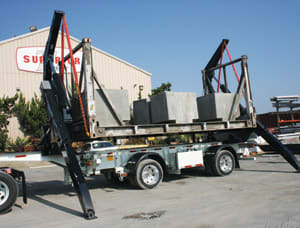
Lifting the demonstration load from the deck of the
Lars Frantzich refers to his container carriers as "machines," not trailers. This gives a hint of the capability and versatility of the Hammar Lift self-loading container-hauling trailer, new to the U.S. market.
Frantzich heads up the fledgling North American operation of the 35-year-old Swedish company. He's been in place here since 2006 starting up a manufacturing operation and getting the word out of the benefits of the side-loading, self-loading trailer that is used extensively in Europe, Australia and New Zealand, South Africa, Malaysia and many island nations where imports come in containers yet there are few destinations with loading docks. Containers have to be lowered to the ground to be unloaded.
The reception he's getting from American operators proves he has an education task ahead of him. Few in this country see the benefits of an admittedly expensive trailer that can lift a loaded container on to - and off - its back in about three and a half minutes.
However, the first adopters of these Hammar Lift trailers have realized some specific benefits in niche operations. Frantzich cites haulers of skid-mounted temporary housing, generator sets and, of course, the military, all of whom are better served by transporting the skid-mounted equipment to a site, then lowering it to the ground. Frantzich says if it has the lifting castings at the bottom corners, it can be hauled and then unloaded without having to use an expensive-by-the-hour crane service.
Experience in other markets shows that even a container hauler can benefit, he says, especially if he can drop a container at one customer, then pick up another from a second for a paying backhaul. It doesn't matter if the second is a loaded container; the lifting cranes mounted to the chassis can pick up 33 or 36 tonne (72,750/80,000 pounds) - as much as any domestic carrier, American or Canadian, would need.
Configurations and options
The gooseneck chassis is configured to handle one 20-foot, two 20-foot, one 40-foot or one 45-foot ISO containers. It can also be configured to handle 48-foot domestic containers, but the need to have the cranes at either end of the container rules out 53-foot boxes.
The trailers are available with a host of configurations and options, from extending frames to accommodate the different sizes of containers, to sliding cranes to most advantageously lift the boxes directly on to the trailers twist locks, to the ability to stack containers two-high. It's all done with a remote-cable controller - or better yet, a wireless control box - that features two toggles to control crane positioning and lifting.
Calling the trailers "machines" seems highly appropriate when you see one in action, which you can do online at www.hammarlift.com/mov.php.
The machine in action
At a fascinating demonstration at the company's production facility (Hammar shares space and tooling at Superior Trailer in Fontana, Calif.), Production Manager Art Hernandez put the machine through its paces.
The first step in picking up a demonstration load of concrete block on a 20-foot container skid was to fire up the power unit - a 100-horsepower VM Motori diesel located in a purpose-built box on the right-side frame within the spread tandem. (VM Motori is a wholly owned subsidiary of Detroit Diesel located in Italy).
The frame was contracted down to the 20-foot setting hydraulically, at which point air-operated pins locked the frame in position. The cranes were positioned at their designated points via the computerized controller. Next the ground-engaging support legs deployed. These have pads at the foot that load the contact area no more than the corners of a loaded container do. Once they are set, the arms lift and swing out hydraulically, again controlled by the computer to give the correct arc to lift or lower the container, clearing the trailer but keeping the box in close.
Since this was a lift, Hernandez swung the chains with their special lifting lugs into position where they lock into the container's lower corner lifting points. The cranes were activated to tension the chains correctly at each end of the container and then the lift was completed smoothly on to the trailer twist locks. The hand controller allows for the operator to compensate for uneven ground conditions, and variable height for the trailer air suspension can also simplify the lift and placing of the box precisely on the twist locks.
The lift is even, enabled by a double-flow hydraulic pump that has been proven over the years by Hammar in Sweden. As an alternative, a tractor can be outfitted with a double-flow wet kit to save the cost and weight of the auxiliary diesel on the trailer.
The "machine" fairly bristles with fascinating options, like the position sensor that allows the driver to position the trailer at exactly the right place to lift. Another is the digital display in the controller box that shows the weight of the container as it is lifted - in this case it was 38,800 pounds.
The trailers themselves are surprisingly light, given the cranes weigh in at around 5,000 pounds to 17,000 pounds according to how it is optioned out. U.S. trailers are generally spread tandems (with lift) to allow for 40,000 pounds; Canadian trailers have a tri-axle setup.
Versatility could mean more loads
Frantzich says many container hauling operators say they don't need a $140,000 trailer when they may be able to haul and drop a container on the ground using a roll-back type of loader. But these need 100 feet of clear space to unload, and they can't pick up a loaded box. Frantzich points out that these operators are turning away business that they could otherwise accommodate. He also says that in other markets, these units are used very successfully in recovering containers where a truck has run off the road, for instance. The alternative is a heavy turntable wrecker, which will often cost upwards of $2,500 for a single call-out.
The Hammar Lift side-loader is certainly not for every container hauler, but there are a few niche operators who are already seeing the benefits of the added versatility in addition to being able to haul containers loaded by conventional cranes at ports and rail terminals.
And these Hammar Lift trailers have a long life. How long? Frantzich says Hammar Lift number one is still working after 30 years as a loaner for customers waiting on a new "machine" on order.
From the January 2010 issue of Heavy Duty Trucking.
More Equipment

How Volvo Updated Its D13 for EPA 2027 [Watch]
Volvo’s updated D13 promises lower emissions without sacrificing performance or fuel economy. Take a closer look at what changed inside the engine in this HDT Spotlight video.
Read More →
Michelin Tire Improves Efficiency and Durability for Regional Fleets
The Michelin X Multi Energy D2 is a regional haul drive tire engineered to help fleets improve fuel efficiency, durability and traction in demanding stop-and-go operations.
Read More →
ZF Expands Commercial Vehicle Push in North America
ZF is expanding its North American commercial-vehicle presence with new transmission applications, electrification, trailer technology and autonomous-driving systems.
Read More →
Tesla Wants a Self-Driving Semi. Are Cameras Enough?
Could Tesla’s camera-only autonomous driving technology work on an 80,000-pound Semi? In this commentary, HDT's Deborah Lockridge takes a look at Tesla, Cybercab, and how autonomous trucks see the road.
Read More →
Kodiak: Driverless Long-Haul Truck Launch on Track for 2026
Kodiak AI says its driverless long-haul safety case is 93% complete and it remains on track to begin commercial operations by year-end 2026.
Read More →
What DOT’s Automated Vehicle Strategy Means for Trucking
The U.S. Department of Transportation issued a new automated-vehicle strategy that outlines plans for driverless-truck regulations, cross-state freight corridors, and federal safety standards.
Read More →
East Coast Port Launches $45M Electric Truck Push
The Port Authority of New York and New Jersey announced millions in incentives for zero-emission drayage trucks, yard tractors, and new charging hubs near the port.
Read More →
PlusAI Going Public to Fund Autonomous Truck Launch
A SPAC deal could provide PlusAI with up to $300 million as it works toward a 2027 commercial launch of factory-built autonomous trucks.
Read More →
NHTSA Moves to Rewrite Truck Fuel-Economy Rules
The National Highway Traffic Safety Administration says it lacks authority to regulate medium- and heavy-duty truck engines separately from complete vehicles, but the existing standards have not yet been eliminated.
Read More →
Detroit Opens Orders for EPA 2027 Engines
Detroit isn’t starting from scratch to meet EPA 2027 diesel emissions standards. Its Gen 6 DD13 and DD15 engines keep much of today’s platform while updating the fuel and aftertreatment systems.
Read More →