





“I’m seeing law enforcement not knowledgeable on ELDs."
Oilfield Company No Renegade When it Comes to ELDs
Todd Caughey was a state trooper for 25 years who retired and took on a new career as HSE/DOT Compliance Supervisor for Renegade Wire Line Services. The company put in electronic logs back in 2014, so he has an unusual perspective on enforcement of the electronic logging device mandate.
October 12, 2017
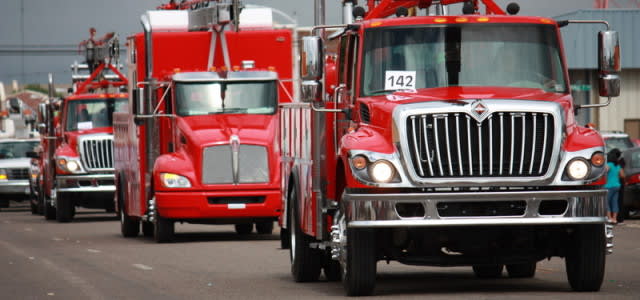
Renegade Wire Line Services has been running on J.J. Keller ELogs for more than three years. Photo: Renegade Wire Line Services
4 min to read
Todd Caughey was a state trooper for 25 years who retired and took on a new career as HSE/DOT Compliance Supervisor for Renegade Wire Line Services. The company put in electronic logs back in 2014, so he has an unusual perspective on how enforcement will go when the electronic logging device mandate kicks in come Dec. 18.
RWLS, which stands for Renegade Wire Line Services, is a Texas-based fleet serving the gas and oil field industry in Texas and other states. “I knew what ELDs would do for us,” says Todd Caughey, a retired state trooper who’s heading up safety and compliance for the company, “and ownership wanted to go this direction before it became mandatory.”
The company initially rolled out e-logs in two of its 12 districts, then added districts. Today it has ELDs in all 300 units, everything from big tandem-axle heavy-duty wire line straight trucks to pickup trucks with trailers.
Caughey chose J.J. Keller’s Encompass with ELogs. He was familiar with Keller from his time in enforcement, and liked the ability to use existing tablets or cell phones. “Most everyone today has a smartphone, so I didn’t have to make an additional investment.”
However, he says, those smartphones have caused problems with enforcement officials who erroneously believed cell phone e-logs were not allowed. “They’re not realizing their connected to an ELD [engine connection hardware] via Bluetooth,” Caughey says. When that happens, he explains, the regulation says the company has 48 hours to provide the logs at the trooper’s request. So he prints them out in the office and emails them to the enforcement official.
“I’m seeing law enforcement not knowledgeable on ELDs,” he says – even some people in the Federal Motor Carrier Safety Administration itself. “But if we receive a violation on an ELD that is not correct, on my DataQ challenges, I’ve won every one of them.”
RWLS operates under oil field hours of service exemptions, and some operations are running under Texas intrastate HOS regs. The Keller ELDs make it easy for operators to choose which regulations they’re operating under and automatically logs under the appropriate rules.
Like many fleets, “form and error” logbook violations were hurting RWLS’ CSA scores. This type of error has been eliminated, Caughey says.
Instead of trying to interpret grids and do math calculations, he says, drivers can see at a glance where they are on their 14-hour clock, their 70-hour clock, their required rest break status, and get alerts that they’re getting near the end of their available hours.
He’s even more excited about how things work in the back office. “Oh my gosh, everything comes in to us,” he says. “Not only do their logs come in; I can pull the driver and it’ll list all his violations. Also on this ELD you’re able to submit your DVIRs electronically into the office.” Encompass also handles driver qualification files, tax reporting, tracks vehicle registrations and inspections, etc.
RWLS has one or two administrators per district assigned to handle driver edits in accordance with the harassment and coercion provisions of the ELD mandate. A common problem is that there may not be cellular service in the oil fields when drivers log on-duty/not driving. “We document word for word what our drivers say” when making annotations, Caughey says. “They get paid off their logs, so they’re making sure their logs are accurate.”
When asked about what advice he would have for other fleets, Caughey says, “You want to be able to purchase or go with an ELD or company that is very user friendly.”
For companies that have not yet made the transition, he says, having a company that will help you through that is even more important. “It takes some time” to switch over to ELDs, he says. “It was several months of some hurdles, but our violations have decreased dramatically.”
He also emphasized the need to provide good training to drivers. Make sure they have “the ability to articulate [to officials] at a roadside inspection how to navigate through the tablet or the phone to provide them with that day’s logs and the previous seven days. My other piece of advice would be, if you encounter roadside inspectors that don’t have the knowledge, the roadside isn’t the time to argue about it.”
Better brush up on those DataQ challenge skills.
Subscribe to Our Newsletter
More Fleet Management

Sponsored•September 16, 2026
Color Match Smarter: Tools That Restore & Perform
For fleet managers and collision repair professionals keeping heavy-duty trucks on the road, getting the color right the first time isn't just about appearance — it's about efficiency, turnaround time, and bottom-line results. Discover how today's digital color tools are transforming the repair process from guesswork to precision.
Read More →
FMCSA Pauses Biennial-Update Enforcement Amid Motus Transition
Carriers whose updates were due on or after June 1 have more time, while FMCSA works to stabilize its new registration system and warns of phishing sites impersonating its new carrier registration system, Motus.
Read More →
Sponsored•September 14, 2026
2026 Blueprint for Countering Smarter Supply Chain Theft
Cargo theft is no longer just the cost of doing business. It's a multi-billion-dollar criminal enterprise exploiting vulnerabilities across your fleet, drivers, and supply chain.
Read More →


Sponsored•September 1, 2026
How Telematics Improves Visibility, Control, and Performance in Refrigerated Fleets
Explore how telematics help refrigerated fleets improve visibility, uptime, efficiency, compliance, and cargo protection across connected cold chain operations.
Read More →
What the U.S.-Canada Trade War Means for Trucking
Escalating U.S.-Canada tariffs could disrupt cross-border freight, reduce truck volumes, raise costs, and create new uncertainty for carriers on both sides of the border.
Read More →
What Are Trucking’s Top Concerns for 2026?
The American Transportation Research Institute wants to know what's worrying trucking fleet managers, drivers, and other stakeholders in its annual Industry Issues survey.
Read More →
American Trucking Associations Looks for a New Leader
ATA President and CEO Chris Spear abruptly left his job at the association on August 21, at a pivotal time for the trucking industry.
Read More →
Public Wi-Fi Cybersecurity Risks: How Truck Drivers and Fleets Can Protect Their Data
Public Wi-Fi can expose truck drivers and fleets to credential theft, malware, and other cyber threats. Here’s how to reduce the risk on the road.
Read More →
For Nicky Cupp, Fleet Innovation Starts With Frustration
HDT Truck Fleet Innovator Nicky Cupp turns everyday pain points at Fraley & Schilling into opportunities for better technology and smarter processes.
Read More →
Adam Buttgenbach’s Approach to Electric Trucks: Start With Where They Fit
HDT Truck Fleet Innovator Adam Buttgenbach helped PepsiCo build one of North America’s largest EV fleets by focusing on where electric trucks make operational sense.
Read More →