





Related: Nikola Vehicles to Replace Cat Trucks for Thompson Machinery
Nikola One: Disruptive Technology?
If its hydrogen fuel cell-electric powertrain proves workable and reliable, it could replace traditional diesel trucks
January 17, 2017
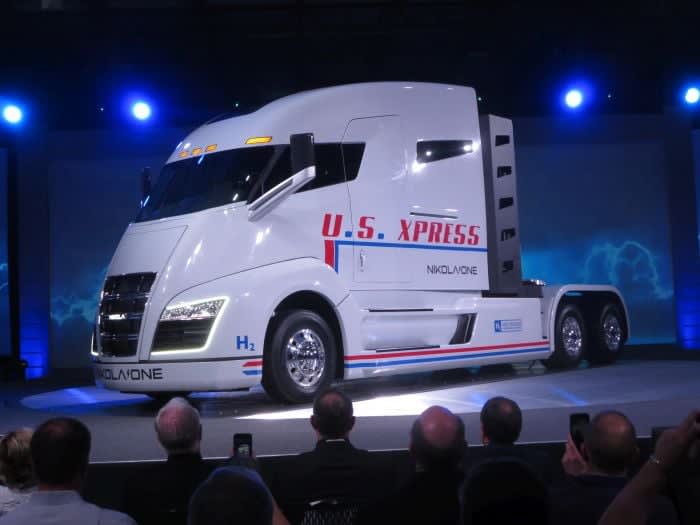
The Nikola One sleeper-cab prototype unveiled in early December in Salt Lake City looks like no other. It’s lettered for U.S. Xpress, whose Chairman and CEO Max Fuller believes Nikola One will be “a game changer.”
Photo: Tom Berg
6 min to read
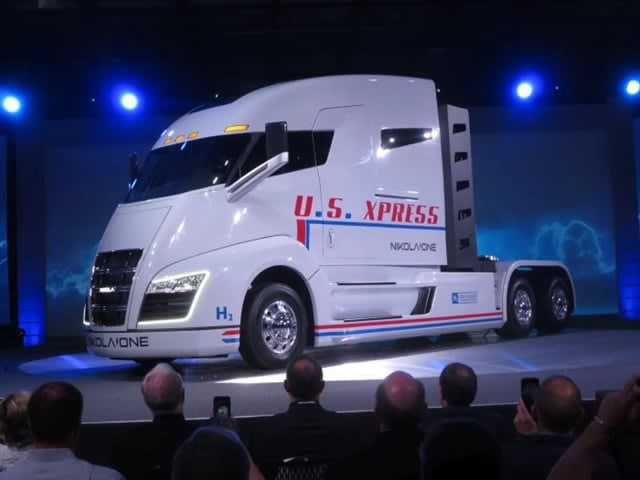
The Nikola One sleeper-cab prototype unveiled in early December in Salt Lake City looks like no other. It’s lettered for U.S. Xpress, whose Chairman and CEO Max Fuller believes Nikola One will be “a game changer.”
Photo: Tom Berg
Trevor Milton has an ambitious plan to change North America’s trucks from diesel power to electric propulsion with hydrogen fuel cells and high-density lithium-ion batteries. If he’s successful, the H2-LI electric powertrain will be a “game changer” and “disruptive technology,” as two trucking executives called it. If not, this project will be another failure involving the hydrogen fuel that’s supposed to revolutionize the automotive world.
Milton, the CEO of Nikola Motor Co., unveiled his Nikola One over-the-road tractor in early December at the firm’s Salt Lake City base. Milton told an audience of several hundred, and many more tuned into a webcast of the event, that the truck will be in production by 2020, with further development, testing, and certification work taking place between now and then.
For months as Nikola’s well-orchestrated publicity teased the new electric truck, observers wondered whether the truck and the project itself were the real thing. The vehicle on the stage was very real, but it never turned a wheel during the presentation or a three-hour technical briefing the following day.
It remains to be seen whether Nikola One will ever freight, but the presence of industry giants like Ryder System, Meritor, and U.S. Xpress lent credibility to the project. Nikola claims to have deep-pocket investors, plus over $4 billion in order reservations for the truck, which may see it through to production and sales success.
Early in his presentation, Milton paid tribute to diesel-powered trucks that have reliably and efficiently hauled cargo for so many years. But he said that diesel trucks, no matter how efficient, will always produce exhaust emissions of some sort, while a true hydrogen-powered vehicle’s only emission is water.
Nikola’s chief engineer, Kevin Lynk, said the project started using a conventional chassis fitted with electric motors rather than a traditional diesel engine and drivetrain.
“We quickly realized that it wasn’t all going to fit,” he told the crowd during a briefing the day after the unveiling. “There was no place to put the batteries and other components. We were going, ‘this will have to move, that has to go, those axles aren’t going to work.’ We eventually scrapped it all and started work designing a whole new chassis right from the ground up. This whole vehicle is designed around the powertrain.”
The basics
The Nikola One uses a fully electric, 320-kilowatt drivetrain powered by high-density lithium-ion batteries. Motors run through 2-speed gearboxes. Energy for the batteries is supplied by a proton-exchange membrane (PEM) hydrogen fuel cell, giving the truck a range of 1,200 miles while delivering up to 1,000 hp and 2,000 lb-ft of torque to the drive wheels.
“Can you imagine pulling a 6% grade with 80,000 pounds at 65 mph?” Milton said. “You can do that with a Nikola One.” However, output will be modulated and limited according to real needs, conserving energy and tire tread life, because under a lease (which is how the trucks will be sold), “the tires will be ours and we don’t want to burn them up.”
Regenerative braking will supply added energy and do 85% of the stopping work, leaving quick-acting air disc brakes to do the rest. With an easy time of it, the disc brakes will have double or triple the life we see today, Milton said. A Nikola One will weigh about 17,000 pounds, some 2,000 pounds less than a similar diesel sleeper-cab tractor, because the heavy engine, gearboxes, axles and fuel tanks are absent.
The truck also will have Meritor fully independent suspensions, low-profile units with two air bags at each wheel position. They’re based upon Meritor’s ProTec line of suspensions now on airport rescue trucks, military tactical wheeled vehicles, and armored personnel carriers. Ride and handling is remarkable, said Dave Damian of Meritor Defense. They’re too expensive for commercial trucking, but “the architecture makes perfect sense in the Nikola application, and the cost-benefit is tremendous when combined with the electric drive system.”
Milton said Nikola One will be very stable, thanks to a stiff frame and a very low center of gravity. “All the batteries are located in between the frame rails,” he said. “That keeps that great bulk of weight very close to the ground.” The prototype has one door, but production versions will have two, one on each side of the cab. Many things on the prototype that guests found unworkable, like an excessively high fifth wheel and rear-frame stance, will be changed for production models, Milton said. He also has plans for a daycab version dubbed Nikola Two.
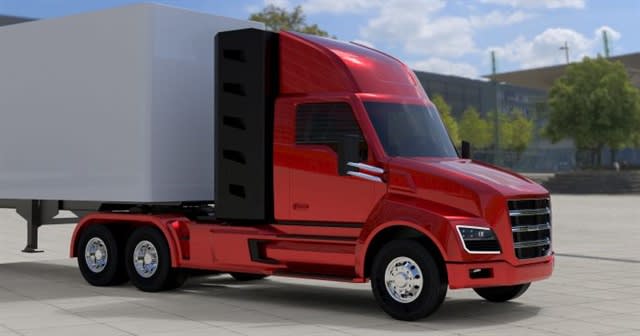
Nikola Two daycab uses the same innovative powertrain and chassis but looks much like a standard conventional-cab tractor. It may be first into production in a few years.Photo: Nikola Motor Co.
H2: Power, production, distribution
A kilogram (2.2 pounds) of hydrogen contains 33.3 kilowatt-hours (kw-h) of energy, engineers explain. When converted to electricity by the 70%-efficient PEM fuel cell, H2 produces 23.3 usable kw-h per kilo. With 100 kilos of H2 on board, at a usage rate of 0.58 mile per kw-h, the truck will go a calculated 1,351 miles. That works out to 15.4 miles per diesel-gallon equivalent, or “more than double the fuel efficiency of today’s diesel powertrains,” Milton said.
Nikola might erect a 100-megawatt solar farm to produce electricity for conversion of water to H2 through electrolysis. Other possible methods include steam reform or gas separation. Fuel for Nikolas will be liquefied and transported in cryogenic tankers to fueling stations; there it will be gasified at 5,000 psi for transfer to Nikola trucks’ storage tanks. Plans call for 364 stations in the U.S. and Canada, with construction to begin in 2019. The pumps will be open to the public for filling hydrogen-fueled cars. Hydrogen fuel will be included in a lease program, pegged at $5,000 to $7,000 per month. So there will be no fuel bills and no need for customers to hedge their bets – and their rates – on fuel prices.
Initial truck production will be done by Fitzgerald Gliders, which has been assembling 6,000 to 9,000 glider-kitted trucks per year. “Fitzgerald will build the first 5,000 trucks, and will continue to build trucks for us into the future,” Milton said. “This will allow us to avoid a lot of the initial capital expenditure. It’s not as advanced as a massive manufacturing facility, but once again, we’re doing things a different way.”
Nikola will eventually invest up to $1 billion in a factory with annual capacity of 50,000 trucks. The plant’s location will be announced in mid-2017. To ensure the trucks are properly assembled, Milton says he will find “bright minds” now working in manufacturing to design the process.
Ryder a big partner
Ryder System, which got involved early in the project, will sell and service vehicles at its 800-plus locations throughout North America. Ryder’s vice president of supply management, Scott Perry, says fleets continue to seek out every possible benefit from technology, and hydrogen power offers them another tool.
“There are a number of factors combining for the perfect storm for a truly disruptive technology to come into the marketplace,” he said. “Even as conservative as commercial trucking may be, there are a number of pressures there from a competitive standpoint, as well as regulatory, that will drive the need to improve efficiency and reduced cost relative to traditional products.”
Subscribe to Our Newsletter
More Fuel Smarts

How Volvo Updated Its D13 for EPA 2027 [Watch]
Volvo’s updated D13 promises lower emissions without sacrificing performance or fuel economy. Take a closer look at what changed inside the engine in this HDT Spotlight video.
Read More →
Diesel Price Spike Shortens Payback for Natural Gas Trucks, Report Says
Energy Vision estimates fleets could recover the higher purchase price of an RNG-fueled Class 8 tractor in 1.3 to 2.8 years under current fuel-price scenarios.
Read More →
Calstart Becomes Catalyst Mobility, Reflecting Broader Focus
Calstart is now Catalyst Mobility, reflecting the nonprofit’s growing national role in clean transportation, including zero-emission trucks, infrastructure and incentive programs.
Read More →

Record Diesel Prices Squeeze Trucking Fleets
Average U.S. diesel prices have climbed to nearly $6 a gallon, surpassing the 2022 record as tight refinery capacity and Middle East disruptions keep fuel costs elevated.
Read More →
Sponsored•September 9, 2026
How Fuel Delivery Shapes Engine Performance
Fuel delivery depends on more than what happens at the injector. For fleet, maintenance and technical professionals, looking at the full path from pump to injector can provide useful context for understanding engine performance.
Read More →
East Coast Port Launches $45M Electric Truck Push
The Port Authority of New York and New Jersey announced millions in incentives for zero-emission drayage trucks, yard tractors, and new charging hubs near the port.
Read More →
California Bill Could Shed Light on Electric Truck Prices
Why do battery-electric Class 8 trucks remain so expensive? A California bill headed to Gov. Gavin Newsom would give fleets and state agencies more visibility into what manufacturers charge.
Read More →
Detroit Opens Orders for EPA 2027 Engines
Detroit isn’t starting from scratch to meet EPA 2027 diesel emissions standards. Its Gen 6 DD13 and DD15 engines keep much of today’s platform while updating the fuel and aftertreatment systems.
Read More →
Zero-Emission Truck Corridor Planned for West Coast
California, Oregon, Washington, British Columbia and Baja California are coordinating plans for truck charging and hydrogen fueling from Canada to Mexico.
Read More →
A Closer Look at Kenworth’s Electric T880E Vocational Truck [Video]
Learn more about Kenworth's T880E battery-electric vocational truck at the Paccar Technical Center, including its range, applications, upfitting considerations, and PTO options, in this HDT Spotlight video.
Read More →