




Next-Generation Cascadia: Driver Comfort & Safety Too
The new Cascadia is loaded with improvements ranging from the layout of the gauges and switches in the driver compartment to features inside the sleeper area, including a new Driver’s Loft configuration.

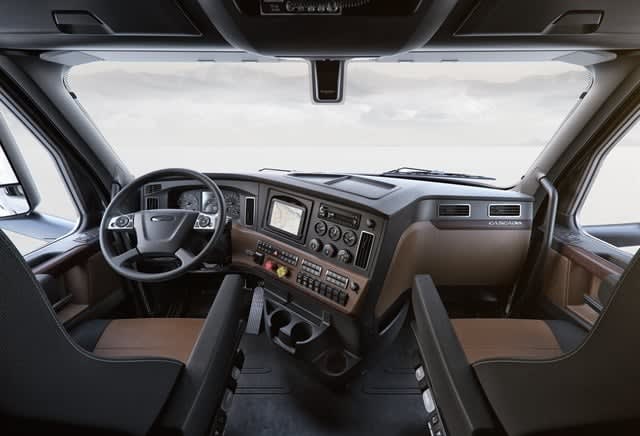
New Cascadia Elite Interior Cockpit Package shown in Saddle Tan and Black.Photo Courtesy of Freightliner.
Drivers like or dislike trucks for all sorts of reasons, but it the truck isn't comfortable, quiet and roomy, chances are your drivers might be on the lookout for something better. With recruiting and retention front of mind, Freightliner says the interior of the new Cascadia received more design attention than any previous Freightliner truck.
"We wanted to develop a truck that drivers are proud to drive," says Kary Schaefer, general manager, product marketing and strategy, Daimler Trucks North America. "We think of it as a tool to attract and retain good drivers, so our goal was to make the Cascadia a truck drivers would want to drive."
Out front where you can't really see the improvements, the steering and handling have been improved with the driver in mind. A new front suspension with long taper-leaf springs provides a smoother ride and improved roll stiffness. Also, the steering gear was pushed farther forward to help improve steering precision. Drivers will notice the improvements in sure-footed handling and less jarring when running on rough pavement.
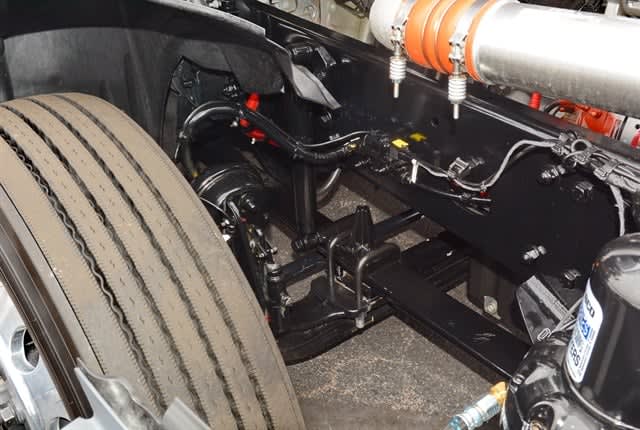
Extra long front springs increase roll stiffness while smoothing out even the most jarring bumps.Photo by Jim Park
The engine and cab mounts were redesigned as well to provide a quieter environment with less vibration transmitted into the cab structure from the chassis. The engine tunnel cover is now constructed using Quiet Steel technology to keep engine noise out of the cab
Engineers have also used, for the first time, an insulating technology familiar to anyone who has ever worn a winter coat: 3M's Thinsulate, known for its thin structure and very good thermal and acoustic insulating properties. It's optional, but it's hard to imagine fleets operating in northern climes deleting this from the option list.
Inside the cab, drivers will find a striking new dash layout and gauge cluster in the A-panel, and some optional gauge and switch placements on the B-panel.
"We did a lot of driver profiling in designing the dash to ensure it would be comfortable to the broadest possible range of the driver population," says Schaefer. "We worked hard to understand where switches and gauges need to be to accommodate drivers of different sizes."
The 5-inch display shows drivers all the safety alerts and warnings and offers plain-text messages rather than cryptic codes in English, Spanish and French.
Two interior and exterior packages are offered on the new Cascadia called Professional and Elite. Both come in several color combinations.
Back in the 72-inch Raised Roof sleeper, Freightliner has gone a long way to make the environment configurable for team or solo drivers. The interior emphasis was on storage, lighting and more creature comforts like additional power outlets, space for a larger microwave and even a flat screen TV up to 26 inches, says Schaefer. There are upper and lower bunk options and even a newly designed dinette that Freightliner calls the Driver Loft.
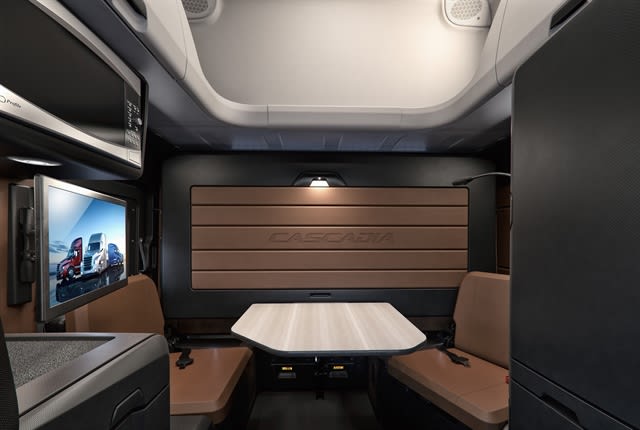
New Cascadia Elite Lounge Package with Driver's Loft and upper cargo shelf shown in Saddle Tan and Black. Photo Courtesy of Freightliner.
"This used to be an option in the current Cascadia, but it was kind of a pain to set up and put away and the mattress wasn't very comfortable," Schaefer told reporters. "We didn't sell many of them, but we learned from our mistakes. The mattress with this option is super comfortable, and we tested it with tall and short drivers for comfortable seating, sleeping and ease of deployment."
The Driver’s Loft also comes standard with aircraft-inspired dimmable LED ambient lighting so drivers can personalize their light levels. If an upper bunk is spec’d, it will come standard with an easily released telescoping ladder, making getting into the upper bunk a breeze.
The interior was designed by the same people who design Boeing aircraft interiors, but they gave the Cascadia a lot more room.
“Professional drivers can spend more than 100 hours in the cab during an average work week, and the environment needs to be friendly and inviting both on the job and during downtime," noted Richard Howard, senior vice president, sales and marketing, Daimler Trucks North America.
Delivering Safety
“Safety is built into the fiber of everything we do,” said Howard. “It’s a critical concern for us, for our customers, and our trucks are designed to help drivers and other motorists on the road.”
The new Cascadia incorporates a number of new passive safety systems such as a full LED headlight system. A new, one-piece windshield design increases wiper coverage by 12% over the current Cascadia, and is specially constructed to provide increased resistance to breakage, the company says.
You will also find thoughtful features such as standard heated door mirrors and optional heated hood mirrors, as well as grab handles redesigned for better grip and better placement for safer ingress and egress from the cab.
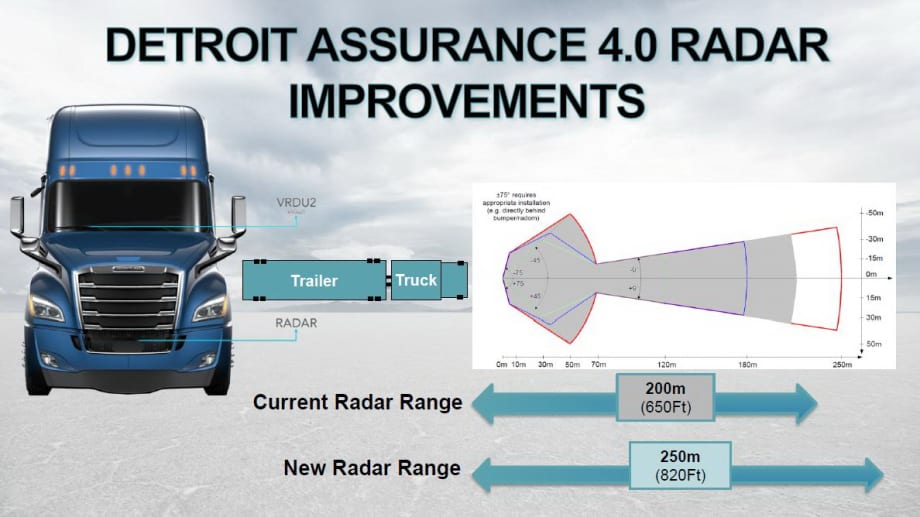
As for active safety systems, the new Cascadia boasts generation upgrades to the Detroit Assurance collision mitigation system and Active Brake Assist. Both are now Gen 4.0. According to Schaefer, the key improvements are improved solid-state radar. The range has been increased from 200 feet to 250. It's also capable of detecting vehicles in adjacent lanes.
There are color-coded pop-ups in the dash display indicating the state the safety system is in, showing following distance in time and distance. Now there's a tailgate warning as well that can instruct the driver in maintaining proper following distance. It can also be included in a package of fleet alerts that advice safety personnel of certain driver behavior.
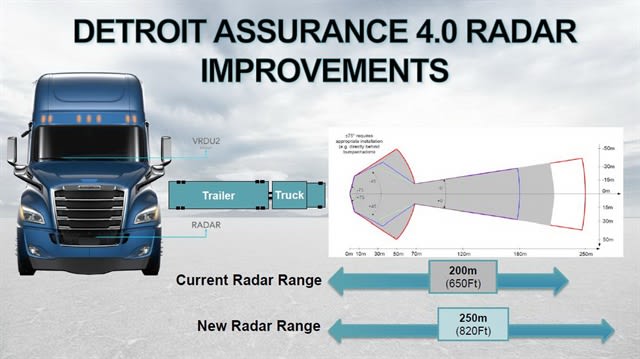
The warning sequence is improved as well. Now there are three audible, haptic or physical warnings before active braking engages. The proprietary safety suite includes driver-friendly controls and is seamlessly integrated into the truck’s dashboard, engine and transmission electronics and can enhance driver safety by mitigating collisions.
The optional Detroit Assurance 4.0 suite of safety systems includes Active Brake Assist that now provides full braking on stationary objects, Adaptive Cruise Control and Lane Departure Warning with optional video capture.
Detroit Assurance safety event reporting can be accessed using Detroit Connect Analytics, which will be available to customers starting in Q1 2017. Safety event reporting available through Analytics can be viewed using the new Detroit Connect portal, informing fleet managers and further enhancing driver safety performance.
More Drivers

Nussbaum, Roehl Announce Second Driver Pay Increase This Year
This year has seen a swath of major truck driver pay increases as freight capacity has tightened.
Read More →
From One Generation to the Next: How Mentorship Builds Safer Truck Drivers
After three decades in trucking, Harold Perry shares what he's learned about driver safety, mentorship, and helping the next generation build confidence behind the wheel.
Read More →
Truck Drivers Need More Than Another Alert
Fleets have more visibility into truck health, safety events, and driver activity than ever. The next challenge is turning all that information into useful guidance for the person who has to decide what to do next.
Read More →
FMCSA Removes 110 Truck Driver Training Schools from Certified ELDT List
Federal regulators also are targeting more than 160 additional training providers and launching a nationwide audit of third-party CDL skills testers as part of a broader crackdown on trucking fraud.
Read More →
Hours of Service Pilot Programs: FMCSA Readies for 2027 Rollout
Two pilot programs could eventually reshape hours-of-service rules, giving truck drivers options to pause their 14-hour clock or use longer split sleeper rest periods.
Read More →
Medical Cards, English Proficiency Reshape Roadcheck Violations
Medical-card violations jumped to the top of the driver out-of-service list during CVSA’s 2026 International Roadcheck, while English-language proficiency violations appeared among the leading violations for the first time.
Read More →
Driver Trust Can Make or Break the Success of Fleet Safety Technology
New Teletrac Navman research suggests that onboarding, transparency about driver data, and positive feedback can play a significant role in how commercial drivers respond to safety and coaching technology.
Read More →
EEOC Sues KLLM Over Alleged Sex Discrimination in Driver Training
KLLM is facing a federal sex-discrimination lawsuit over policies the EEOC alleges put female truck driver trainees at a disadvantage.
Read More →
FMCSA Moves to Codify English Language Requirements for Commercial Drivers
By changing regulations on English-language proficiency requirements for commercial drivers, rather than relying on a guidance memo, the FMCSA said future administrations won't be able to walk back the Trump administration's stricter enforcement with just a memo.
Read More →
Drivers Put Western Star Trucks to the Test at Star Nation Experience
Watch to get an inside look at the Western Star trucks, technology, and community behind the Star Nation Experience 2026!
Read More →