




Heavy Duty Trucking Logo
MenuMENU
SearchSEARCH

New Refrigerants on the Way

Transport refrigeration units will soon be subject to tighter regulations on the use of hydrofluorocarbon refrigerants.

Jim Park
Jim ParkFormer HDT Equipment Editor
Read Jim's Posts
May 2, 2017
New Refrigerants on the Way

Photos: Carrier Transicold

4 min to read


Photos: Carrier Transicold

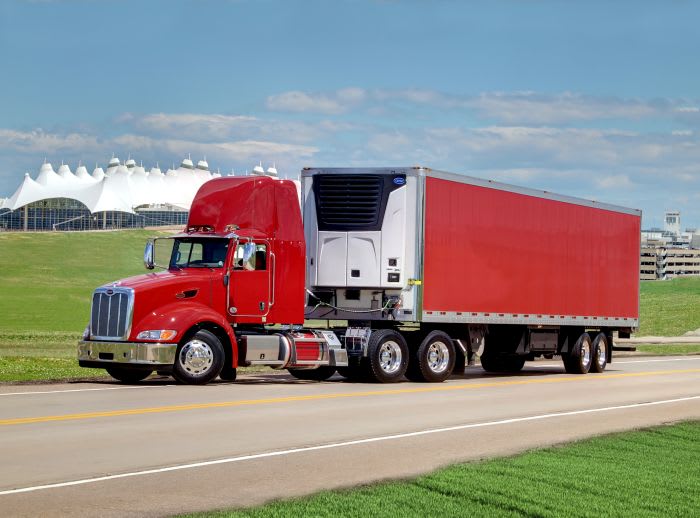
Transport refrigeration units as we know them will not disappear anytime soon, but alternatives to traditional refrigerants and diesel power systems are already proving themselves in some markets around the world.

Ad Loading...

Manufacturers are using low-impact, natural refrigerants such as carbon dioxide and liquid nitrogen to reduce the units’ global warming potential in the event of an unplanned release. And diesel power systems are being scaled to accommodate hybrid-electric systems with high-efficiency heaters and direct-drive compressors that are said to be more energy-efficient and quieter.

Ad Loading...

Last October, at a conference in Kigali, Rwanda, negotiators from nearly 200 nations hammered out a legally binding agreement that will scale back the worldwide use of hydrofluorocarbons, or HFCs, used in air conditioners and refrigeration units. The agreement is structured so the world’s hottest countries and emerging economies will come into compliance over a longer period with less stringent reductions. The richest countries, including the United States and the European Union, will freeze production and consumption of HFCs by 2018, eventually reducing them to about 15% of 2012 levels by 2036, the New York Times reports.

The Kigali agreement will put pressure on TRU producers to develop new refrigerants as well as the blowing agents used in the foam insulation between the trailer’s inner and outer walls.

Some manufacturers are already pursuing alternatives to the current HFC refrigerant, R-404A, including carbon dioxide.

If it sounds counterproductive to use CO2 as a refrigerant while trying to reduce the output of greenhouse gases, consider that CO2 has a “global warming potential” of 1, while R-404A’s GWP is 3,922 (both Thermo King and Carrier in Europe offer R-452A as an alternative with a GWP of 2,140 – 45% lower than R-404A. R-452A is awaiting approval from the U.S. Environmental Protection Agency for use in the United States.)

Last April in Great Britain, Carrier Transicold UK announced a three-year field trial of a modified road version of the company’s NaturaLine refrigeration system for ocean containers, which operates exclusively with CO2 refrigerant.        

Ad Loading...

The new prototype system uses technology from the NaturaLine system, assembled inside a traditional Carrier Vector unit chassis and powered by the same E-Drive all-electric technology as Carrier’s existing European Vector products. Carrier has not disclosed any details on the cost of such a system, or if or when it might come to North America.

Europe has at least one other set of regulations that the U.S. currently does not: noise emissions. Current EU standards require that transport reefer units not exceed a sound pressure level of 60 decibels at a 25-foot radius around the equipment. While equipment noise levels vary with the application, a study published in December 2013 by Rensselaer Polytechnic Institute found the average noise level of refrigerated trucks to be 69-74 dB.

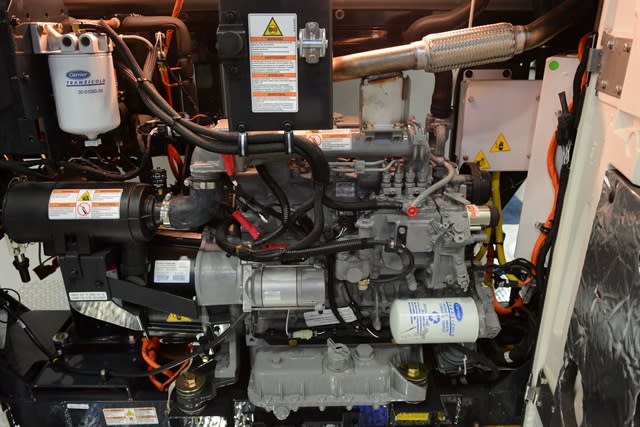
Carrier’s Vector unit uses a high-efficiency generator to drive the cooling system. A European version has been modified to use CO2 as a refrigerant.

Quieter hybrid-electric refrigeration systems are available, but they tend to be more expensive and don’t offer the return on investment expected by major for-hire fleets on their shorter trade cycles. Private carriers, however, tend to keep their equipment longer and often do nighttime deliveries in urban areas. They’re embracing the technology, HDT was told by one OEM official.

Last year we became aware of a trailer cooling system from Boreas Nitrogen Cooling Systems that uses cryogenic liquid nitrogen for cooling. Boreas has had several trailers in fleet testing with a grocery fleet in California and is reporting good results. Nitrogen makes up roughly 80% of the air we breathe and is, therefore, non-toxic and non-polluting, and it’s not a greenhouse gas. Nitrogen-rich environments, however, do not support human life, so special precautions must be taken to keep workers out of the trailer until normal oxygen levels have been restored.

Boreas says the system is cost-effective and offers significant environmental benefits, such as zero diesel emissions and zero global warming potential. Additionally, the system is said to be virtually silent, making it attractive to operators delivering in residential areas, and virtually maintenance-free.

Ad Loading...

While alternatives to current refrigeration technology exist, there’s little need to worry at this point about how your next reefer will work. Save for the Kigali agreement on GHG reduction, no one is demanding we comply with more stringent environmental or noise standards.

Yet.

Reefer to the Rescue

Alternators and batteries on trailer refrigeration units have always been a back-up source of power, though not always convenient. They are useful for boosting tractor batteries, and good for charging liftgate batteries (provided they were pre-wired). But you had to be careful not to sacrifice the reefer starting batteries to keep the liftgate working.

At the Mid-America Trucking Show, Thermo King introduced a comprehensive power generation and management package that solves these problems while protecting the reefer unit’s starting battery.

Paul Kroes, solar business development manager for Thermo King North America, explained how electrical demands in refrigerated trailers have increased in recent years with the addition of multiple lighting sources and greater reliance on liftgates.

“The industry, faced with an aging workforce, is taking steps to make the drivers’ jobs easier and safer,” he explained. “There are a lot more liftgates and electric pallet jacks in use now, but because of restricted run times for reefers and more efficient reefer operation, the units may not run often enough to keep those batteries charged.”

To address those supplemental charging concerns, Thermo King’s expanded power management portfolio brings together several components, including the Boost Charger, Auto-Start Module, Electric Power Jack Charger, Eon Power Module, ThermoLite solar panels, and a supplemental alternator.

  • The Boost Charger, released in late 2016, draws power from several sources, including the tractor batteries through the 7-way connector or the reefer unit alternator and batteries. Optimum battery charging requires managed input voltage, so the Boost Charger’s smart capabilities monitor voltages accordingly. The unit will start the reefer engine to charge the batteries and run for up to 20 minutes at a time to charge the liftgate battery.

  • The Auto-Start Module continuously monitors system voltage and will automatically activate the reefer unit to charge if power levels drop too low. It also provides low-voltage protection for the auxiliary battery to ensure liftgate operation or that lights are running when they are needed most.

  • New this year, the Electric Power Jack Charger delivers 120V of AC power to the inside of a trailer using a 2,000-watt pure sine wave inverter mounted beneath the trailer in a weather-sealed compartment. The charger generates power directly from the liftgate battery pack and has built-in lower voltage protection to preserve liftgate operation. Drivers can charge the electric pallet jack between deliveries.

  • The Eon Power Pack is a dedicated battery for trailer lighting, separate from the reefer starting battery. It will keep the lights on when the reefer starts up and it protects the starting battery.

  • A supplemental alternator is available on most Precedent model reefers to provide additional charging capacity on a dedicated circuit, separate from the reefer charging and starting system. During periods of high current draw, such as when using the condenser or evaporator fans, a 120-amp alternator may only provide 30 amps of power to additional systems. The supplemental alternator can deliver 100% of its rated output to those other systems.

  • ThermoLite solar panels provide additional charging capacity for existing electrical systems. Available in three output configurations, 26-, 36- and 100-watt, they can be used to offset current draw from onboard telematics systems or to power liftgate systems and other large loads.

Many of these options are compatible with Thermo King and competitive refrigeration units and can be retrofitted to existing systems.

Subscribe to Our Newsletter

More Equipment

Diagram of trailer tandem slider suspension
Equipmentby Deborah LockridgeMarch 19, 2026

SAF-Holland Redesigns Suspension Slider to Save Weight in On-Highway Trailers

SAF-Holland reengineered the UltraLite40 Slider for the ULX40 Mechanical Sliding Suspension and Axle System to reduce weight, improve durability, extend trailer life, and increase payload efficiency.

Read More →
Magnus Koeck, Volvo Trucks North America.
Equipmentby Jack RobertsMarch 18, 2026

Volvo Teases Next-Gen VNX as Platform Expansion Continues at TMC

Volvo Trucks North America highlighted new connectivity, safety tech and production investments at TMC. The OEM also signaled that a new heavy-haul flagship tractor is coming soon.

Read More →
Back of truck cab showing air and electrical line connections
Equipmentby Deborah LockridgeMarch 16, 2026

SAF-Holland Introduces SmartSto System for Safer Tractor-Trailer Uncoupling

The system combines a fifth-wheel air release with stowage for air and electrical connections, helping prevent damage and reducing driver injury risk.

Read More →
Ad Loading...
Diagram of SAF Holland BrakeSight
EquipmentMarch 16, 2026

SAF-Holland’s BrakeSight Aims to Take the Guesswork Out of Air Disc Brake Maintenance

New Haldex sensor technology from SAF-Holland integrates with telematics systems to give fleets continuous insight into air disc brake condition.

Read More →
Solar panels on top of a red Class 8 truck sleeper cab
Equipmentby Deborah LockridgeMarch 15, 2026

Vanair Introduces Solar, Battery Power Ecosystem for Class 8 Trucks

The company’s expanded EPEQ ecosystem includes flexible solar panels, lithium batteries, hydraulic power systems, and a portable fast charger for electric trucks.

Read More →
Phillips Connect Smart Trailer technology.
Equipmentby Jack RobertsMarch 15, 2026

Phillips Connect Expands Smart Trailer Platform with New Safety, Cargo and Equipment Intelligence

Phillips Connect Smart Trailer enhancements give fleets deeper operational insights from trailers -- even when another provider supplies basic GPS tracking.

Read More →
Ad Loading...
Accuride ProShield XGT.
Equipmentby Jack RobertsMarch 15, 2026

Accuride Unveils ProShield XGT Aluminum Wheel Coating at TMC

Accuride’s patent-pending surface-coating technology targets filiform corrosion and promises easier cleaning, longer-lasting gloss, and greater durability for aluminum truck wheels.

Read More →
Valvoline at TMC 2026.
Equipmentby Jack RobertsMarch 15, 2026

Valvoline, Cummins Extend X15 Oil Drain Intervals to 100,000 Miles

New approval for Valvoline Premium Blue One Solution Gen2 allows fleets running Cummins X15 engines to extend oil drain intervals by up to 25,000 miles -- reaching intervals as high as 100,000 miles.

Read More →
Al Anderson, Peterson.
Equipmentby Jack RobertsMarch 15, 2026

A New Approach to Lighting Reliability

Peterson’s Genesis lighting system and repairable J560 connector target two persistent fleet problems: LED light failures and costly electrical connector downtime.

Read More →
Ad Loading...
Illustration of a row of trucks with question marks overlaid
EquipmentMarch 12, 2026

The Hidden Cost of Delaying Truck Replacement

Many fleets extended truck replacement cycles during recent market disruptions. But holding equipment too long can lead to higher repair costs, longer downtime, and new operational risks.

Read More →







