




New Reefer Tech Unveiled at MATS Saves Money
Big and tall rigs aren't the only things that hit low overpasses. Medium-duty trucks can hit really low bridges, or at least one of them did in Westwood, Mass

Big and tall rigs aren't the only things that hit low overpasses. Medium-duty trucks can hit really low bridges, or at least one of them did in Westwood, Mass.
It was hauling dairy products, according to some TV news footage I saw on YouTube, and its reefer unit took an awful bashing from the impact. From that we can assume that the milk and ice cream inside lost some of their cool and became, well, milkshakes.
So, the lessons learned are: Pick your route wisely, avoiding "Low Clearance" bridges. And if possible, use a lower-profile truck.
The folks at Thermo King, who've no doubt seen this sort of scene more than once, might have had this type of situation in mind when they designed a V-series reefer unit for light commercial vans, like the Mercedes-made Sprinter, which probably would've squeaked under that bridge intact.
Thermo King people said the V-520 RT and RT Max have a low-profile condenser that measures less than 7.5 inches above the roof to minimize colliding with overhead obstructions. The new products are based on a proven V-520 reefer, and have capacities 50 percent greater than can be found in similar units that are currently available.
Other features include reliable temperature management, to ensure high load quality; a SmartPower electric standby to save fuel and reduce emissions; superior pull-down capability to reach set point quickly after a stop; and a very low refrigerant amount - only 4.5 pounds, which offers less risk to the environment if any of it escapes following catastrophes like the one in Massachusetts.
Thermo King announced the new V-series reefers at the Mid-America Trucking Show in Louisville, Ky. They also had some other announcements:
A new Electronic Throttling Valve for single-temp truck units with scroll compressors, including the T-600, T-800 and T-1000, enables box temperatures to recover to set points quickly after each door opening. The ETV also saves time and fuel with quick pull-downs, which cool the cargo fast at the start of trips, and efficiently maintains temperatures. It further cuts engine running time, which also saves money by stretching calendar time between service intervals. These savings allow the ETV to quickly pay for itself, Thermo King representatives said.
Enhancements to the SB-30 Series trailer reefer conserve time and money. These include:
* Tighter fuel filtration, down to 5 microns, which can save a 500-vehicle fleet about $100,000 a year in fuel-related maintenance and repairs;
* Ultrasonic fuel sensor for more accurate fuel readings than before, cutting expensive out-of-fuel shutdowns and load-loss claims; and
* SR-3 controller which allows data transfer directly from the trailer onto a flash drive (aka thumb drive and memory stick) via a built-in USB port, saving as many as 180 hours a year compared to traditional data transfer methods.
This June the SB-30 will get a new evaporator-blower assembly that will reduce engine run times by up to 7 percent, and integrated wireless capability to track and manage reefer units via Thermo King or third-party telematic services.
Tom Kampf, trailer product manager, does a briefing on the SB-30 features in an online video: www.youtube.com
Anew control system for transport refrigeration units uses "distributed electronics," placing modules around the unit for better reliability and performance, Carrier Transicold said in an announcement at the Mid-America Trucking Show.
Called APX, short for "apex," the system includes a large, bright display with a simplified user interface; greater memory; and an expanded range of applications for customization. APX is optional on Carrier's X2 series of refrigeration units.
APX takes what was formerly housed in a single large metal control box and splits it into compact, sealed subcomponents. They include main microprocessor controls, a large display module with an illuminated information dashboard, and a power-control module. The microprocessor is driven by a powerful operating system, familiar in many ways to users of Carrier's Advance controllers.
The display has a large, vivid color screen that can be read at a distance, offers push-button simplicity and, with fewer keystrokes, shows five lines of information to aid mechanics in getting a full idea of a TRU's condition. The display module sports a USB dock for easy data downloads and software uploads.
Large raised silicone backlit buttons that can easily be pushed with a gloved hand and menu-driven simplicity, with fewer keystrokes, help minimize operator error.
Exclusive to the APX display module is the ability to display data recorder trip graphs - an at-a-glance visual indicator of conditions within the trailer throughout a delivery run. The built-in data recorder has four times the memory capacity of Carrier's Advance controller, the forerunner to APX.
All modules use CAN-bus communications protocols, an automotive industry standard that is also used on Class 8 tractors. It makes system expansion - adding modules for expanded capabilities - as simple as plug-and-play. A system manufactured today can be easily upgraded with future hardware capabilities by adding new modules.
More Equipment

ZF Expands Commercial Vehicle Push in North America
ZF is expanding its North American commercial-vehicle presence with new transmission applications, electrification, trailer technology and autonomous-driving systems.
Read More →
Tesla Wants a Self-Driving Semi. Are Cameras Enough?
Could Tesla’s camera-only autonomous driving technology work on an 80,000-pound Semi? In this commentary, HDT's Deborah Lockridge takes a look at Tesla, Cybercab, and how autonomous trucks see the road.
Read More →
Kodiak: Driverless Long-Haul Truck Launch on Track for 2026
Kodiak AI says its driverless long-haul safety case is 93% complete and it remains on track to begin commercial operations by year-end 2026.
Read More →
What DOT’s Automated Vehicle Strategy Means for Trucking
The U.S. Department of Transportation issued a new automated-vehicle strategy that outlines plans for driverless-truck regulations, cross-state freight corridors, and federal safety standards.
Read More →
East Coast Port Launches $45M Electric Truck Push
The Port Authority of New York and New Jersey announced millions in incentives for zero-emission drayage trucks, yard tractors, and new charging hubs near the port.
Read More →
PlusAI Going Public to Fund Autonomous Truck Launch
A SPAC deal could provide PlusAI with up to $300 million as it works toward a 2027 commercial launch of factory-built autonomous trucks.
Read More →
NHTSA Moves to Rewrite Truck Fuel-Economy Rules
The National Highway Traffic Safety Administration says it lacks authority to regulate medium- and heavy-duty truck engines separately from complete vehicles, but the existing standards have not yet been eliminated.
Read More →
Detroit Opens Orders for EPA 2027 Engines
Detroit isn’t starting from scratch to meet EPA 2027 diesel emissions standards. Its Gen 6 DD13 and DD15 engines keep much of today’s platform while updating the fuel and aftertreatment systems.
Read More →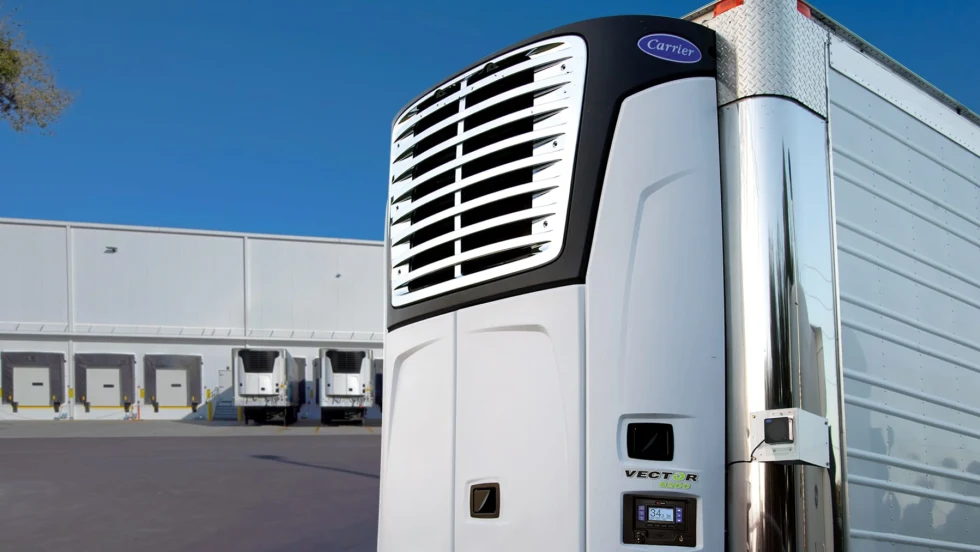
Carrier Transicold Adds All-Electric TRU for Stationary Cold Storage
Carrier Transicold’s new Vector 8200 all-electric transport refrigeration unit gives fleets a diesel-free option for temporary refrigerated and frozen trailer storage.
Read More →
A Closer Look at Kenworth’s Electric T880E Vocational Truck [Video]
Learn more about Kenworth's T880E battery-electric vocational truck at the Paccar Technical Center, including its range, applications, upfitting considerations, and PTO options, in this HDT Spotlight video.
Read More →