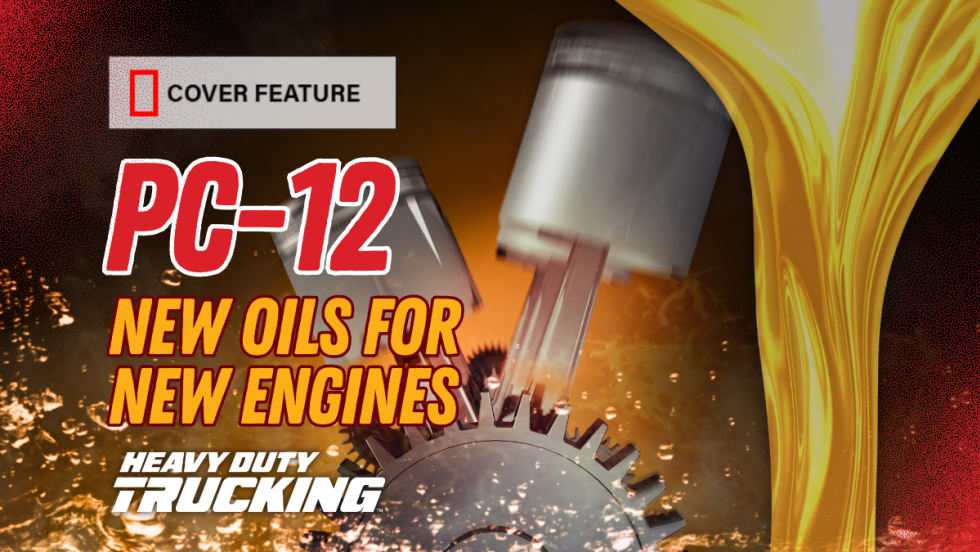
A new donut is being baked. Two, to be exact. The American Petroleum Institute’s Lubricants Group has established a New Category Development Team to launch the test-development phase of what will be a pair of new API diesel engine oil categories.
While under development, the service category will be known as PC-12. It will lead to the release of two new specs for use in formulating engine oil. Then each of the new categories will get its own API service-symbol donut. Those new donuts — expected to be rolled out within the next five years — will go beyond the performance standards set by the last two diesel service categories announced by API in 2016, FA-4 and CK-4.
For a preview of what’ll be cooking over the next several years, HDT spoke to Jeffrey Harmening, API’s senior manager – EOLCS/DEF/MOM.
He explained that the Engine Manufacturers Association requested the development of a new category to help meet the demands of upcoming greenhouse gas and fuel mileage regulations from the Environmental Protection Agency and the California Air Resources Board. The request for first-licensing date from API is no later than Jan. 1, 2027, to coincide with the anticipated 2027 implementation date for EPA and CARB heavy-duty on-highway regulations, Harmening said. “This is similar to the PC-11 [the previous test category] licensing timeline that resulted in API CK-4 and FA-4.”
EPA has stated that by December 2022 it will “propose and finalize new stringent emissions standards to reduce nitrogen oxides (NOx) pollution from trucks starting in model year 2027.” This action will include an update of current GHG standards “to capture market shifts to zero-emission technologies in certain segments of the heavy-duty vehicle sector.” The agency also noted it is working on even tighter new GHG emissions standards for heavy-duty engines and vehicles “starting as soon as model year 2030.”
“The EPA is always a big driver of category development,” noted Harmening. As with the twin categories birthed by PC-11 (CK-4 and FA-4), PC-12 will a produce a “C” subcategory [as in CK-4) that will maintain its backwards compatibility. A new “F” subcategory that replaces FA-4 will not need to retain backwards compatibility — engineer-speak for an oil formulation that is approved for use in all current vehicles.
Oil Viscosity: How Low Can You Go?
Development of the next “F” subcategory will look at further reductions in viscosity, as that will help engine builders meet tighter fuel economy targets. “The ask is whether a new ‘F’ will call for even lower viscosity levels, perhaps moving down from Xw30 to Xw20,” Harmening said.
But retaining backwards compatibility for the “C” subcategory does not mean little will change for its next iteration. According to Harmening, developing a fresh “C” will consider the role of oil performance in engines using newer technology, such as elastomer seals, and the impact of the T-11 and T-12 engine-wear tests used during recent category developments.
“That the wear tests are aging is an ongoing issue that will be addressed in concert with developing PC-12,” he explained. “The hope is that T-11 and T-12 may no longer be needed, and then the question will be whether new tests would be more appropriate. There is also the question of whether to sustain these tests so that older [API] service categories can still be licensed. This is also due to the fact engine makers are global entities, with different products in different markets.”
More specifically on engine wear-test obsolescence, he said the current T-11 and T-12 tests are “not likely available for PC-12” and the new category team will develop a T-11 replacement as needed.
Benefits From New Oil Categories
Overall, the Engine Manufacturers Association is calling for the PC-12 process to attain the following improvements:
- Increased oxidation performance
- New wear-test capability
- Addition of lower viscosities
- Improved aftertreatment capability
- Expansion of elastomer compatibility
Among the potential benefits to diesel engines, Harmening said, are:
- “Enabling new engine technologies that are expected to experience higher brake mean effective pressure and customer demands,” as well as accommodate anticipated regulations on extending useful life and warranty periods.
- “Supporting requirements for fuel economy for certain engine models.”
- “Supporting new elastomers used in modern engines.”
What’s more, he said, the potential environmental benefits from developing PC-12 will include limited SAPS (Sulfated Ash, Phosphorus, Sulphur). He noted that this will help engines “satisfy tighter environmental regulations on lower emissions.”
Once the details on what will become the new donuts baked by PC-12 are done and wrapped, Harmening said fleets can “expect improved oil performance, resulting in more durable engines” from both the new “C” and “F” oils. Longer oil drain intervals may be possible as well, which would help fleets save on maintenance costs and support sustainability efforts.
As for the years-long category development process itself, Harmening said that it will, as always, be a “collaborative effort” among engine makers, oil producers, additive suppliers, and testing operations.
“We’ve got the green flag,” he added. “And this work will be moving forward fast.”