





Related: Help for Tire Management Headaches
Must-Have Tools for the Tire Shop
Fleets describe the must-have tire shop tools they use to improve productivity, safety, and operator comfort and convenience.
May 17, 2019
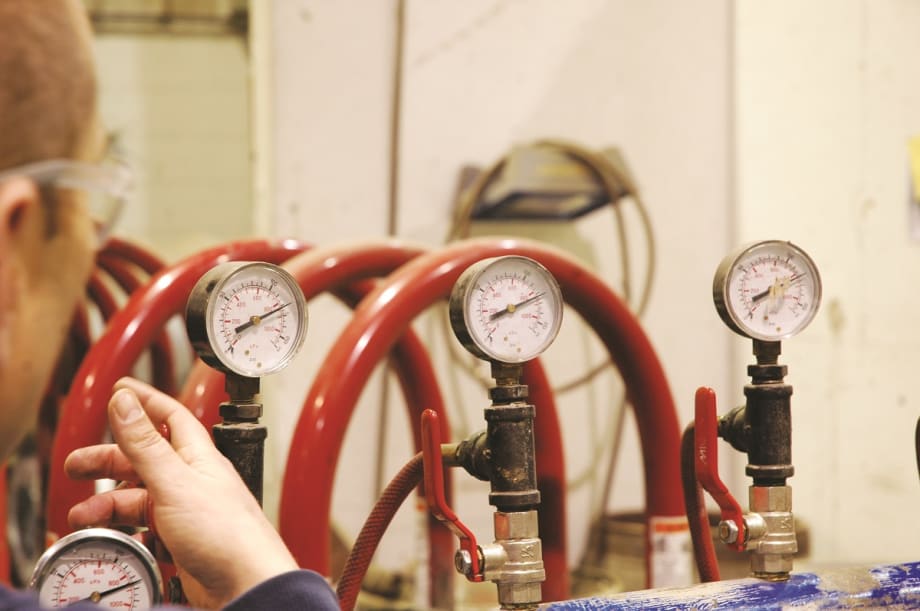
Time-saving tools like this multi-line inflation system can inflate several tires at a time to the same pressure.
Photos: Jim Park
5 min to read
Imagine breaking down a hundred tires a day by hand. Big tire shops used to do that, but machines can accomplish that task in a couple of hours now, and with much less risk to the health, safety and job satisfaction of the operator.
Any job, even changing tires, can be made easier and more efficient with the right tools. Whether it’s speed and improved throughput, better ergonomics for the operator, or a higher-quality installation you’re looking for, the tools you need are probably out there.
We asked several fleets which tools they wouldn’t want to live without in their tire shop.
Keep Your Heavy-Duty Truck Technicians Safe
Beginning with the basics, tire inflation cages appeared in several of the responses. These are required by OSHA, so you’d expect to find them in all tire shops.
Yet in some fleet shops, you still find tires lying in the middle of the floor or leaning against a wall with inflation hoses attached, while the inflation cage sits in the corner with stuff piled around it.
Inflation cages are designed not to contain the energy of an exploding tire, but to dissipate it. That’s why they should never be used close to a wall, in a corner or in a confined space, and they should never be bolted to the floor. If you have ever seen a tire come apart in an inflation cage, you’ll understand why. (If you haven’t, just search for “tire cage” on YouTube.)
Danny Schnautz, operations manager at Clark Freight Lines of Pasadena, Texas, calls his tire shop something “less than leading edge,” and says basic tire tools such as an inflation cage and a good set of tire irons are his most valued tools.
“You can’t do a proper repair without them, and their basic design has not changed for years,” he says. “Finding a set with just the right feel and curve is very valuable to the tire technician, as he will be using them all day long. Ask him what he’d like to use and buy him what he wants.”
For Winnipeg, Manitoba’s, Bison Transport, the nine-time grand prize winner for the large carrier category in the Truckload Carriers Association’s annual Fleet Safety Awards, tire service has really personal feel to it. Jeremy Gough, director of national fleet maintenance, says his most valued tool is a radial runout gauge.
“Besides the safety cage, lifting tools, inflators and calibrated air pressure gauges, etc., we have seen great value and increased driver satisfaction by using a radial runout gauge as final check,” he says.
“We do this to ensure that the steer tire, drum and hub are all concentric to ensure that our professional drivers have a comfortable ride, free of steering pulls and vibrations. This does reduce driver fatigue, and going that extra little step has increased tire life and reduced our overall tire cost.”
That says a lot about the way one of the safest fleets in the nation is managed. Going that extra step is clearly part of the corporate culture.

A good set of tire irons will go a long way toward keeping your tire technicians happy. Pay attention to their preferences and get them the tools they like to use.
The Right Tools to Measure Tire Inflation Pressure
Peggy Fisher is practically synonymous with tires for members of the American Trucking Associations’ Technology & Maintenance Council, and if there are tools a tire shop should have, she’d know about it.
Her first suggestion for a must-have shop tool is a master gauge and service gauge checking station. She says these can be fabricated easily enough or purchased pre-assembled from most tire supply and equipment companies.
“This is not a big expense, nor does it take a lot of time to check service gauges,” she says. “However, checking their accuracy on a regular basis will ensure the quality of the service work technicians perform remains high.”
When gauges are found to be off by 5 psi or more, they should be re-calibrated or replaced. Since proper inflation is vital to the health of tires, having tools that ensure it is correct is necessary, Fisher says.
Next on her list of must-haves is what she calls a “spider” airline drop, which is attached to a regulator and has four air lines on it with clip-on chucks. It is used to inflate four tires at a time on one side of a vehicle.
“You can buy these already made from a tire supply and equipment distributor, or they can be made quite easily, too,” she says. “One on each side of a trailer bay should be used so that the technician can hook them up to all eight tires on a trailer and walk away to check the lights, brakes, etc., while the tires are being topped off.
"This will guarantee that all the tires are inflated to the same pressure and eliminate a lot of irregular wear caused by different pressures in dual tires.”
Computers, Data, and Heavy-Duty Truck Tires
Fisher’s final suggestion is a tablet computer.
“With the advent of telematics, fault codes, and TPMS 2.0 systems, it is essential for technicians to have tablets to access internet portals while they walk around a vehicle,” she says. “Tablets are the best tools for downloading and updating information through the internet. They save time running back and forth to the shop computer and ensure the inputted data is correct.” And Fisher is quite familiar with the importance of tire data as president of TireStamp.
Correct data is also a factor in the can’t-live-without-it tire shop tool for Kevin Tomlinson, director of maintenance at Sandusky, Ohio-based South Shore Transportation, and past chairman of TMC. He uses a lug-nut torque gun that allows him to record and retain a report of the torque values of the nuts of the wheels installed at his shop.
“We send all our tires out for service, but we still do the dismount and remount here at our shop,” he explains.
“We are now using the DataTorque from Mac Tools to log all of our wheel installations. It provides a print-out which we then attach to the work order to show the tires were installed properly. We all know a wheel separation is about one of the worst things that can happen.”
Fleets all have different needs and preferences. This short list includes a few tools that work for the fleets we heard from. If you have discovered a tool that makes a big difference in your tire shop, tell us about it in an email to dlockridge@truckinginfo.com. We might include it in our next tire tool roundup.
Subscribe to Our Newsletter
More Maintenance

Sponsored•September 16, 2026
Color Match Smarter: Tools That Restore & Perform
For fleet managers and collision repair professionals keeping heavy-duty trucks on the road, getting the color right the first time isn't just about appearance — it's about efficiency, turnaround time, and bottom-line results. Discover how today's digital color tools are transforming the repair process from guesswork to precision.
Read More →
Wrong Repair Prompts Recall of Freightliner, Western Star 4x2 Trucks
DTNA is recalling more than 2,400 trucks that received an incompatible software fix instead of the hardware repair required to address brake valve corrosion.
Read More →
Truck Drivers Need More Than Another Alert
Fleets have more visibility into truck health, safety events, and driver activity than ever. The next challenge is turning all that information into useful guidance for the person who has to decide what to do next.
Read More →
The Maintenance Checks Trucking Fleets Should Prioritize Before Fall Freight Picks Up
Making it through August isn’t the same as being ready for the next several months of operation. Find out what systems may have suffered from summer heat and need to be checked out before fall.
Read More →
What Three Fleets Are Doing Differently When Buying Truck Parts in 2026
With freight improving but costs still climbing, fleet maintenance executives explain how they're balancing price, quality, and supplier relationships.
Read More →
Paccar Recalls 2027 Trucks Built This Summer for Possible Electrical Problem
The nearly 6,000 Kenworth and Peterbilt trucks in the recall could potentially lose engine power, among other things.
Read More →
Will API PC-12 Oil Change Trucking Fleet Maintenance?
The new API PC-12 heavy-duty engine oil category reflects the changing demands of modern diesel engines. But fleets like Foodliner are looking to getting their own data before making decisions on adopting the new oils and questions such as extending oil drain intervals.
Read More →
Brake Safety Week to Focus on Drums and Rotors
Commercial vehicle inspectors are focusing on truck brakes during CVSA's Brake Safety Week, August 23-29.
Read More →Possible Battery-Cable Fires Prompt Recall of 15,000+ International MV and HV Trucks
On the recalled vehicles, manufacturing variations can cause the battery interconnect cable to contact the auxiliary stud and hold down the bracket.
Read More →
Rush, MCT Team Up to Grow Refrigeration Service Network
The joint venture will operate MCT's network of Carrier Transicold dealerships and mobile service locations, with the companies promising greater service capacity and uptime for refrigerated fleets.
Read More →