More Viewpoints, More Ideas, Stronger Trucking Teams
As trucking becomes more diverse, successful fleets are rethinking not just how they hire, but also how they can make the most of a team that doesn’t all think the same way.
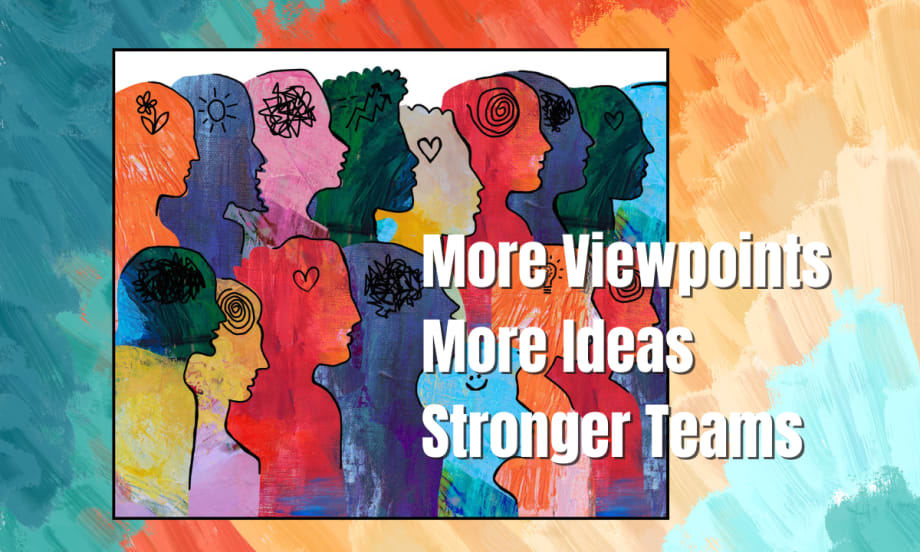
A diversity of experiences, backgrounds, and ideas can help trucking companies avoid blind spots that can happen when everybody is looking at something from the same viewpoint.
Image: HDT Graphic, Getty/StellaLevi
5 min to read
As trucking continues to attract a more diverse range of people, successful fleets are rethinking not just how they hire, but also how they can make the most of a team that doesn’t all think the same way.
Ad Loading...
For years, the trucking industry has been reaching out to different demographics, such as young people, women, minorities, and veterans, to replace a generation of retiring and “aging out” employees.
This is the first in a series exploring how trucking companies can boost performance, retention, and culture in today's more diverse workforce.
But it’s not enough to recruit from a diverse talent pool. Successful fleets will work to manage and support their people to improve retention and create a dynamic that leads to success.
Ad Loading...
To get there means working to make sure every employee feels respected, heard, and set up to succeed.
Multiple Viewpoints Help Avoid Blind Spots
When experts have evaluated failures that led to disasters, from power plant explosions to the Oscar mix-up a few years ago, they’ve found that the root cause is often a lack of diversity in the decision-making team.
“People end up having blind spots where they don’t see a problem coming up, and then that problem comes up and bites them,” says Mark Murrell, president of online training provider CarriersEdge and co-creator of the Best Fleets to Drive For program.
Fostering a culture that embraces a diversity of experiences and ideas “can help avoid the blind spots that come up when everybody has the same background and same mindset,” he says.
Kelly Cruse, vice president of human resources and chief diversity officer at Atlas World Group, explains that when people bring diverse experiences to the table, “that truly is at the heart of what makes a high-performing team.
Ad Loading...
“You’re going to see all angles when you have people with diverse backgrounds looking at the same problem.”
Atlas World Group received an American Trucking Associations Change Leader Award for its work to create a workplace culture that fosters belonging and long-term career growth for their employees.
Photo: Atlas World Group
Cruse's team partnered with the University of Evansville to create bias-awareness training that helped employees better understand how people differ.
That training earned Atlas the Change Leader Award from the American Trucking Associations last year. The award recognizes ATA members that demonstrate commitment to a culture of acceptance and belonging.
“How do we find the brightest and most capable employees to come together? Because we want a strong workforce,” she says. “So how do we make an environment that attracts people to us?”
She points out that diversity isn’t just an internal issue. It affects how a company serves its customers, too.
Ad Loading...
“We have diverse customers. How do we make sure we’re meeting our customers’ needs? And if we put everybody in a room and we’re all the same and we’re all cookie-cutter, we’re not going to meet the needs of our customers or our employees.”
Diversity Is More Than Meets the Eye
Often when people think of “diversity,” they think of visual characteristics — race, gender, age. But the training at Atlas helped workers realize it’s not just about visual diversity; it’s about people’s life experiences, Cruse says.
“Everybody has a different perspective based on their background,” she says.
In her case, she brings the perspective of a woman, a mother, and a Midwesterner. But coworkers may bring very different experiences to the table.
Atlas’ training programs focus on giving people the tools to understand where others are coming from and how to work effectively as a team.
Ad Loading...
“We’re building a workforce that reflects our customers and our communities — and that means thinking differently about what support looks like," Cruse says.
At Polaris Transportation Group, a cross-border logistics company specializing in U.S.-Canada freight, diversity is part of a broader sustainability strategy.
The company believes a strong DEIB (diversity, equity, inclusion, and belonging) strategy is essential for an environment where every individual can thrive.
“This inclusive environment leads to higher employee engagement, better decision-making, and a more adaptable workforce,” the company states on its website. “Ultimately, that contributes to our company's overall success.”
"Part of the sustainability pillar is obviously providing a healthy work environment, equal opportunities, and building a culture of trust and continuous career improvement," says Brenda Brajkovich, director of marketing for Polaris.
Ad Loading...
The Women in Trucking Association last year named Polaris one of the Top Companies for Women to Work in Transportation, and Trucking HR Canada named the company a Top Fleet Employer.
“Our strength as employers is in our ability to celebrate everyone’s uniqueness while promoting a united team culture,” said Polaris Chief Human Resources Officer Laura Muir in announcing last year's Trucking HR Canada award.
“We see the potential in every person on our team and want them to have everything they need to reach it."
Expanding The Circle of Diversity
In recent years, both Atlas and Best Fleets to Drive For have seen diversity defined in broader, more nuanced ways — encompassing language, ability, neurodiversity, and more.
At Atlas, one employee shared during a listening session that although she was fluent in English, it wasn’t her first language, and communication could still be challenging. Her manager responded by taking it upon himself to learn Spanish to better support her.
Ad Loading...
“He wanted to meet her where she was,” Cruse says.
Several Best Fleets to Drive For companies now have office staff fluent in sign language, and Murrell notes a rise in fleets offering resources for deaf or hard-of-hearing drivers.
At Atlas, a renewed focus on inclusion also led the company to evaluate its physical facilities, resulting in new accessible parking areas and automatic doors.
“We’re starting to see diversity having a more diverse definition, where it is not just gender and ethnicity, but diverse abilities as well,” Murrell says.
That includes neurodiverse individuals, who may experience the workplace differently.
Ad Loading...
“Sometimes the hum and buzz of the office or other locations is harder for them,” Cruse says. To support these employees, Atlas connected them with Wesselman Woods — a large nearby urban forest — so they could take restorative nature breaks during the day.
When companies support more diverse groups, what benefits one group can benefit everyone:
A handicap-accessible door button can also help an employee whose hands are too full to easily pull open a traditional door.
Improving security to help women drivers is appreciated by all drivers.
Getting out into nature offers mental health benefits for everyone.
CORRECTION: An earlier version of this article incorrectly attributed a quote to Brenda Brajkovich, director of marketing for Polaris, and had her title wrong. We apologize for the error.
For fleet managers and collision repair professionals keeping heavy-duty trucks on the road, getting the color right the first time isn't just about appearance — it's about efficiency, turnaround time, and bottom-line results. Discover how today's digital color tools are transforming the repair process from guesswork to precision.
Carriers whose updates were due on or after June 1 have more time, while FMCSA works to stabilize its new registration system and warns of phishing sites impersonating its new carrier registration system, Motus.
Cargo theft is no longer just the cost of doing business. It's a multi-billion-dollar criminal enterprise exploiting vulnerabilities across your fleet, drivers, and supply chain.
Explore how telematics help refrigerated fleets improve visibility, uptime, efficiency, compliance, and cargo protection across connected cold chain operations.
Escalating U.S.-Canada tariffs could disrupt cross-border freight, reduce truck volumes, raise costs, and create new uncertainty for carriers on both sides of the border.
The American Transportation Research Institute wants to know what's worrying trucking fleet managers, drivers, and other stakeholders in its annual Industry Issues survey.
HDT Truck Fleet Innovator Adam Buttgenbach helped PepsiCo build one of North America’s largest EV fleets by focusing on where electric trucks make operational sense.