




More Than a Temporary Corrosion Covering: Chemically Bonded Phosphate Ceramics
Fighting corrosion in trucks, ships, tanks, planes and equipment costs the Pentagon $22.9 billion a year
Fighting corrosion in trucks, ships, tanks, planes and equipment costs the Pentagon $22.9 billion a year.
Corrosion costs advanced industrialized nations about 3.5% of GDP to replace damaged material and components, plus a similar amount due to lost production, environmental impact, disrupted transportation, injuries, and fatalities.
While traditional corrosion protection has relied mostly on short-lived physically-bonded coverings of substrate surfaces, a new category of Chemically Bonded Phosphate Ceramics (CBPCs) can create a long-lived passivation layer that stops corrosion. This is further protected by a tough ceramic outer layer. This new category of CBPC holds much promise for the trucking industry, where corrosion of truck and trailer chassis that run across salted roads and trailers that get splashed in salt water is a significant issue.
The Limits of Traditional Corrosion Protection
For generations, polymer paints have acted as a physical barrier to keep corrosion promoters such as salt water and oxygen away from steel and aluminum substrates on trucks and trailers. This works until the paint is scratched, chipped, or breached and corrosion promoters enter the gap between the substrate and polymer coating. Then the coating can act like a greenhouse, trapping water, oxygen and other corrosion promoters and allowing corrosion to spread.
Placing sacrificial, reactive elements next to steel that will corrode first, such as zinc and galvanized coatings, is another strategy. This works until the sacrificial elements are used up and recoating must be done, usually after a few years.
For assets that demand long-term corrosion protection, stainless steel alloys work. But with stainless steel costing up to six times more than mild steel, this option is often cost-prohibitive and can significantly impact a company's bottom line.
A New Approach to Corrosion Protection
Ideally, truck and trailer companies, facility managers, and industrial paint contractors would want the long-term corrosion-resistance of a stainless steel part with the lower cost of coating application. A new category of CBPCs is now making this possible. One example is EonCoat.
"Unlike polymer paints that simply cover a substrate, CBPCs essentially 'alloy' the surface," says Tony Collins, CEO of EonCoat.
Arun Wagh, a former materials engineer at Argonne National Lab, and lead developer of the technologies underlying EonCoat ceramics, explains it like this:
"When a dual-component spray gun mixes an acid phosphate with base minerals and metal oxides in a water slurry, a chemical reaction occurs on the surface of the steel substrate. A handheld thermometer indicates a 10-12 degree temperature rise, as iron becomes a corrosion-resistant passivation layer of iron oxy hydroxide. Because the passivation layer is electrochemically stable, like gold and platinum, it does not react with corrosion promoters such as water and oxygen."
Scanning electron microscopy indicates this passivation layer is about 20 microns thick. X-ray diffraction indicates this passivation layer is about 60% iron with components of phosphate, magnesium, silicon, hydrogen and oxygen.
"History suggests that EonCoat's passivation layer may resist corrosion indefinitely, as demonstrated by the Iron Pillar of Delhi," says Wagh. "The Iron Pillar, a 7-meter-high, 6-ton Indian artifact that has resisted corrosion for 1,600 years with its original inscriptions still legible, has a virtually identical passivation layer to that of EonCoat."
How it Works
In contrast to typical paint polymer coatings that sit on top of the substrate, EonCoat bonds through a chemical reaction with the substrate, so slight surface oxidation actually improves the reaction. This makes it virtually impossible for corrosion promoters like oxygen, water, salt and humidity to get behind the coating the way they can with ordinary paints.
The corrosion-resistant passivation layer is further protected by a ceramic outer shell. This dense ceramic outer shell is impermeable to water, and resists impact, abrasion, chemicals, and fire. The ceramic outer shell forms simultaneously with the passivation layer and chemically bonds with it, after acid and base materials mix in the spray gun nozzle then react with the substrate surface. The dual-layer ceramic coating can be used both as a primer and a topcoat, and can be applied in a single pass that's dry to the touch in a minute, hard dry in 15 minutes, and a truck can be returned to service in an hour.
Though CBPCs such as EonCoat have proven themselves in the laboratory and in examples such as the Iron Pillar, Tony Collins knew that the effectiveness of the new material had to be compared to that of traditional anti-corrosion coatings.
Duplicating a NASA corrosion test, Collins put EonCoat to the test against 19 leading anti-corrosion coatings in a live corrosion test, viewable to the public by webcam. Coated samples were scribed, then exposed to 12 hours of sea spray, followed by 12 hours of sunlight (or the UV light equivalent). After 45 days, every other high-performance coating tested failed, says the company. Except for the rust on its scribe (gouge) line, the EonCoat sample looked the same as day one.
Several of the largest truck fleets in the country are currently conducting similar tests on their own with EonCoat to test its effectiveness on trucks that are constantly being exposed to the harsh elements.
"There's nothing like seeing results with your own eyes," says Collins of the ongoing corrosion tests displayed by webcam. "The product has gone more than 10,000 hours with no corrosion in a salt spray ASTM B117 test, but we believe that truck and trailer facility managers, and industrial contractors will see value in comparing its effectiveness with leading brands. CBPCs like EonCoat are a new approach to corrosion protection that should be looked into as aging trucks, trailers, equipment, and infrastructure need to be safely maintained as long as possible."
Del Williams is a technical writer based in Torrance, Calif., writing for EonCoat.
More Maintenance

Truck Drivers Need More Than Another Alert
Fleets have more visibility into truck health, safety events, and driver activity than ever. The next challenge is turning all that information into useful guidance for the person who has to decide what to do next.
Read More →
The Maintenance Checks Trucking Fleets Should Prioritize Before Fall Freight Picks Up
Making it through August isn’t the same as being ready for the next several months of operation. Find out what systems may have suffered from summer heat and need to be checked out before fall.
Read More →
What Three Fleets Are Doing Differently When Buying Truck Parts in 2026
With freight improving but costs still climbing, fleet maintenance executives explain how they're balancing price, quality, and supplier relationships.
Read More →
Paccar Recalls 2027 Trucks Built This Summer for Possible Electrical Problem
The nearly 6,000 Kenworth and Peterbilt trucks in the recall could potentially lose engine power, among other things.
Read More →
Will API PC-12 Oil Change Trucking Fleet Maintenance?
The new API PC-12 heavy-duty engine oil category reflects the changing demands of modern diesel engines. But fleets like Foodliner are looking to getting their own data before making decisions on adopting the new oils and questions such as extending oil drain intervals.
Read More →
Brake Safety Week to Focus on Drums and Rotors
Commercial vehicle inspectors are focusing on truck brakes during CVSA's Brake Safety Week, August 23-29.
Read More →
Possible Battery-Cable Fires Prompt Recall of 15,000+ International MV and HV Trucks
On the recalled vehicles, manufacturing variations can cause the battery interconnect cable to contact the auxiliary stud and hold down the bracket.
Read More →
Rush, MCT Team Up to Grow Refrigeration Service Network
The joint venture will operate MCT's network of Carrier Transicold dealerships and mobile service locations, with the companies promising greater service capacity and uptime for refrigerated fleets.
Read More →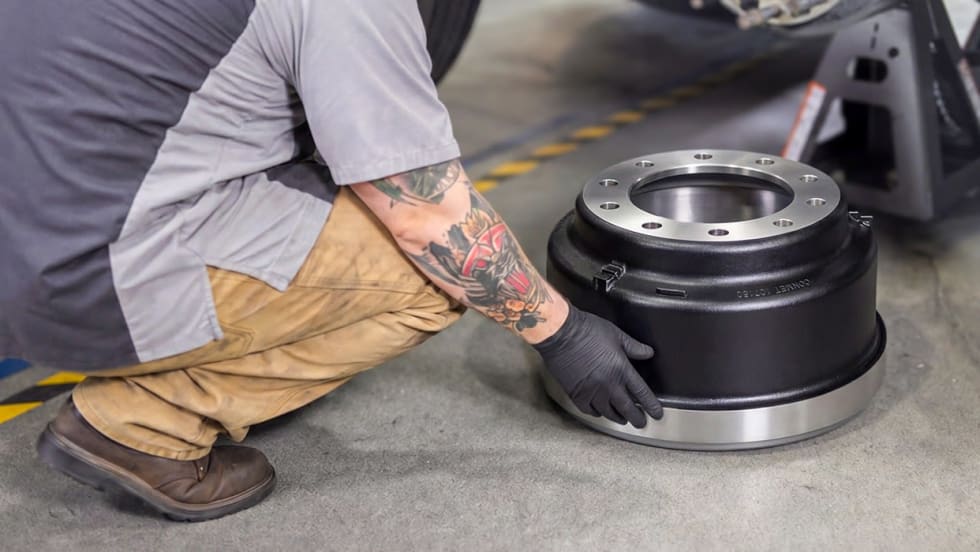
ConMet Expands Aftermarket Brake Drum Lineup With TruCast
A new heavy-duty truck brake drum option in the aftermarket gives customers more flexibility within the ConMet product family.
Read More →
Mack Expands Premium Service Contract Coverage to Medium-Duty MD
With a service contract, inspections, preventive maintenance and repairs can be handled in a single visit instead of multiple ones.
Read More →