




Mistaken Identity: Do Light Loads Really Cause Excessive Tire Wear?
Empty miles can chew up more than your balance sheet. Running empty one way may be good for fuel consumption, but it's hell on tires

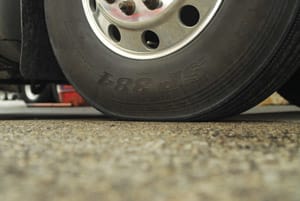
Normally loaded, tires have a flat, even footprint. When empty at highway speed, the only center of the tread makes contact with the pavement.
Empty miles can chew up more than your balance sheet. Running empty one way may be good for fuel consumption, but it's hell on tires.
There's some debate over the impact running empty has on tire wear, but fleets than run a high ratio of light or unladen miles seem to report higher instances of irregular wear such as cupping, scalloping, and flat-spotting. It's not clear whether that irregular wear is a direct result of light tire loading or collateral damage resulting from some other condition, but evidence suggests tires tend to perform much better under pressure than when lightly loaded.
"By far, the largest contributing factor to tire wear is improper tire pressure for the anticipated axle load," says Brian Buckham, program manager for axles, brakes, and wheel-ends at Hendrickson. "With tires typically pressurized for a loaded condition, trailers operating with a high percentage of empty or lightly loaded miles can see a decrease in tire life as a result of the tires being over-inflated for the reduced axle load."
Tread rubber is constantly being scuffed away from a tire at predictable rates under normal loads. But when running light, it wears at a slower rate. If some other factor is causing irregular wear - such as bad alignment or loose wheel bearings - the wear caused by the problem would probably keep pace with normal tire wear under normal loads. But compared to slower "normal" wear rates under light loads, the irregular wear might appear to be more aggressive or more pronounced. This could lead to the assumption that running light or empty is the root cause of the accelerated wear.
Mike Beckett of MD Alignment in Des Moines, Iowa, disagrees with that assumption - to a point. He was once called upon to settle a dispute between a fleet owner, a tire maker, and a trailer maker. A large portion of the trailers in that fleet were burning through tires in about 25,000 miles, Beckett says.
"The fleet ran 250- to 450-mile headhauls and returned empty. Through all the finger-pointing, the high percentage of empty miles emerged as the principle culprit," Beckett says.
Upon inspecting the fleet, however, Beckett found a higher-than-normal incidence of loose wheel bearings, improperly matched tires in dual assemblies, and improper inflation.
"Once all the problems were rectified, and they went to a quality tire, the fleet average miles-to-pull leapt to 150,000 miles," Beckett says. "Was it the high empty miles? No, it was a poor maintenance."
Changing the footprint
Idaho Milk Transport is a textbook case of a high-empty-mile fleet. Based in Burley, Idaho, the food-grade tank carrier runs a lot of dedicated trailers loaded one way and back empty. Leased owner-operator Tony Head, says he has switched to running a closed-shoulder drive tire to minimize cupping along the edge of his dual drive tires.
"I used to run lug tires, but the edges cupped out real quickly," he says. "And I see more center wear on the company's wide-base single trailer tires."
Shawn Estes, IMT's fleet services facilities manager, agrees with Head's observations. While he notes that proper alignment can solve some of the cupping problems, he says running light seems to make the problem worse.
"The unloaded tires just skip down the road without any weight to bear down on the tire," Estes says.
The tread surface is generally pretty close to flat, or square with the road, at operating pressure. Under load, contact with the pavement is pretty even across the tread face. But when empty at normal operating pressure, the center of the tread tends to be slightly higher than the shoulder. This is more acute at high speed, where centrifugal force acts on the tread, causing it to extend outward at the center.
What you get in this situation is an egg-shaped footprint, with the center of the tread having a slightly larger circumference than the edges. This increases the scuffing action, because the edges are not revolving at the same rate as the center of the tread.
"In addition," notes Guy Walenga, director, Engineering, Commercial Products and Technologies at Bridgestone, "an unloaded tire that bounces along the road actually slows while it is airborne, causing a minor bit of scuffing each time it regains contact with the road."
Walenga says tire pressure has a role to play here, as does the damping effect of the suspension.
"Think of a fully inflated tire as a Super-Ball," he says. "With relatively little weight to keep them on the ground, they'll bounce like crazy at normal inflation pressure. The suspension can mitigate this, but only to a certain extent."
Correct tire pressure for the load would have a large influence on tire wear, in theory, Walenga says. But, he admits, adjusting tire pressure downward for one half of the trip is a task few drivers would undertake.
Suspension solutions
Low-spring-rate suspensions could also help to reduce irregular wear by maintaining better contact between the tire and the road.
"Air suspensions typically have a lower spring rate than leaf spring suspensions, and they maintain a relatively constant low spring rate whether the trailer is loaded or empty," explains Jim Rushe, program manager for on-highway products at Hendrickson. "Air suspensions also have shock absorbers that dampen the suspension movement, further improving the suspension's ability to maintain tire contact with the road."
Leaf springs provide a stiffer ride on an empty trailer resulting in a varying load on the tire as it encounters irregular road surfaces, Rushe adds. "Leaf spring suspensions do not have shock absorbers, but the leaf springs themselves provide some damping characteristics."
In many high-empty-mile applications, tires and suspensions run either fully loaded or empty, so "tuning" the suspension and tire pressure to work equally well at opposite ends of the spectrum is realistically out of the question.
"For air suspensions, the air pressure is used to maintain the trailer height, so changing air pressure would have little effect on the spring rate," notes Rushe. "Leaf springs can be designed to provide varying spring rates at different loads, but the amount the spring rate can be varied is limited."
Start with tire matching
Since there are no spec'ing options to help manage this unique situation, the duties seem to fall on the maintenance department's shoulders. Beckett sees this issue cropping up constantly in his alignment shops. He suggests the jump-in point is careful tire matching.
"Mixing brands and models of casings in a dual assembly encourages irregular wear. They don't all have the same sidewall flex," he says. "The more focus on matched brands, models, circumference, and inflation pressure, the better the tires will wear - even under these conditions."
And he says shock absorbers on air suspensions need particular attention. "That's where all the damping takes place. If they're failing, your tires will fail, too."
Since your fuel costs will be lower in a half-loaded application, maybe some of the savings should allocated to the maintenance budget.
Think outside the box
Since it's practically impossible to spec or tune a tire or suspension to an application operating at opposing ends of the spectrum, other measures might do the trick. What follows are suggestions, not tried-and-true solutions born of million-mile field trials. They have some merit on paper, but the ROI will be up to you to prove.
* Alignment
The consensus seems to be that alignment plays a role in irregular tire wear, and wear is exacerbated when tires are run lightly loaded. Keeping the vehicle properly aligned may minimize your irregular wear issues.
* Lift Axles
Lifting one axle of an unladen tandem will obviously reduce wear on those tires. It also increases the load on the working axle, which could help reduce the scrubbing action caused by
More Equipment

Detroit Opens Orders for EPA 2027 Engines
Detroit isn’t starting from scratch to meet EPA 2027 diesel emissions standards. Its Gen 6 DD13 and DD15 engines keep much of today’s platform while updating the fuel and aftertreatment systems.
Read More →
Carrier Transicold Adds All-Electric TRU for Stationary Cold Storage
Carrier Transicold’s new Vector 8200 all-electric transport refrigeration unit gives fleets a diesel-free option for temporary refrigerated and frozen trailer storage.
Read More →
A Closer Look at Kenworth’s Electric T880E Vocational Truck [Video]
Learn more about Kenworth's T880E battery-electric vocational truck at the Paccar Technical Center, including its range, applications, upfitting considerations, and PTO options, in this HDT Spotlight video.
Read More →
Kenworth T880E Brings EV Power to Vocational Trucks
A closer look at the Kenworth T880E’s range, charging, powertrain and upfit options — and where fleets are showing the most interest.
Read More →
What the U.S.-Canada Trade War Means for Trucking
Escalating U.S.-Canada tariffs could disrupt cross-border freight, reduce truck volumes, raise costs, and create new uncertainty for carriers on both sides of the border.
Read More →
Autonomous Truck Testing Moves Ahead in California as Teamsters Challenge Rules
California has begun permitting heavy-duty autonomous truck testing, with Aurora and Kodiak among the first to receive approval, as the Teamsters sue the DMV over the new regulations.
Read More →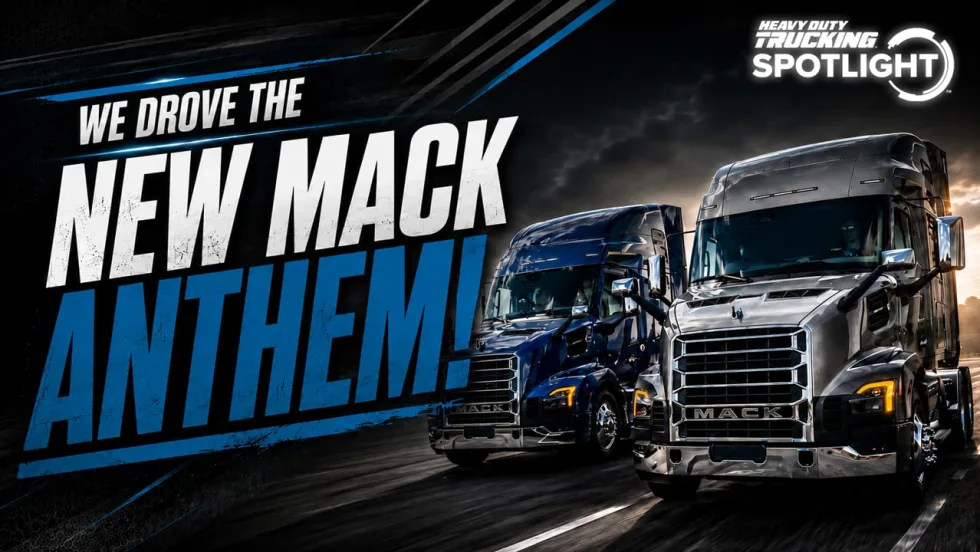
Behind the Wheel of the New Mack Anthem [Video]
HDT takes the new Mack Anthem around Mack’s Pennsylvania test track to see how its driver-focused design, technology, visibility and handling perform from behind the wheel.
Read More →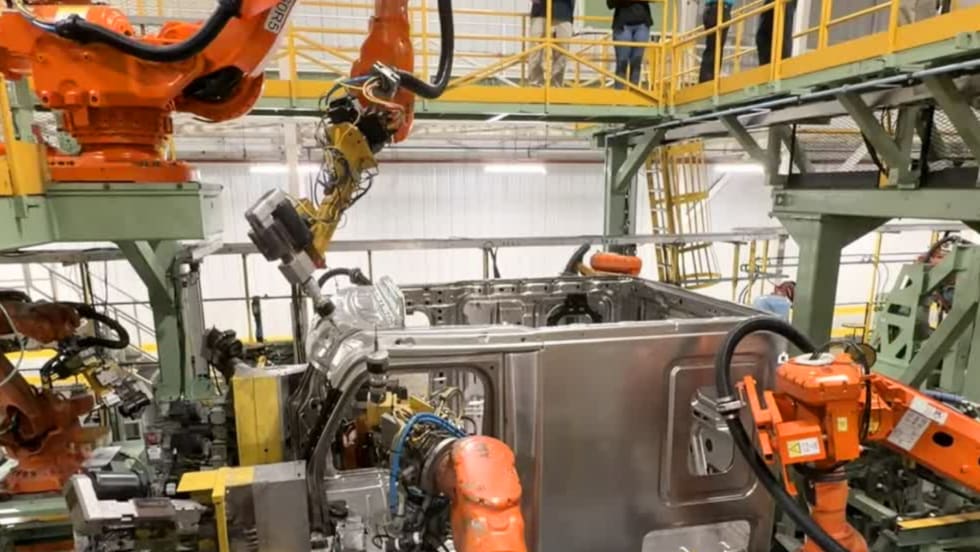
DTNA Plans New U.S. Truck Plant as Manufacturing Footprint Shifts
Daimler Truck North America is evaluating sites for a new assembly plant expected to open in 2029 while winding down operations at its longtime Portland manufacturing facility.
Read More →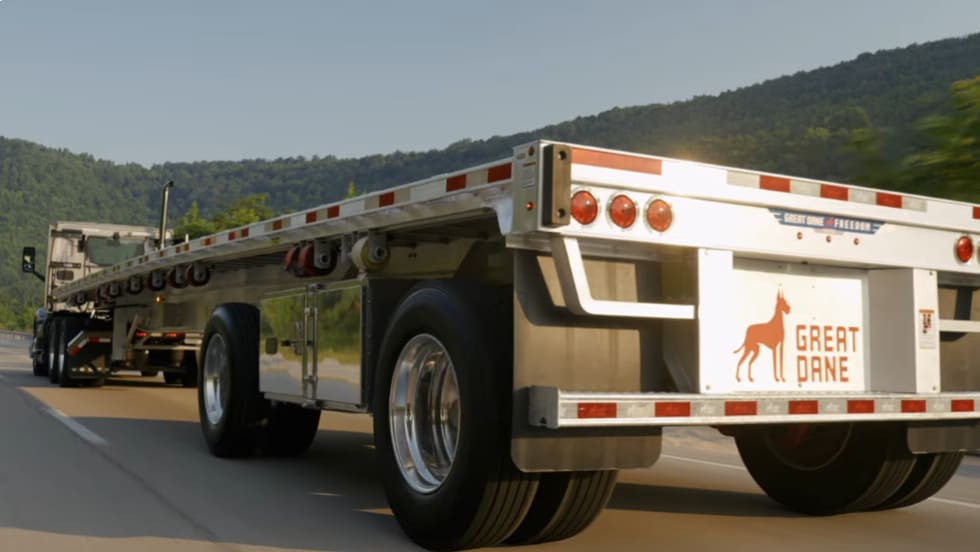
Great Dane Flatbed Trailer Offers Light Weight and Strength
Freedom Ultra is designed for a wide range of open-deck applications, including building materials, lumber, machinery, steel products, industrial freight, and coil hauling.
Read More →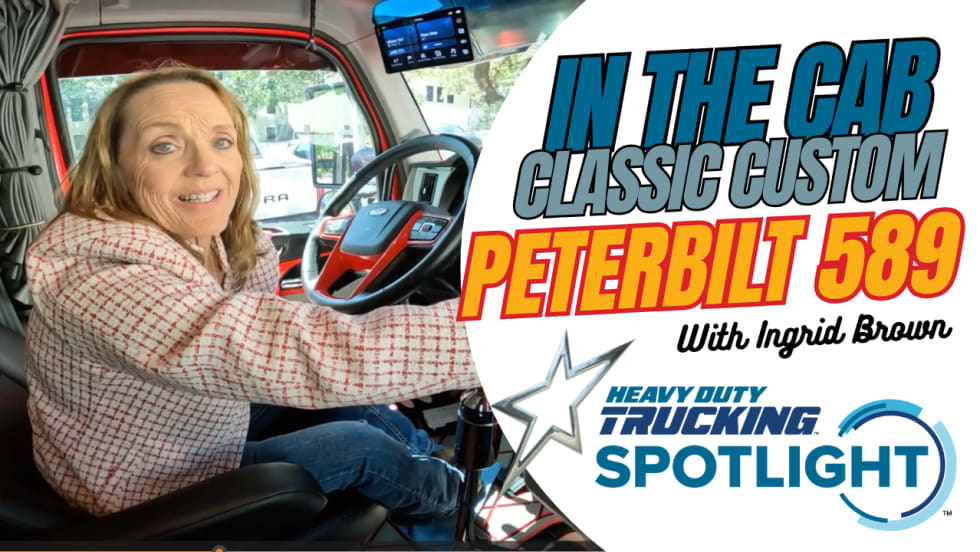
What It's Like Inside this Custom 2025 Peterbilt 589?
Take a driver's-eye tour of this customized 2025 Peterbilt 589 in this video, as longtime driver Ingrid Brown explains its features, compares it to previous models, and shares plenty of personality along the way.
Read More →