




Midrange Engine Trends
More power from smaller packages. That sums up what's been happening in medium-duty engines in the previous decade, where diesels of modest displacement are making more horsepower and torque than was possible before the advent of electronic controls and advanced combustion methods

More power from smaller packages. That sums up what's been happening in medium-duty engines in the previous decade, where diesels of modest displacement are making more horsepower and torque than was possible before the advent of electronic controls and advanced combustion methods.
What's happening in midrange engines is connected to trends in trucks themselves. They've been getting both lighter and heavier as users find advantages in going in both directions. The result is higher horsepower under the hoods of many midrange trucks, for practical and performance reasons.
Performance is at the lower end of midrange, which as a whole we'll call Class 4, 5, 6 and 7 (weighing 14,000 to 33,000 pounds fully loaded). Class 5 trucks have become more popular in recent years as operators realize that a less-massive truck can haul just about anything they want but costs less to buy and run. So they've switched from Class 6 to 5. That's where the sales action has been in commercial trucks, even during the Great Recession, when all sales were down but not quite as much in Class 5.
Domestically built Class 4 and 5 trucks are closely related in chassis and powertrain specifications, and the most popular current sellers from Ford and Dodge are derived from Class 2 and 3 pickups. These all come with 300-plus-horsepower diesels that also make 500 to 600 or more pounds-feet of torque. Their drivers want them to go like their personal pickup trucks, and keeping drivers happy is important because they'll be more likely to more efficiently perform their primary tasks, whatever they might be. Brisk acceleration lets a truck keep up with traffic and theoretically moves it from one job to another, so maybe there's some benefit there, too.
Practicality is at the higher end, in Class 6 and especially Class 7. As owners see that their trucks must carry more tools or products, they've been buying bigger and stronger bodies and chassis, moving them from Class 6 into 7, and extending into Class 8 territory as they cross the 33,001-pound threshold. Heavier Class 7s and Baby 8 trucks need more propulsion power, so horsepower has been going up.
Trucks and tractors that deliver beverages to retail outlets are one example cited by Tim Shick, director, engine sales and marketing, at Navistar International, which sells nearly half of all Class 6 and 7 trucks. "It used to be 80 percent straight truck," he says of beverage hauling. "Now it's almost switched the other way around, and it's nearly 80 percent tractor."
It really started about three years ago, he says, when operators found that customers were buying more soft drinks and beer, and they were hauling more product on their trucks. So the trucks got bigger, but it was more productive to go to tractor-trailers. The trailers are still the beverage type, with bays and roll-up doors, but there are more bays in those trailers, and in straight trucks, too.
"About 35 percent of the trucks in Class 6 and 7 are 225 to 245 horsepower," Shick says. "Above 250 horsepower is another 30 percent. Above 300 is another 8 percent; that was only 2 percent just three years ago. The rest is in the low 200-horsepower range, like the 195 V-8 and 210 DT. The 210 used to be 50-60 percent of the market; the 210 DT was the midrange engine. Not anymore. It's the result of bigger, heavier trucks."
Manufacturers calling for power
But most customers haven't been consciously specifying more power, says Brian Daniels, product manager, powertrains, for Daimler Trucks North America. "It's manufacturer demand rather than customer demand. Manufacturers have been calling for more power" as they've seen their vehicles grow in size and weight. "And they want more power in a smaller package."
For Freightliner's FLs and M2s and the now-discontinued Sterling Acterra line, that meant more use of Cummins' ISB diesel versus the larger ISC. The current 6.7-liter ISB now makes up to 300 horsepower, and more for emergency use. The 8.3-liter ISC goes to 350 horsepower in commercial trucks and more for emergency and other applications where maximum output is only occasional. The 8.9-liter ISL, a heavy-duty diesel with medium-duty displacement, is rated by Cummins at up to 380 horsepower.
Helping the small-engine concept are automatic transmissions, which now go into a large majority of medium-duty trucks. Torque-converter automatics, mostly from Allison in domestic trucks, multiply torque at startup, allowing smaller engines to do more work. A steady flow of torque and horsepower make up for any low numbers in either category, so a truck with an automatic will out-accelerate one with a manual transmission, even if a bigger, more powerful engine is running through the manual. Only at high sustained road speeds will the larger engine do better, but that's seldom a requirement in a midrange truck.
Optimization - precise matching of engine, drivetrain and chassis - also helps, because the engine can more effectively propel the truck and its load, Daniels says. Allison uses the product name Optimized to describe a line with special care in pairing its transmissions with engines and vehicles, and Daimler Trucks has an exclusive on this feature into March.
Longer-lasting engines
Longer service life was and is a reason to buy a bigger-block engine, and in midrange trucks the issue was "parent" bore design versus "wet sleeve" construction, Daniels recalls. The latter's cylinder sleeves, called wet because they're partly surrounded by liquid coolant, can be pulled and replaced or machined at rebuilding time. A parent-bore engine has no cylinder sleeves, so some block material is ground away during rebuilding - fine if done properly, but it's a less safe process than dealing with sleeves.
However, advances in metallurgy and other areas have allowed parent-bore engines to last much longer than before. So the ISB, as an example, may well last beyond the life that the truck's first owner needs or wants. He might trade it in before the B50 life of 350,000 miles, and the second owner can contend with rebuilding the engine, or not if its second life sees low annual miles. And the ISC might last well beyond what its first owner needs, or be economically buildable even if he wants 400,000 or 500,000 miles of use.
Meanwhile, engine makers have done away with under-200-horsepower ratings of their smaller medium-duty models. For example, 170- and 190-horsepower versions of the ISB are now gone, partly due to fewer orders but also to streamline the expensive emissions certification process. An engine builder must demonstrate that its engines meet government exhaust-emissions limits, and this must be done for each rating. The exacting tests cost millions of dollars, so it makes immense sense for a builder to reduce the number of ratings.
Hybrids, electric, alternative fuels
Hybrids, alternative fuels and electric powertrains represent separate but slowly growing power categories in midrange trucks, and ones that have gotten considerable attention in recent years. All are ways to avoid use of imported petroleum and, thanks to federal, state and local tax incentives, can cost less to own and operate than straight diesel trucks, even if the vehicles initially cost far more. While thousands are on the road, they constitute a small percentage of the total midrange truck population. But their future is assured if diesel fuel prices climb, as they have been doing recently, and Congress continues to mandate tax incentives and subsidies for such vehicles.
The Hybrid Truck Users Forum, formed in 2000, has encouraged development and trial use of hybrid-drive trucks, and now has wrapped its arms around alternative fuels and electric trucks. Bill Vam Amburg, who helps run HTUF from his post as vice president at CalStart, a specialty management and advoc
More Equipment

ZF Expands Commercial Vehicle Push in North America
ZF is expanding its North American commercial-vehicle presence with new transmission applications, electrification, trailer technology and autonomous-driving systems.
Read More →
Tesla Wants a Self-Driving Semi. Are Cameras Enough?
Could Tesla’s camera-only autonomous driving technology work on an 80,000-pound Semi? In this commentary, HDT's Deborah Lockridge takes a look at Tesla, Cybercab, and how autonomous trucks see the road.
Read More →
Kodiak: Driverless Long-Haul Truck Launch on Track for 2026
Kodiak AI says its driverless long-haul safety case is 93% complete and it remains on track to begin commercial operations by year-end 2026.
Read More →
What DOT’s Automated Vehicle Strategy Means for Trucking
The U.S. Department of Transportation issued a new automated-vehicle strategy that outlines plans for driverless-truck regulations, cross-state freight corridors, and federal safety standards.
Read More →
East Coast Port Launches $45M Electric Truck Push
The Port Authority of New York and New Jersey announced millions in incentives for zero-emission drayage trucks, yard tractors, and new charging hubs near the port.
Read More →
PlusAI Going Public to Fund Autonomous Truck Launch
A SPAC deal could provide PlusAI with up to $300 million as it works toward a 2027 commercial launch of factory-built autonomous trucks.
Read More →
NHTSA Moves to Rewrite Truck Fuel-Economy Rules
The National Highway Traffic Safety Administration says it lacks authority to regulate medium- and heavy-duty truck engines separately from complete vehicles, but the existing standards have not yet been eliminated.
Read More →
Detroit Opens Orders for EPA 2027 Engines
Detroit isn’t starting from scratch to meet EPA 2027 diesel emissions standards. Its Gen 6 DD13 and DD15 engines keep much of today’s platform while updating the fuel and aftertreatment systems.
Read More →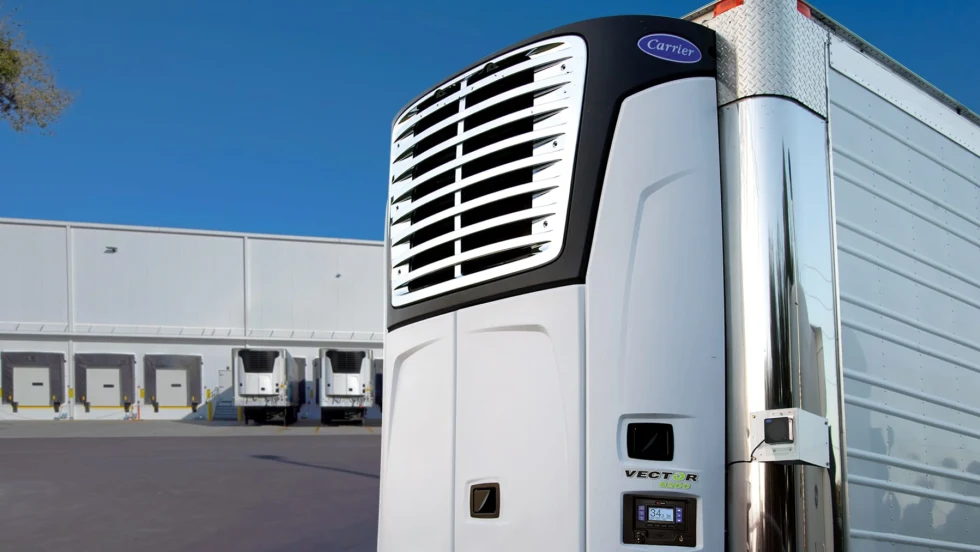
Carrier Transicold Adds All-Electric TRU for Stationary Cold Storage
Carrier Transicold’s new Vector 8200 all-electric transport refrigeration unit gives fleets a diesel-free option for temporary refrigerated and frozen trailer storage.
Read More →
A Closer Look at Kenworth’s Electric T880E Vocational Truck [Video]
Learn more about Kenworth's T880E battery-electric vocational truck at the Paccar Technical Center, including its range, applications, upfitting considerations, and PTO options, in this HDT Spotlight video.
Read More →