




Related: Will Future Trucks Be Powered by Batteries or Fuel Cells?
Meritor CTO Describes Path to Electric Trucks
There’s no question that battery-electric commercial vehicles are on the horizon and John Bennett, the vice-president and chief technology officer at Meritor, says exact predictions about the growth of electric trucks are not important.
by John G. Smith
September 13, 2019
There’s no question that battery-electric commercial vehicles are on the horizon and John Bennett, the vice-president and chief technology officer at Meritor, says exact predictions about the growth of electric trucks are not important.
Image by Paul Brennan from Pixabay
4 min to read
John Bennett, the vice-president and chief technology officer at Meritor, says exact predictions about the growth of electric trucks are not important. “Everybody is at least predicting that it’s higher than today,” he says.
There’s no question that battery-electric commercial vehicles are on the horizon. Every major OEM is working on the technology today, along with emerging manufacturers, he told an audience at FTR’s annual conference. Work is underway in North and South America, Europe, India and China.
“In some cases they already have them in production,” he says. “China especially.”
Those manufacturers that are missing pieces of the puzzle are also in acquisition mode, preparing for an electrified future.
Several factors are expected to drive the interest.
The dropping cost of batteries is “potentially a game changer” when it comes to the business case, he said as an example.
But the true driver of electrification comes in the growing focus on climate change – whether someone believes in it or not, he said. News reports about the perils of climate change is becoming more frequent, and they’re appearing in front of legislators on a daily basis.
Granted, it’s hard to argue that it’s happening. Twenty of the hottest years ever recorded have occurred in the last 22 years, and the four hottest years have been in the past four years. Based on that trend, temperatures will increase three degrees by 2050 and raise ocean levels by a full meter – sinking the coastlines that are home to 10% of the world’s population, he said.
“I don’t know if I believe it, but a lot of governments do, and they’re acting on it.”
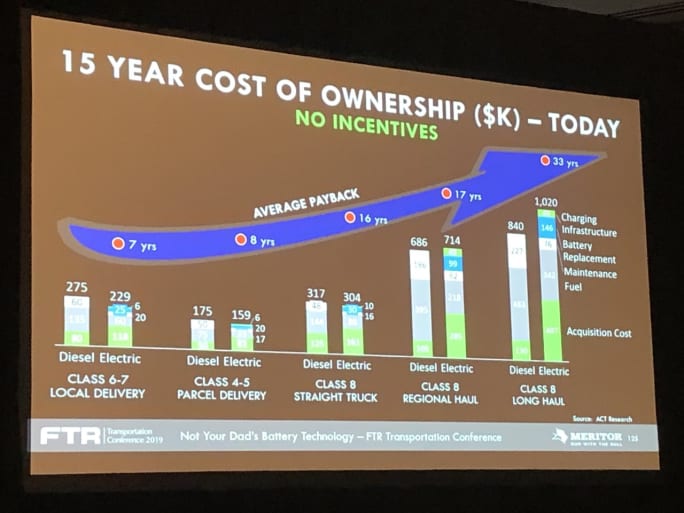
The payback periods on electric vehicles is undeniably longer, but many jurisdictions offset the costs through incentive programs.
Photo: John G. Smith
Carbon dioxide emissions in the crosshairs
Previous emissions regulations have focused on NOx and particulate matter, but now carbon dioxide is in the crosshairs. The European Union alone wants to cut levels 15% by 2025 and another 15% by 2030. That’s led to cities establishing “green zones” that will require zero-emissions vehicles.
“There’s going to be this gradual increase of these low-emission zones, and you won’t be able to enter these zones without a battery-electric truck.”
Countries such as Norway, Sweden and Denmark are looking to be net-zero producers of carbon dioxide by 2050.
Even as the Trump Administration pulls out of the Paris Accord and its pledges to cut emissions, many states continue to move forward with plans of their own, he said.
With the legislated “sticks”, however, comes the promise of incentives like the California HVIP funding to offset the costs.
Electric equipment is undeniably more expensive. A transit bus can cost $200,000 more than its diesel counterpart, while a step van might cost another $50,000, he said. In the latter case, incentives available in the U.S. can deliver a return on the extra investment almost immediately.
Incentives won’t be there forever, though. “This is where the falling cost of batteries comes in,” he said. A 100 kwh battery that cost $120,000 in 2009 is now worth $25,000. By 2025 the price is expected to drop to $15,000.
A battery like that would power a school bus. Commercial vehicles require 200-500 kwh, Bennett said. Tesla wants 1,000 kwh for a Class 8 truck with enough range to have real value.
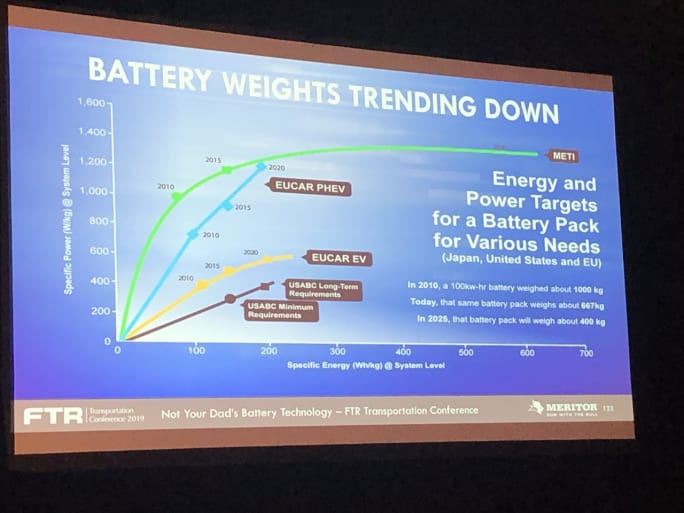
The batteries required for electric vehicles are getting lighter — and quickly.
Photo: John G. Smith
Electric vehicle batteries getting lighter
The price isn’t the only thing that’s dropping, though. The batteries are also getting smaller and lighter. The 100 kwh battery that weighed 2,200 pounds in 2009 weighs in at 1,470 pounds today. By 2025 it could be down to 880 pounds.
Adding to the business case is a lower operating cost. Electricity is less expensive than diesel, and a battery-electric vehicle could save $2,000 to $11,000 per year because of things such as limited brake wear, supported by things like driveline retarders.
As the electric trucks become cheaper, it’s also important to remember that diesel-powered equipment prices will continue to rise, Bennett added, referring to the ongoing introduction of new emission-cleaning equipment.
“Depending on legislation again, that will have a significant influence on when that switchover makes sense.”
Other changes will come. Today’s electric infrastructure is enough to support a market where 20% of the trucks are electric, as long as they’re charged at the right time, he said. Anything beyond that will require investments that will hinge on the will of government administrations. As taxes collected through gasoline or diesel sales continue to decline, the revenues will also need to be replaced with something like a road use tax, he said.
But Bennett thinks fleets should begin investing in electric vehicles before that happens.
“Electric trucks are coming, they are absolutely coming, so take advantage of the incentives while they’re out there and try these vehicles in your operation because every operation is different,” he said.
“Don’t get caught off guard. This is disruptive on many different levels.”
John G. Smith is the editor of the award-winning Canadian publication Today's Trucking. This article was used under a cooperative editorial sharing agreement between HDT and its Canadian counterpart.
Subscribe to Our Newsletter
More Fuel Smarts

How Volvo Updated Its D13 for EPA 2027 [Watch]
Volvo’s updated D13 promises lower emissions without sacrificing performance or fuel economy. Take a closer look at what changed inside the engine in this HDT Spotlight video.
Read More →
Diesel Price Spike Shortens Payback for Natural Gas Trucks, Report Says
Energy Vision estimates fleets could recover the higher purchase price of an RNG-fueled Class 8 tractor in 1.3 to 2.8 years under current fuel-price scenarios.
Read More →
Calstart Becomes Catalyst Mobility, Reflecting Broader Focus
Calstart is now Catalyst Mobility, reflecting the nonprofit’s growing national role in clean transportation, including zero-emission trucks, infrastructure and incentive programs.
Read More →

Record Diesel Prices Squeeze Trucking Fleets
Average U.S. diesel prices have climbed to nearly $6 a gallon, surpassing the 2022 record as tight refinery capacity and Middle East disruptions keep fuel costs elevated.
Read More →
Sponsored•September 9, 2026
How Fuel Delivery Shapes Engine Performance
Fuel delivery depends on more than what happens at the injector. For fleet, maintenance and technical professionals, looking at the full path from pump to injector can provide useful context for understanding engine performance.
Read More →
East Coast Port Launches $45M Electric Truck Push
The Port Authority of New York and New Jersey announced millions in incentives for zero-emission drayage trucks, yard tractors, and new charging hubs near the port.
Read More →
California Bill Could Shed Light on Electric Truck Prices
Why do battery-electric Class 8 trucks remain so expensive? A California bill headed to Gov. Gavin Newsom would give fleets and state agencies more visibility into what manufacturers charge.
Read More →
Detroit Opens Orders for EPA 2027 Engines
Detroit isn’t starting from scratch to meet EPA 2027 diesel emissions standards. Its Gen 6 DD13 and DD15 engines keep much of today’s platform while updating the fuel and aftertreatment systems.
Read More →
Zero-Emission Truck Corridor Planned for West Coast
California, Oregon, Washington, British Columbia and Baja California are coordinating plans for truck charging and hydrogen fueling from Canada to Mexico.
Read More →
A Closer Look at Kenworth’s Electric T880E Vocational Truck [Video]
Learn more about Kenworth's T880E battery-electric vocational truck at the Paccar Technical Center, including its range, applications, upfitting considerations, and PTO options, in this HDT Spotlight video.
Read More →