




Maintaining Tires
Taking care of your tires is one of the easiest types of routine maintenance you can perform on a truck.
Typically, the easier a task, the more likely you are to do it. But for some reason, that doesn't seem to hold true when it comes to tire maintenance. Taking care of your tires is one of the easiest types of routine maintenance you can perform on a truck. You would think every fleet in the world would do it. But some fleets don't – and it's costing them big bucks.
Any tire manufacturer or expert will tell you, the most important part of a tire maintenance plan is simple: Check air pressure regularly. Low air pressure is one of a tire's biggest enemies. It leads to premature and irregular wear, lower fuel economy, increased downtime and many more problems.
Why is air pressure so important? In short, tires can only do what they are designed to do (carry the weight and cargo of the vehicle, absorb shocks, etc.) if they have the right amount of air. Take that away, and you've got an expensive piece of black, round rubber that's going nowhere.
The first step is a good tire pressure gauge. Most tire gauges are accurate to plus or minus 3 psi right out of the box, according to the Tire Retread Information Bureau. Contrary to what some makers of tire gauges claim, TRIB says they have found no significant difference between those from different manufacturers. However, drop a tire gauge (especially a stick gauge) on the concrete a few times and that accuracy goes right out the window. That's why TRIB and other experts advise fleets to calibrate stick gauges using a master gauge on a regular basis in a range of pressures, such as 50, 75, 100 and 125 psi.
The second step is a regular schedule. Ideally, tires should be checked before every trip, and that means making it the responsibility of the driver. But that's probably an unrealistic expectation. There will always be drivers who will never check their tires (or insist on using a virtually useless tire billy) no matter how much you beg and plead or shout and scream. So what's the solution?
"When you start talking about putting an emphasis on inflation pressure, it starts with a formal program for checking tires," says Jim Green, field engineer for Yokohama Tires. "Somehow a fleet has to design a way that makes sense to them that inflation pressure checks are done regularly and adjustments are made." Typically this means checking pressure once a week and anytime a truck rolls into a terminal or shop.
Fleets that make drivers solely responsible for air pressure run a greater chance of having underinflated tires, Green says. "I visited a fleet recently and did a quick check of air pressure on a vehicle while it was in the shop, and one tire had 82 psi and another had 84," he says. "Before I could finish they were rolling the truck out of the shop, because they had given the responsibility of checking tire pressure to the driver and basically no one was doing it."
Some fleets are making their drivers more accountable when it comes to tire pressure, using reward programs. If drivers go a certain amount of time without a tire problem due to poor maintenance such as low air pressure, they get some sort of bonus. While such a program is easier to administer when a driver uses a particular truck all of the time, it can still be done even when a driver uses different pieces of equipment, provided you have a way of tracking who is driving a particular piece of equipment and when.
"Driver behavior is another big factor when it comes to tire maintenance," says Yokohama's Dan Guiney, manager of technical service. "When you're looking at tire maintenance records, you may wonder why one vehicle is so different from another when all other things are equal. It may be possible to trace the problem to the driver."
As important as air pressure is to a good tire maintenance program, so are using your eyes and making sure the truck is in proper mechanical condition. A visual inspection can reveal damage that can be repaired, allowing the tire to continue in service, lessening the changes of a roadside emergency and increasing the chance you will have a good casing that can retreaded in the future.
Such an inspection can also reveal problems such as irregular wear, allowing you to correct a problem and get the most life from your tires. For example, you may see that tires are wearing unevenly or irregularly on the drive axle, which may be corrected with a simple rotation.
"If you have a difference in remaining tread of 4/32 or more between axles, that's an indication you need to rotate just straight from front to back; but a wear pattern that's irregular, then you go for cross rotation, changing the direction of the tires," says Green. When it comes time to replace the drive tires, you may be able to replace eight at the same time rather than four, which gives maximum traction and performance.
To lessen the chances of irregular wear, it's important to have all of the axles in alignment. Michelin says there are four times to check alignment: upon delivery of new vehicles, at the first maintenance check (15,000-30,000 miles or 90 days), when new steer tires are installed or front end components are replaced, and when tire wear indicates a concern.
Any tire manufacturer can provide more detailed information on alignment. There is also information on this topic from the American Trucking Associations' Technology and Maintenance Council. They have a Recommended Practice on total vehicle alignment that includes recommended target values for the alignment of trucks, as well as a recently revised RP for another important aspect of tire maintenance – balancing.
If you think proper air pressure doesn't get enough attention, try balancing. That's because the number of out-of-round tires fleets see is smaller than ever, and new aluminum wheels are so good, especially when proper mounting procedures are used, most tires don't need an excessive amount of balance weight. Nevertheless, tire balance is still important.
"I know there are a lot of major fleets that feel balance is not important, but we would like to see at least steer tires balanced with standard balance weights because it plays into less driver fatigue and greater comfort," says Yokohama's Guiney.
Finally, for a little extra peace of mind, don't forget about the valve stems. Not only should they be replaced anytime a tire is newly mounted, TRIB recommends installing valve caps on all valve stems and keeping them tight to seal against valve leaks and keep out dirt and water. Metal valve caps are best because they contain a rubber gasket to provide an airtight seal.
The bottom line is, tires lose pressure simply because the air permeates through the rubber. There is nothing you can do to stop this. But keeping them filled properly and taking the time to look them over is easy and will give you longer tire life and less downtime.
More Fleet Management

What Geotab's New AI Connector Means for Fleets
Fleets can now ask their usual AI assistants questions about maintenance, safety, fuel use, and vehicle performance, using their live Geotab data, and take action on the answers without leaving their preferred AI tool.
Read More →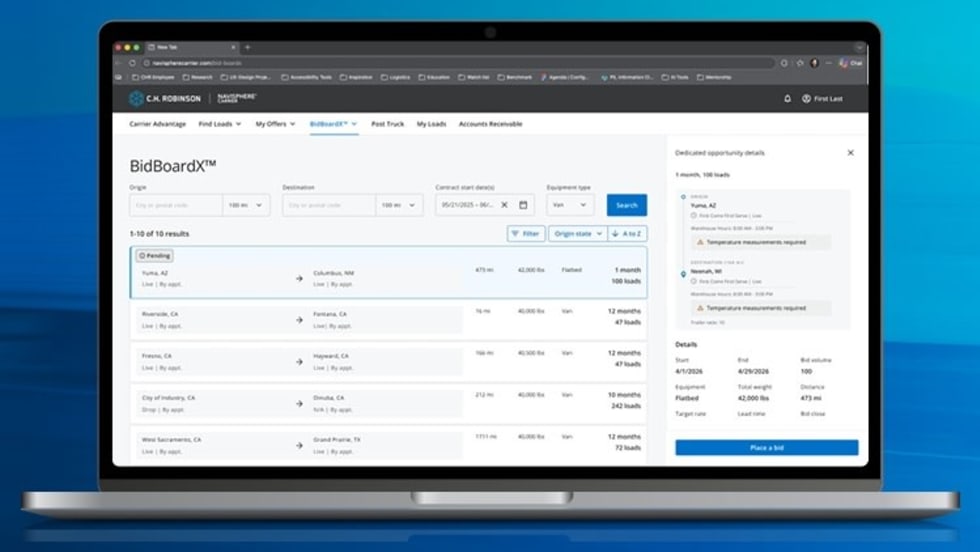
New C.H. Robinson Tool Opens Door to More Predictable Freight
BidBoardX lets carriers search, bid on, and secure committed freight opportunities through a single digital marketplace.
Read More →
New York City's Microhub Project is Delivering Results
Trucking, last-mile delivery companies, and environmental advocates like what they are seeing so far with New York's microhub program.
Read More →

Why Truck Detention Keeps Costing Fleets Time and Money
A 2024 ATRI study found detention affects nearly 40% of truckload stops and costs the industry more than $15 billion annually. Despite the toll on drivers, fleets, and supply chains, the problem remains stubbornly persistent.
Read More →
Time is Running Out to Apply for Exclusive HDT Event
Heavy Duty Trucking Exchange brings fleet managers and suppliers together for the deeper conversations that lead to ideas, partnerships, and solutions. Time is running out to apply for the September event.
Read More →
Amazon Launches Less-Than-Truckload Freight Offering for All Businesses
This launch is the latest addition to Amazon Supply Chain Services, a portfolio of supply chain capabilities from Amazon, including freight, distribution, fulfillment, and parcel shipping.
Read More →
Import Cargo Volume to See Year-Over-Year Gain Again in June, Then Remain Below 2025 Levels Into Fall
After July, the report predicts a weakening in import volume as consumer uncertainty remains high and the impact of increasing inflation takes its toll.
Read More →
AUCTION OF EQUITY INTEREST IN HEAVY HAUL TRUCKING COMPANY!!
Mark your calendar: June 30, 2026 (10:00 a.m. PDT). A 37.5% ownership interest in MagnaTrans, LLC, a California limited liability company doing business as Magna Transportation Group, will be sold in an in-person and online auction to the highest bidder or bidders under Article 9 of the Uniform Commercial Code. The Rancho Cucamonga-based heavy haul and over-dimensional trucking company operates across California, Oregon, and Arizona.
Read More →
Volvo Trucks Adds Unattended Over-the-Air Software Update Capabilities
The latest evolution of Volvo’s over-the-air update technology allows software updates to run while trucks are parked, helping fleets keep vehicles current without disrupting operations.
Read More →
How Waste Connections is Using Data, Telematics, and AI
How do you manage and maintain more than 18,000 connected trucks? Data. Lots of it.
Read More →