




Mack's MD Electric Simplifies Fleet Transition from Fossil Fuel
Mack's MD Electric offers flexible charging options for fleets of all sizes and applications. See what HDT’s Jim Park thinks of the Mack MD Electric after giving it a test spin at Sonoma Raceway.

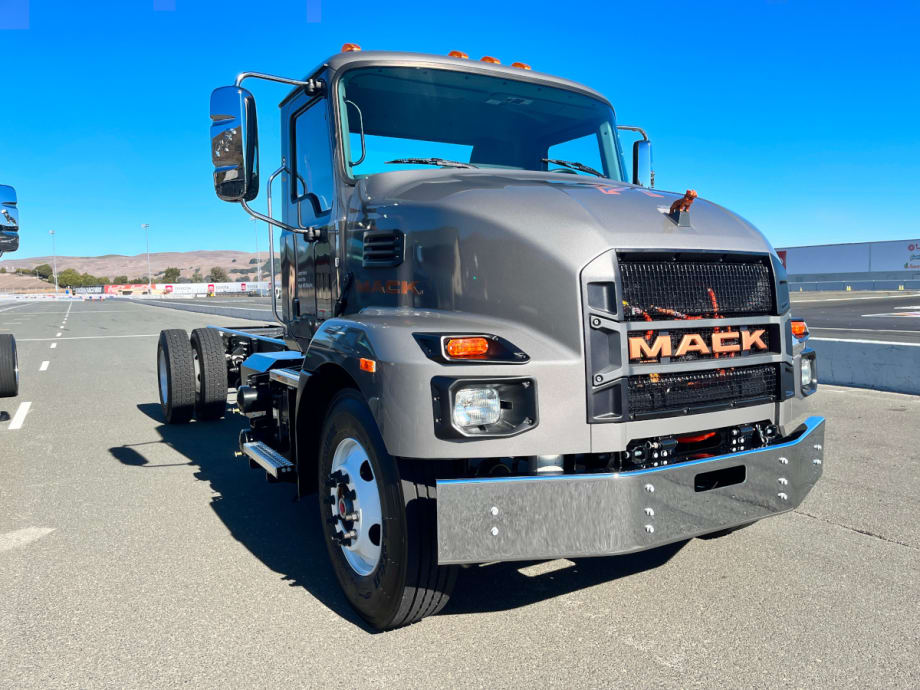
Mack's MD Electric Is best suited for P&D and route delivery applications with dry and refrigerated van bodies, tow trucks and light dumps with e-PTO requirements, and stake bodies.
Photo: Jim Park
The medium-duty box truck might be the best prospect fleets currently have for beginning the transition to battery power from traditional diesel or gasoline engines. There are still some painful realities to be overcome in the heavier Class 8 space, but a Class 6 or 7 box truck is about the simplest configuration on the road today, and probably the easiest of the heavier vehicle classes to electrify.
The North American Council for Freight Efficiency believes that nearly the entire medium-duty box truck market segment is ripe for electrification right now. That's about 380,000 vehicles, according to NACFE, representing a possible avoidance of about 7.7 million metric tonnes of CO2e or “carbon dioxide equivalent” annually.
Recognizing an opportunity too good to pass up, Mack Trucks is offering new Class 6 and 7 MD Electric cab and chassis.
Mack's MD Electric was introduced at the National Truck Equipment Association 2023 Work Truck Show in Indianapolis in March. However, it made its full media debut in late October at a media/dealer ride-and-drive event at the Sonoma Raceway in Sonoma, California.
At the same event, Mack released details of a new Truck-as-a-Service subscription program that makes it much easier for fleets, even really small fleets, to transition away from fossil fuels.
About the Mack MD Electric Truck
As the name suggests, the MD Electric is a battery-electric version of the now three-year-old Mack MD model.
The truck is available in 4x2 configurations, and it's well suited to the task. It features a short 103-inch bumper-to-back-of-cab (BBC) measurement and a ZF steering gear for sure steering and a sharp wheel cut in tight urban settings.
The battery packs are located between the frame rails in three locations: under the hood, under the cab, and directly behind the cab. Customers opting for the 150 kWh two-battery configuration will not see the battery directly behind the cab.
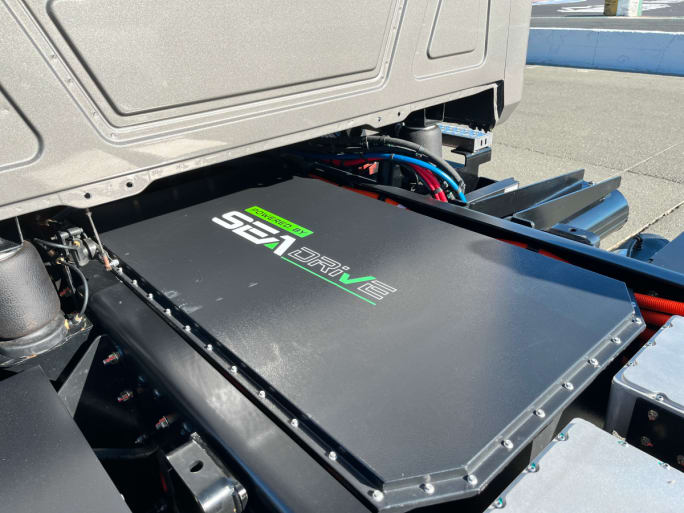
Mack reviewed several powertrain options at the onset of the project, deciding ultimately on the SEA Electric solution. It was determined to be the best fit for its medium-duty product in the North American market.
Photo: Jim Park
"That's a safe position for the batteries, and it leaves the side rails free for truck equipment manufacturers to mount things they might need. It makes body mounting easier," noted Scott Barraclough, Mack Trucks' senior product manager, emobility.
The frame rails are clean for the most part. A small about of space on the right-hand side just behind the cab is occupied by the 24-volt two-cylinder reciprocating air compressor for the truck's air brake system. Over on the left-hand side lives the cooling module for the batteries, motor, and power electronics.
The batteries are air-cooled, but that is supplemented with temperature monitoring software that will automatically derate the output of the motor or slow the charging rate a little if any of those components starts to get a little warm. There's no radiator up front under the hood, leaving that space open for improved airflow over the sensitive electronics. That also means there's no cooling system maintenance needed.
Further back on the frame, just forward of the drive axle, is the motor. It's connected directly to the drive axle. There's no transmission. It's direct drive, but the axle has a 5.75:1 reduction. It can manage a top speed of 70 mph, but there's still tons of hill-busting torque available at startup.
The top of the frame is flat, of course, and all the components are mounted below frame level. It's business as usual for truck equipment manufacturers and body installers. Mack has also used existing bolt patterns where possible to minimize confusion during production and body installation.
It's worth noting that the weight distribution of the truck has hardly changed. It's only 3,000 pounds heavier than a diesel. It picked up a little more weight on the steer axle than the drive axle, but customers won't have to worry if existing payloads are within spec for the truck.
The MD Electric is aimed at the route delivery market, food service, etc., and is ideally suited to dry or refrigerated van or stake bodies. It has also been engineered for light dump applications or tow trucks and can be equipped with a 10kW e-PTO unit to drive accessory equipment like hoists.
And maybe the best news of all: The Class 6 version does not require a commercial driver’s license to operate for non-hazardous payloads.
Inside the Cab of the Mack MD Electric
The Mack MD Electric has a stylish cab based on the Mack Anthem on-highway model, so it's bound to attract interest from drivers on that count alone. The cab is roomy and comfortable with great visibility and really good ergonomics. On top of the optional air-ride main suspension, cab air suspension and an air-ride driver's seat are standard equipment.
The dash panels and the instrument cluster remain largely unchanged from the diesel version. Gone, however, is the tachometer and some of the monitoring gauges, such as oil pressure, coolant temp, and of course, the fuel gauge.
That tachometer is replaced by a power meter. It illustrates graphically the level of current flow into or out of the battery. When accelerating, the needle swings to the right. When in regenerative braking mode, the needle swings to the left, indicating the battery is charging. This is the most useful tool for drivers wishing to make the most out of every charge. They will quickly grasp that hard acceleration — when the needle is pegged over the right — consumes a lot of energy.
There's also a battery start-of-charge indicator that is sensitive enough to show positive results during regen braking. Drivers will immediately see the benefits of making the most of every deceleration event, too.
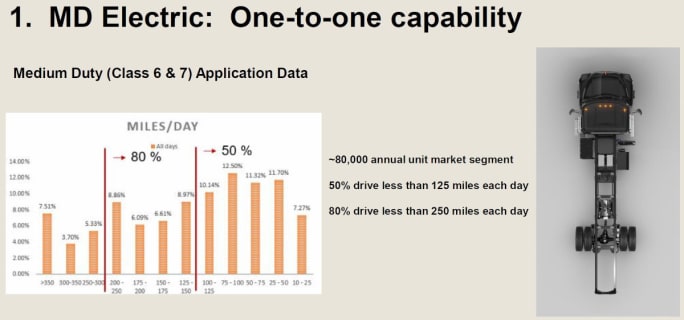
Figures on the x-axis represent mileage traveled. The y-axis represents the percentage of the vehicle population. Mack found that 80% of its MD customers drive less than 250 miles per day, while 50% of the customers drive less than 125 miles per day.
Source: Mack Trucks
Driving the Mack MD Electric
I had the opportunity to drive the diesel version of the MD a couple of months after it launched in March 2020, just as the pandemic was gripping America. It impressed me then, and that holds true for the electric version.
I noted at the end of that test drive story that the MD was a truck perfectly suited for electrification. Mack wasn’t making any predictions at that time, but here it is — an all-electric MD.
Aside from changing out the diesel powertrain for an electric motor and batteries, not much has changed on the MD. It still has an impressive list of standard driver comfort features, and I remarked at the time how quiet the cab was. It was right up there with most of the high-end Class 8 models I’ve driven recently, including the Anthem. I also really liked the steering and handling of the truck.
"The steering was a delight, and the handling on S-curves and less-than-perfect country roads was remarkable," I wrote. "It was right at home on downtown city streets. A right turn from the curb lane, owing to the length of the truck, required me to cross only slightly into the adjacent lane to complete the turn. Good marks for maneuverability."
During the ride-and-drive event, we drove a couple of laps around the track at the Sonoma Raceway. It wasn't a full-length test drive, but it still left me satisfied. There were several grade changes to the track and some good twisting turns.
The regenerative braking was really nice. It has a three-position selector mounted on the steering wheel that allows drivers to choose the level of retarding power needed, much like an engine brake. Position three (full) was a bit aggressive for the lightly loaded trucks we drove, but with a bit of weight in the box, it would be well on its way to being a one-pedal truck in the hands of a skilled driver.
Obviously, it was super quiet and really torquey. It's electric, after all, and all BEVs share those attributes. But the MD is quiet to begin with. I think drivers will love working full shifts in relative silence.
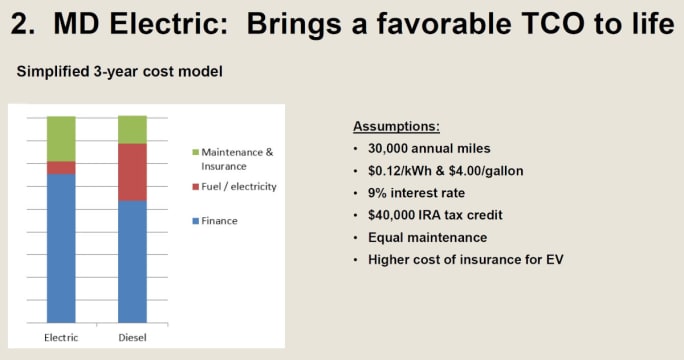
Based on some generalized and simplified calculations, Mack says the sweet spot where TCO turns positive on the MD model is about three years.
Source: Mack Trucks
The Business Case for Medium-Duty Electric Trucks
Unlike the Class 8 side of the business, the stars are better aligned for electrification of medium-duty trucks, particularly for box trucks like Mack's MD. As HDT has written previously, positive TCO (total cost of ownership) on such trucks is already proven.
“Light- and medium-duty are the ideal applications for [electrification] right now,” said Lydia Vieth, a research analyst in electrification and autonomy at ACT Research, as we earlier reported. “Our analysis already shows there’s a positive financial case for switching from diesel to electric.”
Based on some generalized and simplified calculations, Mack says the sweet spot where TCO turns positive on the MD model is about three years.
"The three-year mark is where you get the positive TCO," said George Fotopoulos, Mack vice president and e-mobility business unit leader, speaking at the Sonoma Ride-and-Drive event. "Obviously, this is going to grow through the fourth- and fifth-year marks, and the delta is going to get better all the way out through 10 years."
Mack based its assumptions on factors such as:
30,000 annual miles
$40,000 Inflation Reduction Act tax credit
Equal maintenances costs between diesel and electric
Slightly higher insurance costs
9% interest rate on financing for a diesel and energy costs of $0.12/kWh versus $4 diesel fuel.
Weight and Range for the Mack MD Electric
For most medium-duty users, some of the big factors that limit acceptance of Class 8 trucks — excess weight and reduced range — don't come into play. Mack says the 26,000-lb GVW Class 6 version of the MD electric with the 150-kWh battery configuration will be just 1,000 pounds heavier than the diesel version. The 33,000-lb GVW Class 7 version of the MD Electric will be about 3,000 pounds heavier than its diesel counterpart.
Mack's published range estimates of 140 miles for the 2-battery 150 kWh configuration, and 230 miles for the 240 kWh 3-battery put the MD Electric, fit squarely within documented customer use profiles.
"The range test that we do is based on diminishing loads — out fully loaded, return to base empty," said Fotopoulos. Testing was done in the Greensboro, North Carolina, area in ambient temperatures that are pleasant for human beings, he said, but noted that climate is a range-determining factor, so "cold or really cold weather could shorten the estimated range by 10%-20% respectively."
Mack believes this truck will be a one-for-one replacement for existing diesel trucks in most applications. Fleets will not need two or three electric MDs to replace a diesel because of weight and range restrictions or availability constraints imposed by charging times.
Shippers are getting serious now with corporate social responsibility and environment, social, and governance (ESG) goals. They are actively urging their transportation providers to get aboard, too, and the sooner the better.
Medium-duty box trucks such as the MD Electric are a less complex way into that space than Class 8. And Mack is making it about as easy as it could be for fleets.
More Equipment

How Volvo Updated Its D13 for EPA 2027 [Watch]
Volvo’s updated D13 promises lower emissions without sacrificing performance or fuel economy. Take a closer look at what changed inside the engine in this HDT Spotlight video.
Read More →
Michelin Tire Improves Efficiency and Durability for Regional Fleets
The Michelin X Multi Energy D2 is a regional haul drive tire engineered to help fleets improve fuel efficiency, durability and traction in demanding stop-and-go operations.
Read More →
ZF Expands Commercial Vehicle Push in North America
ZF is expanding its North American commercial-vehicle presence with new transmission applications, electrification, trailer technology and autonomous-driving systems.
Read More →
Tesla Wants a Self-Driving Semi. Are Cameras Enough?
Could Tesla’s camera-only autonomous driving technology work on an 80,000-pound Semi? In this commentary, HDT's Deborah Lockridge takes a look at Tesla, Cybercab, and how autonomous trucks see the road.
Read More →
Kodiak: Driverless Long-Haul Truck Launch on Track for 2026
Kodiak AI says its driverless long-haul safety case is 93% complete and it remains on track to begin commercial operations by year-end 2026.
Read More →
What DOT’s Automated Vehicle Strategy Means for Trucking
The U.S. Department of Transportation issued a new automated-vehicle strategy that outlines plans for driverless-truck regulations, cross-state freight corridors, and federal safety standards.
Read More →
East Coast Port Launches $45M Electric Truck Push
The Port Authority of New York and New Jersey announced millions in incentives for zero-emission drayage trucks, yard tractors, and new charging hubs near the port.
Read More →
PlusAI Going Public to Fund Autonomous Truck Launch
A SPAC deal could provide PlusAI with up to $300 million as it works toward a 2027 commercial launch of factory-built autonomous trucks.
Read More →
NHTSA Moves to Rewrite Truck Fuel-Economy Rules
The National Highway Traffic Safety Administration says it lacks authority to regulate medium- and heavy-duty truck engines separately from complete vehicles, but the existing standards have not yet been eliminated.
Read More →
Detroit Opens Orders for EPA 2027 Engines
Detroit isn’t starting from scratch to meet EPA 2027 diesel emissions standards. Its Gen 6 DD13 and DD15 engines keep much of today’s platform while updating the fuel and aftertreatment systems.
Read More →