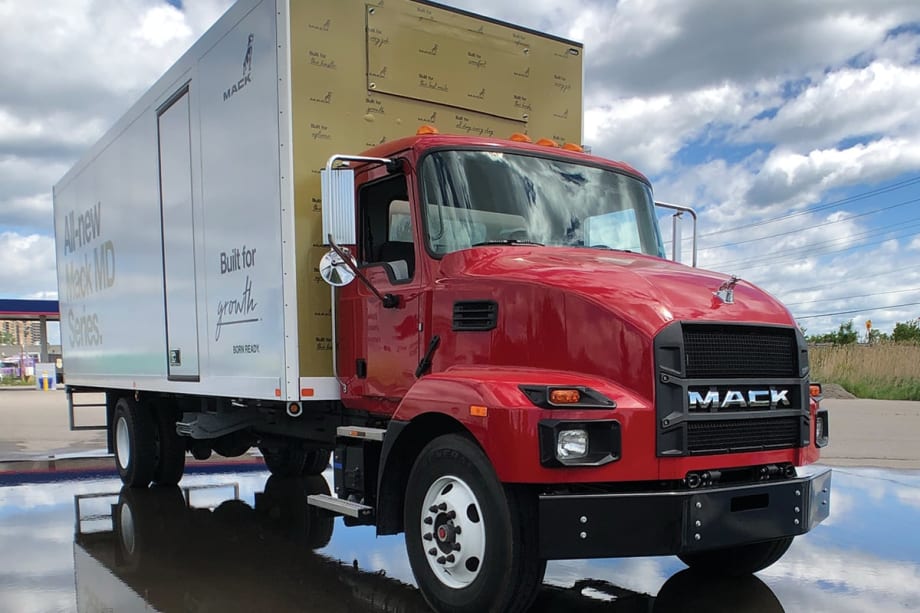
The introduction of the MD series trucks returns Mack Trucks to the medium-duty market after a 17-year hiatus. It was worth the wait. HDT's Jim Park has an industry-first test drive of the new truck.
Mack’s MD series opens new markets for the truck maker, whose customers previously had to go elsewhere for their medium-duty equipment.
Photo: Jim Park
9 min to read
Mack Trucks strode back into the medium-duty market earlier this year, after a 17-year absence. The MD Series are Class 6 and 7 straight trucks aimed at private fleets and the pickup and delivery crowd. That’s not Mack’s traditional customer base, but the dealer network has been pushing hard for a slice of the nearly 100,000 medium trucks built for the U.S. and Canadian market each year.
Ad Loading...
“MD is a good strong market, and it makes sense for Mack to become a full-line, Class 6-8 supplier to the industry,” said Jonathan Randall, Mack Trucks senior vice president of North American sales and marketing, speaking at the reveal of the MD model at the Work Truck Show in early March.
At the time (a few weeks prior to the real onset of the coronavirus pandemic), Randall was predicting orders for 240,000 Class 8 trucks for 2020, with a slight shift in the product mix of product registrations, favoring work trucks and straight trucks at the expense of highway trucks. Little could he have known then that orders for all types of medium and heavy trucks would be slashed by the pandemic. As of June, Class 8 orders were down about 37% and Class 5-7 order were down 54%, according to ACT Research and FTR.
Ad Loading...
Adding the MD to the lineup won’t help Mack much this year, but along with the Granite and LR models, the company’s product mix will be a little less susceptible to the swings in demand historically seen with highway tractors.
The Medium-Duty Market
The MD is initially targeted for the van/reefer box truck segments along with stake trucks, dumps and tankers, Randall said. “Those four segments make up about 70-75% of the total Class 6-7 market. Within the 100,000-truck total medium-duty market, about 65% are Class 6, the rest are Class 7.
“A lot of our Class 8 customers are in the medium segments too, but they had to go somewhere else to satisfy their Class 6 and 7 needs,” Randall added. “Now they have a single source for their equipment needs, and the MD opens up additional markets for us as we continue to grow our share of the market.”
Mack will build the MD at a new facility in Roanoke Valley, Virginia. Production was originally slated to begin in July, but has been pushed back until Sept. 1 due to the pandemic.
The MD isn’t Mack’s first medium-duty rodeo. The company offered a low-cab-forward Class 6 model called the Mid-Liner from 1979-2001, when it was replaced by the Mack Freedom. (Both were built by Renault in France, which had a stake in Mack starting in 1979, with Mack becoming a wholly owned subsidiary in 1990. Volvo bought Mack and Renault in 2001).
Ad Loading...
Mack introduced a conventional version of the Mid-Liner, the CS300P, in 1988. The company withdrew from the medium-duty market in 2003 when it halted production of the Freedom series.
The MD is right at home on a busy city street. Even with a 26-foot cargo box, I could make right-hand turns just barely encroaching on the opposite lane of traffic.
Photo: Jim Park
Lots of Standard Features
Mack will build two versions of the new truck: the Class 6 MD6 (19,501-26,000 pounds GVWR) and the Class 7 MD7 (26,001-33,000 pounds GVWR). There's also a Low Profile version of the MD6. The MD6 will not require a commercial driver’s license to operate, but the MD7 will. Both versions are equipped with air brakes, but the lighter GVWR on the MD6 eliminates the need for an air brake endorsement.
The suspension and axle ratings on the MD6 are lighter, 10,000 and 17,000 pounds, compared to 12,000 and 21,000 for the MD7. The MD6 comes with 7-mm frame rails, while the MD7 features an 8-mm frame. Both are rated at 120,000-psi yield strength compared to the industry-standard 80,000 psi. Other than that, the two trucks are basically the same.
Both offer Mack’s AL 190 (19,000-pound)/AL 210 (21,000-pound) optional rear air suspensions and rear-axle uprates to 21,000 pounds. Chassis configurations accommodate body lengths of 10 to 26 feet on eight wheelbase options ranging from 150 to 270 inches.
The MD6 is also available in a low-profile configuration, which lowers the chassis height for easier street loading, making it ideal for last-mile delivery or even towing and recovery. It comes with 19.5-inch wheels rather than the taller 22.5 standard tires.
Ad Loading...
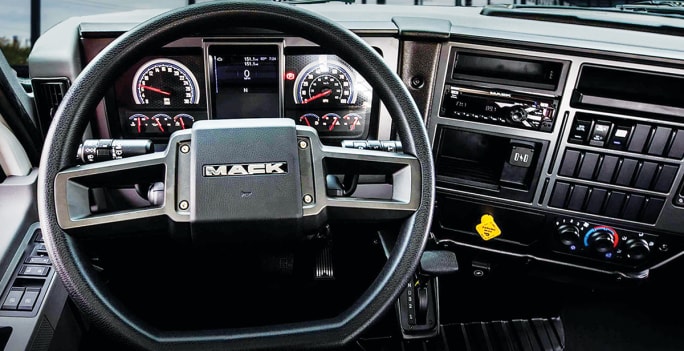
Inside, Mack brought many of the amenities found in the Class 8 Anthem cab over to the MD cab, including the stylish dash A and B panels and the flat-bottom steering wheel. Various bits of interior door and cab trim come from the Granite and Anthem models. The cab shell and doors are based on the Granite, and the cab has dual air-bag cab suspension for additional driver comfort and structural durability. The only significant modification from the previous cab design is the wrap-around portion of the dash B-panel, which had to be set forward a few degrees to make more knee room for the folks sitting in the center position of the bench seat.
Standard features include power windows and door locks, cruise control, air conditioning, and an air-ride high-back driver’s seat, which are sometimes available only as optional upgrades on other Class 6 and 7 models. Almost everything a driver could want comes standard with the MD, so there’s not a long list of options available.
The cab has a decidedly retro “bull-nose” look thanks to the short 103-inch bumper-to-back-of-cab measurement. This gives the advantage of a shorter turning radius and the ability to put a little more weight on the front axle in higher-payload applications.
Visibility is outstanding to the front and sides, and the cut-away side windows offer a view very close to the side. An optional peephole window is available for the passenger door.
The cab and dash are more than most straight-truck drivers will be used to, and should make the MD a go-to truck for fleets looking to recruit drivers.
Photo: Jim Park
Powertrain
Since Mack doesn’t make a medium-duty powertrain, Cummins and Allison got the nod for the MD Series. The on-road version of the Cummins B6.7 is well proven, having been in production for 38 years. Cummins says B6.7 engines in the 200-260 hp rating family can typically deliver an 8.5% fuel economy improvement over the EPA 2013 version, thanks to improvements to combustion and aftertreatment system design resulting in increased airflow to the VGT Turbo. Mack offers the B6.7 in ratings from 220-300 hp with 660 lb-ft of torque across the board.
Ad Loading...
The Single Module aftertreatment system combines diesel particulate filter, selective catalytic reduction, and diesel exhaust fluid dosing in one unit. Non-CDL drivers will probably need some training on the DEF refill requirements and aftertreatment regen procedures, but other than that, the B6.7 is long on performance and light on maintenance requirements.
The Allison 2500 HS 6-speed automatic is an industry bulwark and needs practically no introduction. It comes standard with FuelSense 2.0 Plus. The 2500 RDS is an optional upgrade and it can be spec’d with FuelSense 2.0 Max and power take-off options.
All that to say, Mack is coming back to medium-duty with a strong-looking product offering that gives experienced truck buyers everything they would need in such a truck without overthinking the spec. For buyers who see a truck simply as a means of getting product to market, it might take a bit of a nudge before they’ll see the value proposition compared to a bare-bones, utilitarian six-wheeled box. But the “Built Like a Mack Truck” mantra will probably hold water and help sell the MD as sure as its savvy standard spec.
Driving the MD7
The travel bans in place due to COVID-19 have put a wrench in our usual test drive process, but I stumbled upon this MD7 parked at the Vision Truck Group’s dealership in Stoney Creek, Ontario, in early June. It had been shipped to Canada to make an appearance at Toronto’s Truck World show, since postponed due to the pandemic. I made a few calls to procure all the official blessings and in no time had a test drive arranged. So, this is a global exclusive. You read it here first, folks.
I spent several hours up close to the MD shooting a Focus On video of the truck, so I had plenty of opportunity to poke into the nooks and crannies of the thing. It’s really well put together. All the service points and driver inspection points are easy to access, with the possible exception of the auto transmission fluid level dipstick. It’s located up above the Cummins engine and might be a stretch for a vertically challenged driver. Otherwise, top marks for the pre-trip.
Ad Loading...
The driving position is super-comfortable and the visibility is great. The biggest surprise was the absence of road and engine noise.
Photo: Jim Park
Everything in the MD cab checked out fine; after all, it’s based on the proven Anthem and Granite platforms. Driving position, steering wheel adjustment, sight lines, all great. The only rub was the transmission shift lever. It doesn’t have a “park” position, and the slot for reverse is at the top, where a driver might expect to find “park.” As we all do in cars, we shove the shift lever full forward when parking. If a driver were to forget to set the parking brakes before bailing out, believing the truck was in park, a few of these may wind up being chased around parking lots by frantic drivers. Since the MD6 will wind up in the hands of non-CDL drivers, this is probably something worth having a second look at.
I wasn’t an hour into the drive when I had made up my mind on the MD7, and it just got better from there. We did about 15 miles at highway speed and I was shocked at how quiet it was in the cab. It was right up there with most of the high-end Class 8 models I’ve driven recently, including the Anthem. Having a conversation in the cab was not a problem.
The steering was a delight, and the handling on S-curves and less-than-perfect country roads was remarkable. It was right at home on downtown city streets. A right turn from the curb lane, owing to the length of the truck, required me to cross only slightly into the adjacent lane to complete the turn. Good marks for maneuverability.
I really liked the Cummins/Allison combo, too. Allison’s FuelSense 2.0 really smooths out the upshifts and gives it an almost automotive feel. Drivers will really like that. And the B6.7 was much quieter than I expected.
Also, the mirrors are as solid as a rock. Absolutely no vibration in the wind at highway speed or while idling around the yard. That’s a huge plus.
Ad Loading...
Coming out of the gate, Mack is targeting the MD at the local and P&D sectors, seeing it fitted with van and reefer boxes, flat decks and even fuel tankers. I can see it as an expeditor (with a rear-axle ratio change) and probably even a battery-electric version. Mack wasn’t making any predictions, but this truck is designed for exactly the application best suited to electrification. Seems like a no-brainer to me.
Updated 11:30 a.m. EDT 7/28/2020 to correct information on the specifics of the Cummins engine. We apologize for the error.
Spec Sheet: Mack MD7
Class 7 straight truck chassis with 26-foot Schmitz Cargobull M.KO COOL insulated body
Engine: Cummins B6.7 250 hp/660 lb-ft
Transmission: Allison 2500 HS 6-speed automatic, FuelSense 2.0 Plus
Front End
Axle: Meritor MFS 12 I-beam 12,000 lbs.
Suspension: Mack taperleaf, 12,000 lbs.
Brakes: Meritor S Cam, 16.5" x 5" Q+
Tires: General RA 11R22.5, steel wheels
Rear End
Axle: Meritor MS-21-13x 21,000 lbs. 5.29:1
Suspension: Taperleaf 21,000 lbs.
Brakes: Meritor S Cam, 16.5" x 7" Q+
Tires: General RD 11R22.5, steel wheels
Frame: 8mm 120,000 psi yield, 34-in. width
Tanks: Fuel 90-gal, DEF 7-gal (340L 25L)
Cab
Driver seat: high-back, air suspension, cloth
Passenger: 2-pass bench
Cab air suspension
12V and USB power outlets
Premium dash cluster
Flat-bottom steering wheel
Tilt & telescopic steering column
Power windows & door locks
AM/FM radio w/Bluetooth
Cab Mirrors: Bright finish & lower convex mirror
For a photo gallery of the Mack MD, plus more Test Drive articles, photos, and videos, go to our Test Drive page.
Volvo’s updated D13 promises lower emissions without sacrificing performance or fuel economy. Take a closer look at what changed inside the engine in this HDT Spotlight video.
The Michelin X Multi Energy D2 is a regional haul drive tire engineered to help fleets improve fuel efficiency, durability and traction in demanding stop-and-go operations.
ZF is expanding its North American commercial-vehicle presence with new transmission applications, electrification, trailer technology and autonomous-driving systems.
Could Tesla’s camera-only autonomous driving technology work on an 80,000-pound Semi? In this commentary, HDT's Deborah Lockridge takes a look at Tesla, Cybercab, and how autonomous trucks see the road.
The U.S. Department of Transportation issued a new automated-vehicle strategy that outlines plans for driverless-truck regulations, cross-state freight corridors, and federal safety standards.
The Port Authority of New York and New Jersey announced millions in incentives for zero-emission drayage trucks, yard tractors, and new charging hubs near the port.
The National Highway Traffic Safety Administration says it lacks authority to regulate medium- and heavy-duty truck engines separately from complete vehicles, but the existing standards have not yet been eliminated.
Detroit isn’t starting from scratch to meet EPA 2027 diesel emissions standards. Its Gen 6 DD13 and DD15 engines keep much of today’s platform while updating the fuel and aftertreatment systems.