Windshield replacement, alignments, and even minor repairs can affect advanced driver assistance systems, or ADAS, on heavy-duty trucks. Here’s what fleets need to know about maintenance and calibration.
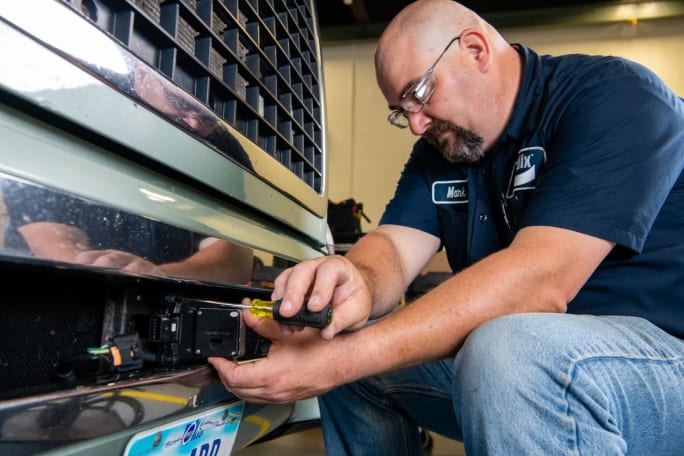
External ADAS sensors can be knocked out of alignment when unrelated maintenance is being performed on a vehicle — body work or windshield replacements, for example. Have technicians follow up those repairs by recalibrating any sensors that may have been affected.
Photo: Bendix
8 min to read
ADAS only works as designed when cameras, radar and sensors are properly maintained and calibrated.
Routine repairs such as windshield replacement, alignments and body work can affect ADAS performance.
Technicians need the right training and diagnostic approach to spot problems before drivers lose trust in the technology.
*Summarized by AI
No good deed goes unpunished, the saying goes, and that’s kind of the case with advanced driver-assistance systems, commonly known as ADAS.
Ad Loading...
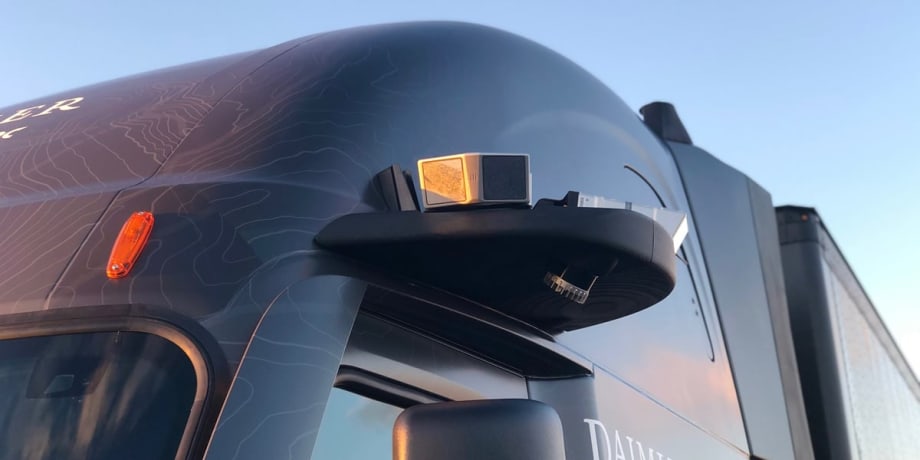
These safety technologies encompass a variety of high-tech driver assistance aids, such as anti-rollover warning systems, lane-departure warning systems, active cruise control, and collision warning and mitigation systems. Lidar, radar and camera systems can help with front and rear vehicle tracking as well as blind-spot warnings.
ADAS are increasingly integrated with other systems, as well as the vehicle itself, to create a suite of systems that work together to help keep drivers alert and safe.
Ad Loading...
ADAS has become increasingly common on heavy-duty trucks. In HDT’s 2025 fleet safety survey, forward collision warning was among the most widely used safety technologies.
The American Automobile Association’s Foundation for Traffic Safety estimates that advanced truck safety technologies, including lane-departure warning systems, automatic emergency braking, air disc brakes, and video-based onboard safety monitoring systems, have the potential to prevent up to 63,000 truck-related collisions a year.
Why Truck ADAS Maintenance Matters
It also stands to reason that spec’ing trucks with these technologies would provide a powerful defense against costly legal verdicts and settlements following an accident involving commercial vehicles.
But lawyers who target truck fleets in accident litigation have found an end-run around the ADAS defense in the courtroom.
During the discovery phase of a trial, lawyers are increasingly requesting fleet maintenance records to verify that any ADAS on vehicles involved in crashes were properly maintained and calibrated. If the fleet can’t provide documentation proving those procedures were done before the truck left the shop, lawyers allege improper maintenance and negligence on the fleet’s part contributing to the accident.
Ad Loading...
That’s a very real financial and legal imperative for fleets to establish set guidelines for ADAS maintenance and document any inspections, repairs, or adjustments made to them.
How to Check Whether Truck ADAS Is Working Properly
The good news is that, because these are largely self-diagnosing systems, there’s not much additional work that typically goes into inspecting ADAS and verifying that they are performing properly.
“I call ADAS ‘self-reporting’ systems, actually,” says Chuck Brodie, service team leader for ZF.
“Many times, you just need your technicians to take the truck for a test drive after working on it and check for any ADAS fault codes during that drive, and then note what they saw — or didn’t see — on the repair reports.”
Properly maintaining and calibrating lidar, radar, and camera sensors will become even more important as autonomous control systems become more commonplace on commercial vehicles in the future.
Photo: Jack Roberts
Why ADAS Maintenance Affects Driver Trust
Beyond the legal aspect, ADAS maintenance can affect driver buy-in and confidence in the systems. This technology is still fairly new, says Fred Andersky, director of demos, sales and service training for Bendix.
Ad Loading...
“If the system is not maintained properly, when it comes time for it to be needed, it won’t be as effective in helping the driver mitigate a situation as if it were properly maintained,” Andersky explains.
“This can also hinder driver acceptance of the technology when the system performance does not meet expectations.”
In addition, he says that, depending on the system, a malfunction indicator light on the dash could cause a driver to refuse to drive the truck, which means a load doesn’t get delivered and a customer is not satisfied.
Another ADAS concern has been tampering by drivers, Brodie says, although this problem has lessened as the systems become more commonplace and accepted in the driver community.
“In the early days, there were a lot of cases of drivers tampering with camera systems, in particular,” he says. “And we saw a lot of attempts to change settings on following-distance sensors and collision mitigation systems because some drivers didn’t like the setting or the ‘feel’ they got while driving.”
Ad Loading...
If you suspect a driver has been attempting to alter ADAS settings, Brodie says, simply accessing the fault code history in the system can usually reveal when changes were made and allow them to be corrected.
What Technicians Need to Know About Truck ADAS
It’s also important to think about the technicians you have working on ADAS, Brodie says, as these systems are a departure from traditional vehicle maintenance.
“I think one of the most important things fleets need to do is seek out and hire techs with strong electronics backgrounds,” he says.
“These components are a different beast from conventional moving engine parts. They are typically solid-state electronic components. Having a solid understanding in CAM networks – particularly J1939 and other common systems — is a plus, as well.”
Suppliers such as ZF offer specific training on ADAS maintenance and calibration, which means truly understanding how these systems build upon one another and function together.
Ad Loading...
“Let’s say you’re getting feedback from a collision mitigation system,” Brodie says. “You’ve got to have someone who can determine the root cause of the issue.
"It might just be a driver insisting on following too closely. It might be a sensor out of adjustment. Or you might have a problem with the active cruise control system or in the [automated transmission] itself. To make that determination accurately, you’re going to need a technician who can get into the vehicle’s fault codes and diagnose the issue properly.”
The need to install the sensing devices for ADAS around the periphery of the vehicle makes them vulnerable, says Ben Johnson, director of product management at Mitchell 1, a provider of repair information software.
Sometimes simple maintenance tasks require moving a sensor or camera out of the way while a repair is made. Or the vehicle can “nudge” something on the road, slightly warping a bumper or grille that has a radar unit or camera mounted behind it.
Ad Loading...
For instance, if windshield glass is replaced and there is a camera mounted behind that windshield, recalibration may be required. Or if the vehicle is re-aligned and the thrust angle is affected, the forward-facing camera and/or radar system may require calibration.
Likewise, if any of the “black boxes” that control the ADAS are removed and reinstalled to allow access to other components (radiator, A/C condenser etc.) calibrations may be necessary.
Johnson stresses that any time a vehicle is maintained in such a way that these devices are moved, or any time there’s an impact that might have warped or shifted a sensor, ADAS sensors should be rechecked to ensure proper calibration.
“Any action that could relocate one of these sensors, even by a very small amount, can require re-calibration to ensure it’s still sending information to the computer which is accurate,” Johnson says. “If a critical sensing device becomes shifted and not re-calibrated, the vehicle could act abnormally, causing a safety issue.”
What Happens When ADAS Sensors Are Miscalibrated?
That kind of miscalibration can result in warnings and emergency braking when a truck approaches an overpass because the radar interpreted the overpass as an object (presumably another vehicle) being rapidly overtaken by the truck.
Ad Loading...
“We’ve also seen systems erroneously indicate an imminent collision because the forward-facing radar was skewed a little to the left,” Johnson says. “As vehicles in the oncoming lane were approaching, the system deduced they were in front of the truck and a collision was imminent.”
These miscalibrations are “double risks” for fleets. The driver has to deal with a misbehaving safety system that’s incorrectly interpreting oncoming traffic. At the same time, the system may not be identifying the real vehicles the truck may be overtaking.
When events like this occur, driver confidence in these systems wanes. They may even try to disable the systems.
In a worst-case scenario, problems caused by miscalibration can contribute to the causes of a collision — negating the effort to improve safety by installing them in the first place.
8 Common ADAS Maintenance Problems on Trucks
There are a number of common maintenance “bugs” that arise with advanced driver assistance systems, according to Fred Andersky, director of demos, sales and service training for Bendix. They are:
Ad Loading...
These systems build on the antilock braking and stability technologies. A fault with the ABS system or ESP system will mean the ADAS system won’t be available.
Many ABS issues tend to be wheel-speed sensors, which are susceptible to chassis harness issues such as rubs and chafing and also can be damaged when service is done at the wheel-end. The sensor may become non-functional, a wire may be severed, or a sensor may not be close enough to the tone ring.
For stability control, the steering angle sensor may fall out of calibration. This can sometimes happen after a front-end alignment, so it’s important to calibrate the sensor after any front-end work.
A rare but sometimes recurring issue can be the incorrect placement of a lateral acceleration/yaw rate sensor after work on the frame rail or chassis modifications. If this sensor is moved or not returned to the correct orientation, this may cause a fault in the stability control system.
Faults can be caused by road conditions or terrain. Sometimes these can be cleared by restarting the vehicle. If the fault returns after restarting, then the truck needs to be taken to a qualified repair facility as soon as possible.
Small video cameras, which are a crucial part of many systems, can malfunction. Make sure the camera is connected/plugged in. Chassis wires that are frayed, cut or improperly repaired may create problems, so check the chassis harness first for non-obvious issues.
If the windshield is replaced, the camera needs to be placed in the same position and using the correct bracket as the original OEM installation.
Camera blindness is usually a temporary, self-correcting phenomenon caused by sun and fog. However, if the camera is blocked by something, such as a large bug, it will cause problems. The fix is typically to remove the obstruction or correct the camera mounting position.
This article first appeared in the March 2022 issue of Heavy Duty Trucking.
[Editor's Note: This article was updated on March 16 at 1:53 p.m. to correct the spelling of ZF Service Team Leader Chuck Brodie's last name.]
For fleet managers and collision repair professionals keeping heavy-duty trucks on the road, getting the color right the first time isn't just about appearance — it's about efficiency, turnaround time, and bottom-line results. Discover how today's digital color tools are transforming the repair process from guesswork to precision.
DTNA is recalling more than 2,400 trucks that received an incompatible software fix instead of the hardware repair required to address brake valve corrosion.
Fleets have more visibility into truck health, safety events, and driver activity than ever. The next challenge is turning all that information into useful guidance for the person who has to decide what to do next.
Making it through August isn’t the same as being ready for the next several months of operation. Find out what systems may have suffered from summer heat and need to be checked out before fall.
With freight improving but costs still climbing, fleet maintenance executives explain how they're balancing price, quality, and supplier relationships.
The new API PC-12 heavy-duty engine oil category reflects the changing demands of modern diesel engines. But fleets like Foodliner are looking to getting their own data before making decisions on adopting the new oils and questions such as extending oil drain intervals.
The joint venture will operate MCT's network of Carrier Transicold dealerships and mobile service locations, with the companies promising greater service capacity and uptime for refrigerated fleets.