




Inside Waymo's Autonomous Truck [VIDEO]
Waymo offers a virtual ride-along in the cab of one of its autonomous fleet trucks. A 15-minute loop around the south side of Phoenix reveals how the AI recognizes and responds to traffic.

![Inside Waymo's Autonomous Truck [VIDEO]](https://assets.bobitstudios.com/image/upload/f_auto,q_auto,dpr_auto,c_limit,w_920/waymo-gen-5-a_1768077466743_mqae7h.jpg)
Waymo's truck has 360-degree cameras and Lidar that can detect objects greater than 550 yards away. It also has a built-in cleaning system combining ducts, fans, vents, heaters and air nozzles.
Screenshot: Waymo Live Ride Demo
Residents of Phoenix, Arizona, will get used to seeing pale blue trucks with arrays of roof-mounted sensors driving along their freeways. They may or may not be aware that those trucks, operated by Waymo Via, the robotic truck arm of Waymo, are navigating those roads under their own mechanical and intellectual horsepower.
Waymo, formerly Google's self-driving car project, pulled back the curtain March 24 with an online demonstration of how the truck works. Waymo officials demonstrated how "the Waymo Driver" sees and interprets the world around it, and provided a detailed look at the sensor technologies the fourth-generation truck used in the demo.
The fourth-generation Waymo Driver (see video below) has a GPS dome atop the cab, 19 individual cameras, two radar sensors, and short-, medium- and long-range Lidars mounted above the cab and above the mirrors.
"Our sensor suite also includes microphones, which are like the ears of the Waymo driver,” said Waymo Product Manager Pablo Abad. "They allow the truck to detect and react to sirens from things like emergency vehicles and law enforcement officers, even when they're not within line of sight."
Waymo also offered a sneak peek at its new fifth-generation truck with a new sensor array and greater AI capabilities. This new configuration was first seen last year on Waymo's fleet of Jaguar I-Pace vehicles.
It has 360-degree cameras and higher resolution Lidar that can detect objects greater than 500 meters (550 yards) away. It also has a built-in cleaning system combining ducts, fans, vents, heaters, and air nozzles.
Much of the technology is shared across the truck and passenger car platforms, which Brad Newman — the head of Waymo's motion planning software engineering team for trucking — says is a great advantage for Waymo.
"The spinning Lidars on the mirrors, for example, are basically identical to the sensor that you see on the Jaguar I-Pace with a few differences in how it's positioned and some of the specifics," Abad said. "That same kind of sensor will work in both of these cases, which really helps us drive reliability and hit those economies of scale.”
Waymo has just started testing this on public roads.
"All of these improvements and range and reliability also come with a lower cost and are better set to scale up for production,” Newman said. “You see it here on top of our Peterbilt test platform, but our longer-term plan is to work with Daimler for the first kind of fully redundant Level 4 tracking system that will meet our safety requirements to be fully autonomous."
The Waymo View of the World
The demo truck was fitted with a forward-looking camera to grab visuals of the drive while interior cameras stayed focused on the human safety driver sitting in the left seat and the technology monitor sitting in the right seat. The demo ride also offered visual representation of how the Waymo Driver “sees” the world, pulled from the laptop of the technology monitor.
The trip began at Waymo's operations center in the Chandler area. The truck was driven manually from there to a freeway on-ramp where the Waymo Driver took over with the flip of a switch. The 15-minute trip around the south end of the city showed through a three-way view how the truck tracks nearby vehicles, lane merges, and varying traffic densities so viewers could compare the camera view with the digital representation.
A running commentary provided by Abad and Newman explained what was happening throughout the trip.
The digital view shows the truck from an elevated position behind the truck. Present on the screen are the roadway lanes and shoulders as well as pertinent markings such as exit and on ramps. The geography and the geometry of the roads are already mapped in high resolution and stored within in the memory. Using a combination of GPS as well as visual references, the truck “knows" where it is at all times and it knows in advance the route it will follow.
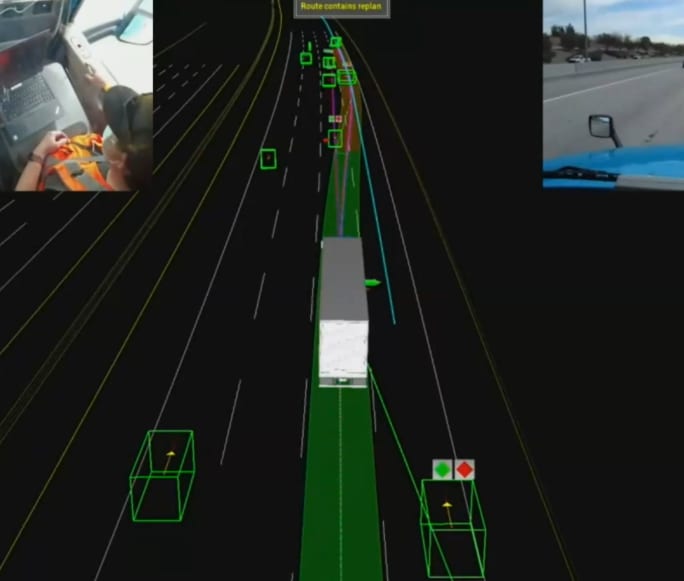
This digital view shows the truck from an elevated position behind the truck. Present on the screen are the roadway lanes and shoulders as well as pertinent markings such as exit and on ramps.
Screenshot: Waymo Live Ride Demo
What the truck technology can’t account for in advance is how traffic flow will affect its journey. The truck must react to what happens around it. At various times, the path ahead of the vehicle turns from green to purple, indicating an intended lane change.
Vehicles around the truck are displayed as green cubes or rectangles. Occasionally those shapes will turn purple, indicating that the Waymo Driver is focusing on those as potential threats or conflicts to which it may need to react.
Driving Style
Because interacting with traffic is a complex exercise, the Waymo driver is trained to predict and react to evolving situations, but it can also be proactive or mildly assertive.
“It's certainly not aggressive, but it will drive defensively, and it will, in some cases, drive assertively in a safe way," Newman said. "Being too passive is actually not the safe thing to do. If you're approaching a lane-merge at 60 miles an hour and there's another truck that you're negotiating traffic with, being very reactive and passive is actually less safe than claiming your spot in the lane. We want to be safely assertive and clearly communicating our intent."
Newman described an example where being slightly assertive can help the truck complete a maneuver safely and in a timely fashion.
"We'll activate the turn signal and then maybe move over a little bit in the lane before we actually crossed that lane boundary to clearly signal our intent," he said. "Is someone intending to let us in by slowing down a bit or are they responding by speeding up so maybe we ought to try for a different gap."
There are situations, as any human driver can attest, where failing to make a lane change in dense traffic can have huge consequences.
"For example, if we miss a lane change, we might go 50 miles round trip before we can get back to where we were," Newman said. "That's a situation where we want to be able to improve our ability to complete those lane changes, but we want to do so in a way where we communicate clearly while being safe."
Still Not Ready for Prime Time
The 15-minute demo ride around Phoenix provided a good glimpse at how well the Waymo Driver performs, but the company admits there still a lot of work to be down before these trucks are turned loose without human supervision.

The spinning Lidars on the mirrors are basically identical to the sensor on the Jaguar I-Pace. That same kind of sensor work in both cases.
Screenshot: Waymo Live Ride Demo
"I think we've been open that we're looking at driving out within the next few years or so but it's important to remember that autonomous trucking is not going to be like a light switch that suddenly flips," notes Abad. "It won't be all of a sudden now we have autonomous trucks on the road where previously we didn't the day before."
Waymo is concentrating its efforts on routes that are well mapped and fairly predictable in areas like Texas, Nevada and Arizona where the weather isn't a big factor.
"As we deploy, as we scale, we will slowly grow that network by looking at different areas, freight volumes, and whether to expand and so it'll be more of a gradual process," he says.
More Equipment

Used-Truck Remarketing Math Is Changing
Used-truck value is no longer just a concern at trade-in. Decisions made throughout a truck’s first life can influence what it’s worth years later.
Read More →
How Volvo Updated Its D13 for EPA 2027 [Watch]
Volvo’s updated D13 promises lower emissions without sacrificing performance or fuel economy. Take a closer look at what changed inside the engine in this HDT Spotlight video.
Read More →
Michelin Tire Improves Efficiency and Durability for Regional Fleets
The Michelin X Multi Energy D2 is a regional haul drive tire engineered to help fleets improve fuel efficiency, durability and traction in demanding stop-and-go operations.
Read More →
ZF Expands Commercial Vehicle Push in North America
ZF is expanding its North American commercial-vehicle presence with new transmission applications, electrification, trailer technology and autonomous-driving systems.
Read More →
Tesla Wants a Self-Driving Semi. Are Cameras Enough?
Could Tesla’s camera-only autonomous driving technology work on an 80,000-pound Semi? In this commentary, HDT's Deborah Lockridge takes a look at Tesla, Cybercab, and how autonomous trucks see the road.
Read More →
Kodiak: Driverless Long-Haul Truck Launch on Track for 2026
Kodiak AI says its driverless long-haul safety case is 93% complete and it remains on track to begin commercial operations by year-end 2026.
Read More →
What DOT’s Automated Vehicle Strategy Means for Trucking
The U.S. Department of Transportation issued a new automated-vehicle strategy that outlines plans for driverless-truck regulations, cross-state freight corridors, and federal safety standards.
Read More →
East Coast Port Launches $45M Electric Truck Push
The Port Authority of New York and New Jersey announced millions in incentives for zero-emission drayage trucks, yard tractors, and new charging hubs near the port.
Read More →
PlusAI Going Public to Fund Autonomous Truck Launch
A SPAC deal could provide PlusAI with up to $300 million as it works toward a 2027 commercial launch of factory-built autonomous trucks.
Read More →
NHTSA Moves to Rewrite Truck Fuel-Economy Rules
The National Highway Traffic Safety Administration says it lacks authority to regulate medium- and heavy-duty truck engines separately from complete vehicles, but the existing standards have not yet been eliminated.
Read More →