





Related: IdleAir at 5 Years Post-Purchase: Growing, Changing
From the HDT archives: IdleAire To Be Installed At Hunts Point Market (2001)
IdleAir Not Letting Lower Diesel Prices Stop Idle Reduction Growth
As temperatures heat up around the country, IdleAir is working to expand the number of fleets using its idle reduction technology to keep trucks cool and provide power for cab comforts. IdleAir CEO Ethan Garber tells HDT's Deborah Lockridge how the company is adapting to lower diesel prices.
June 1, 2017
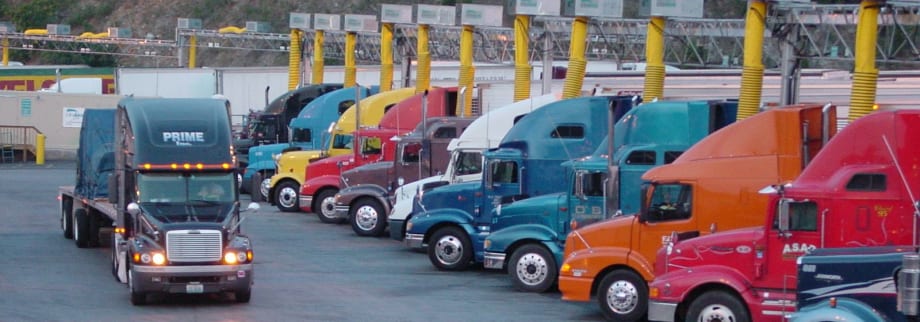
A partnership with Duke Energy is allowing a truck stop facility to be installed in Kenly, N.C. Photo courtesy Duke Energy.
5 min to read
A partnership with Duke Energy is allowing a truck stop facility to be installed in Kenly, N.C.Photo courtesy Duke Energy.
As temperatures heat up around the country, IdleAir is working to expand the number of fleets using its idle reduction technology to keep trucks cool and provide power for cab comforts.
IdleAir offers heat and air conditioning, power, TV, Internet and other services at truck stops, terminals and other locations to reduce overnight truck idling. But low fuel prices have made it harder for truck owners to justify the investment in idle reduction services and technologies, whether that be APUs or electrification.
When Convoy Solutions bought the defunct Idle Aire and resurrected it as IdleAir in 2010, diesel fuel was running about $3 a gallon retail. Last year it averaged about $2.30. If idling takes a gallon of fuel per hour, and the charge for Idle Air at truck stops is $2.19 per hour, that’s not a lot of savings (although bundles are available that can get that cost down to as low as $1.75 per hour.)
“We’ve had to be more competitive on a price basis because diesel prices are 40% lower than they were in 2014,” IdleAir CEO Ethan Garber told HDT in an interview.
Last year, Idle Air said it was responding to the challenge of lower diesel prices by offering more value, locking in long-term electricity rates when possible, streamlining internal operations to reduce costs — and focusing more on building its facilities at fleets.
Fleets and IdleAir
IdleAir's traditional market is owner-operators at truckstops. But today, major fleets such as Covenant Transport and Western Express are tying IdleAir usage to their fuel cards on a seasonal basis, allowing them to turn on the access to the service only in the summer months, relying on more-efficient bunk heaters during the colder months.
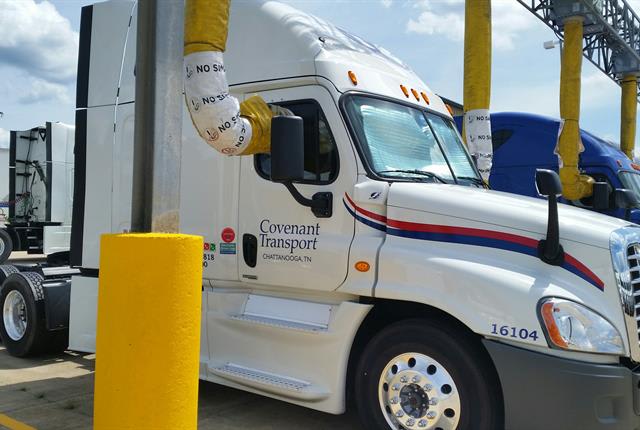
Covenant is one of a number of fleets that is having IdleAir facilities installed at terminals.Photo courtesy IdleAir.
In addition, Covenant, Schneider, CFI, and Southern Refrigerated Transport are among the fleets where IdleAir is installing terminal-based idle reduction facilities. It currently has 10 terminals with as many fleets either already built or under construction. Garber expects there will be about 15 in place by the end of the year. Some fleets are even paying for their owner-operators to use the IdleAir facilities at their terminals as well as for company drivers. At some terminals, thermostats will regulate whether the IdleAir can be used based on the ambient temperature.
That doesn’t mean Idle Air has abandoned its truck stop efforts. It’s working to expand that through various partnerships, including a recent one announced by Duke Energy to fund electrification at Big Boy’s Truck Stop in Kenly, North Carolina. “We’re partnering with electric utilities around the country,” Garber said.
“We are still running a truck stop network and growing that when it makes economic sense,” Garber explained. “Our primary focus is developing our fleet relationships because it’s an easier product to manage.”
The cost structure for fleet facilities is lower than its truck stop locations, Garber explains, because they can operate the fleet locations more efficiently — and those savings are passed along to fleets. “We’re targeting 50% of the national Energy Department average as our price point” at fleet facilities, he said.
Keeping cool
Garber said while it’s hard for IdleAir to beat a bunk heater for versatility and efficiency in the winter, IdleAir has an advantage over many other idle reduction technologies when it comes to air conditioning in hot climates.
“We have arguably the lowest marginal costs for delivering air conditioning savings, about 25 cents per hour, a little more than a bunk heater,” he said. The disadvantage, of course, is that it’s stationary and there isn’t a big infrastructure for irregular-route operations.
“We’re trying to target the hottest, most unpleasant conditions for drivers when they’re stuck in their metal greenhouses,” Garber said. Battery-based auxiliary HVAC systems may struggle to keep drivers cool for the full rest period under such conditions.
“It’s not an accident that Schneider asked us to build a terminal for them in Phoenix,” he said. “We hope to add some bells and whistles, maybe even a solar canopy” at that location.
IdleAir is also exploring working with refrigerated fleets to combine its traditional HVAC cab systems with plug-in power for trailer refrigeration units at fleet facilities.
Demand in Mexico
Partly because of that air conditioning benefit, IdleAir’s strongest area of growth is south of the border, where diesel fuel is more expensive. IdleAir launched its first dedicated fleet terminal in Mexico in late 2015 and has seen an eager market in that country where diesel prices are often $1 per gallon higher than in the U.S.
It recently expanded its fleet facility at Egoba in Mexico from 18 spaces to 48.
“On a fleet terminal we can rotate more than one truck per day per parking space, and in Mexico we’re getting over 20 hours of utilization per parking space during the hottest times of the year,” Garber said.
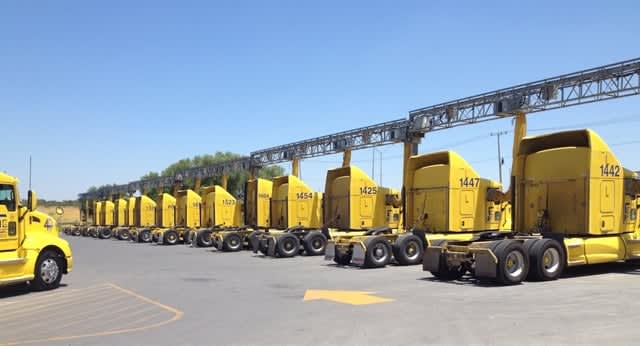
IdleAir recently expanded this facility at Transportadora Egoba in Nuevo Laredo, Mexico.Photo courtesy IdleAir.
Upgrading equipment
At the same time, IdleAir is working to upgrade its equipment. The big plastic panels that go into driver windows are over 10 years old. The company is replacing the insides with new computer technology that uses less power and is both smarter and simpler to use. Drivers can use their smartphones to control the system rather than having to use the touch panel. They aren’t as vulnerable to moisture or wear and tear, requiring less maintenance.
They also hope to start installing something called “lift assist,” a retractable spring-loaded weight-reducing system would make it easier for drivers to lift the service module (which weighs about 50 pounds) into the window. Smaller drivers, women drivers, drivers who are disabled or have shoulder problems or back problems, would now be able to use the IdleAir system. “It’s heavy and not everyone can lift it,” Garber says. “It limits a small percent of the audience. Plus it’s more convenient not to have to lift something that weighs as much as a Rotweiller.”
Subscribe to Our Newsletter
More Fleet Management

Sponsored•September 16, 2026
Color Match Smarter: Tools That Restore & Perform
For fleet managers and collision repair professionals keeping heavy-duty trucks on the road, getting the color right the first time isn't just about appearance — it's about efficiency, turnaround time, and bottom-line results. Discover how today's digital color tools are transforming the repair process from guesswork to precision.
Read More →
FMCSA Pauses Biennial-Update Enforcement Amid Motus Transition
Carriers whose updates were due on or after June 1 have more time, while FMCSA works to stabilize its new registration system and warns of phishing sites impersonating its new carrier registration system, Motus.
Read More →
Sponsored•September 14, 2026
2026 Blueprint for Countering Smarter Supply Chain Theft
Cargo theft is no longer just the cost of doing business. It's a multi-billion-dollar criminal enterprise exploiting vulnerabilities across your fleet, drivers, and supply chain.
Read More →


Sponsored•September 1, 2026
How Telematics Improves Visibility, Control, and Performance in Refrigerated Fleets
Explore how telematics help refrigerated fleets improve visibility, uptime, efficiency, compliance, and cargo protection across connected cold chain operations.
Read More →
What the U.S.-Canada Trade War Means for Trucking
Escalating U.S.-Canada tariffs could disrupt cross-border freight, reduce truck volumes, raise costs, and create new uncertainty for carriers on both sides of the border.
Read More →
What Are Trucking’s Top Concerns for 2026?
The American Transportation Research Institute wants to know what's worrying trucking fleet managers, drivers, and other stakeholders in its annual Industry Issues survey.
Read More →
American Trucking Associations Looks for a New Leader
ATA President and CEO Chris Spear abruptly left his job at the association on August 21, at a pivotal time for the trucking industry.
Read More →
Public Wi-Fi Cybersecurity Risks: How Truck Drivers and Fleets Can Protect Their Data
Public Wi-Fi can expose truck drivers and fleets to credential theft, malware, and other cyber threats. Here’s how to reduce the risk on the road.
Read More →
For Nicky Cupp, Fleet Innovation Starts With Frustration
HDT Truck Fleet Innovator Nicky Cupp turns everyday pain points at Fraley & Schilling into opportunities for better technology and smarter processes.
Read More →
Adam Buttgenbach’s Approach to Electric Trucks: Start With Where They Fit
HDT Truck Fleet Innovator Adam Buttgenbach helped PepsiCo build one of North America’s largest EV fleets by focusing on where electric trucks make operational sense.
Read More →