





Related:
IdleAir at 5 Years Post-Purchase: Growing, Changing
Convoy Solutions officials told reporters at the Mid-America Trucking Show they've learned a lot about the idle-reduction business in the five years since they resurrected IdleAir.
April 10, 2015
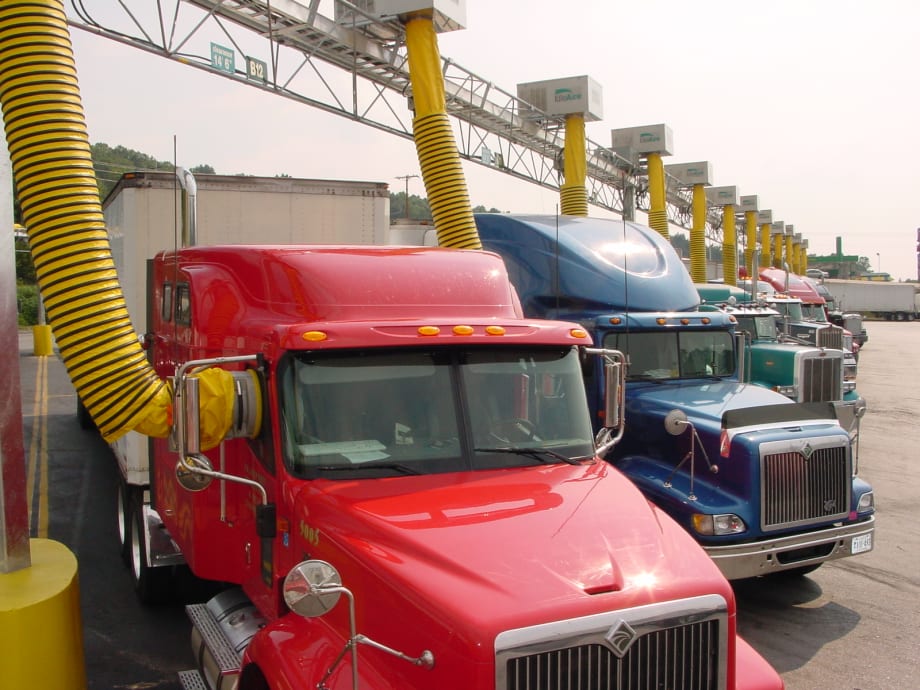
IdleAir's overhead truss system. Photo courtesy IdleAir
4 min to read
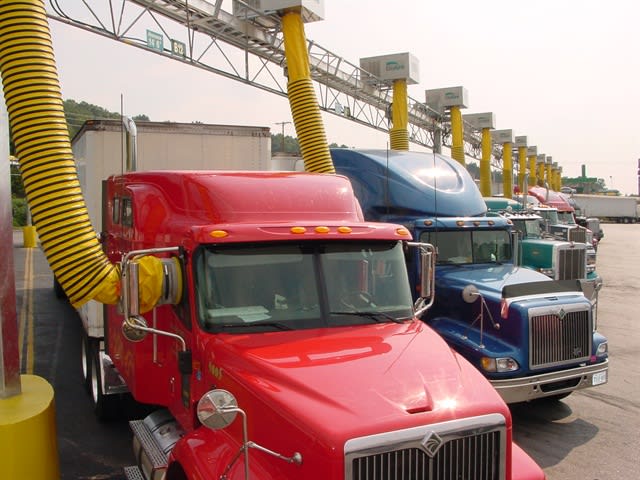
IdleAir's overhead truss system.Photo courtesy IdleAir
It's been five years since the defunct Idle Aire was bought by Convoy Solutions and renamed IdleAir, and the revived company continues to expand locations as well as types of services and packages.
IdleAir offers heat and air conditioning, power, TV, Internet and other services at truckstops, terminals and other locations to reduce overnight truck idling.
In an update at the recent Mid-America Trucking Show, Convoy CEO Ethan Garber said in those five years, "We found ways it works, ways it doesn't work, and ways it works even better," such as in IdleAir's addition of installations at fleet terminals in addition to the old truckstop locations.
The new company preserved about 6,000 parking spaces' worth of hardware. A lot of it is still in storage, but about 600 of those have been refurbished and redeployed. The operational space count is closer to 1,200, including the ones already installed and just reactivated. The company has doubled its footprint from the original 20 "legacy locations" it reopened soon after taking over.
The recent lower price of diesel prompted IdleAir to launch some new bundled discount pricing programs in an effort to both streamline offerings and make them more affordable. A 40-hour reset special is designed for drivers taking a 34-hour restart. "We try to have it cost less than half the price of staying in a hotel," Garber said. There's also a 10-hour special price for TV and Internet access without the HVAC aspects of the system. There's also a new 12-hour discount bundle for Owner-Operator Independent Driver members.
Some recent milestones:
Over the winter, IdleAir absorbed most of the assets and operations of the former American Idle Reduction (AIR), whose predecessor was Airedock. IdleAir is currently working to modify some of those locations to be IdleAir enabled, especially those located at turnpike locations. "Some of these lcoations are in interesting places that enhance our footprint," Garber said. "Others we might shrink." Those use a pedestal-type solution that often is a better fit for locations than the IdleAir overhead truss system, he said. AIR also brought to the company MediDock, a proprietary idle-mitigation sytem for the ambulance industry. "Ambulances already have 120-volt capability, but they also have very expensive drugs in the back of their module that are sensitive to temperature," Garber noted.
IdleAir is building a new facility in Nuevo Laredo in Mexico, its first location outside of the U.S., for EGOBA Transportadora. "Diesel prices are higher there now than they are in the states," Garber noted. "Most of their fleets don't like to have drivers stop at truckstops and possibly get hijacked or worse, so they tend to go hub to hub and have very large terminal facilities." It's a situation that works very well for IdleAir dedicated terminal facilities.
It recently completed building the first of several dedicated IdleAir terminals for Covenant Transport at its headquarters in Chattanooga, Tenn. It mirrors similar facilities it has done for carriers such as Con-way and C.R. England.
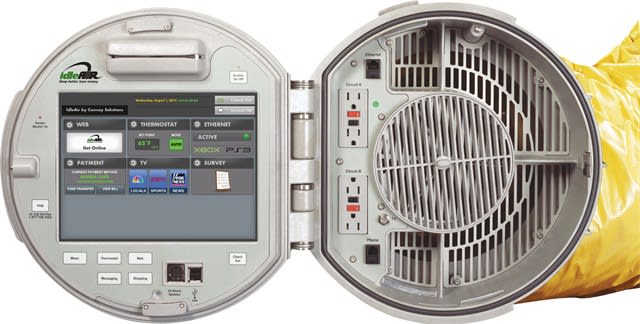
The unit that fits into the truck window. Photo courtesy IdleAir
IdleAir also continues to improve the technology itself.
It is finishing beta testing of a motorized lift for service modules and hoses, which will make it easier for drivers to insert and remove the standard window units, which weigh more than 50 pounds. It also will allow IdleAir to install electrified parking spaces in pull-through locations, which should broaden the range of parking locations.
It's also completing beta tests of a mobile tablet unit, which will allow truckstop staff to sign up customers, troubleshoot hardware issues and do customer account maintenance outside the IdleAir office. "This capability is going to become increasingly critical as we ramp up our experimental parking reservation service at select locations," Garber explained.
IdleAir is working to upgrade bandwidth options, with nearly half of its locations sporting at least 10 MB of broadband access and one already at 100 MB.
CORRECTED April 13, 11 a.m. EDT, to correct the spelling of MediDock, correct the trucking company for which the Mexican terminal facility is being built, and clarify the number of parking spaces currently equipped with IdleAir as well as the goal for pricing. We apologize for any confusion.
More Fuel Smarts

Trucking’s Diesel Squeeze Isn’t Letting Up
With diesel topping $6 a gallon nationally, ATA's Bob Costello explains why fleets should prepare for continued pressure at the pump.
Read More →
FlowBelow Redesigns Trailer AeroSlider to Cut Fuel Use
The lighter trailer aerodynamic system installs in less than 45 minutes, according to the company, with potential payback in under a year depending on fuel prices and trailer mileage.
Read More →
Why Diesel Price Relief Efforts May Fall Short
Diesel prices have eased from September’s record high, but doubts about additional Russian supply and limits on dyed-diesel tax relief mean trucking fleets still face expensive fuel. And prices could go higher.
Read More →
Why Small Fuel Savings Matter in Trucking
Can better fuel economy help pay for driver raises? In this podcast, GP Transco explains how small efficiency gains create room to reinvest in its people.
Read More →
How GP Transco Cuts Trucking Fuel Costs, a Tenth of a Gallon at a Time
What’s another tenth of a mile per gallon worth? GP Transco shares how equipment upgrades and driver coaching turn small gains into meaningful fuel savings.
Read More →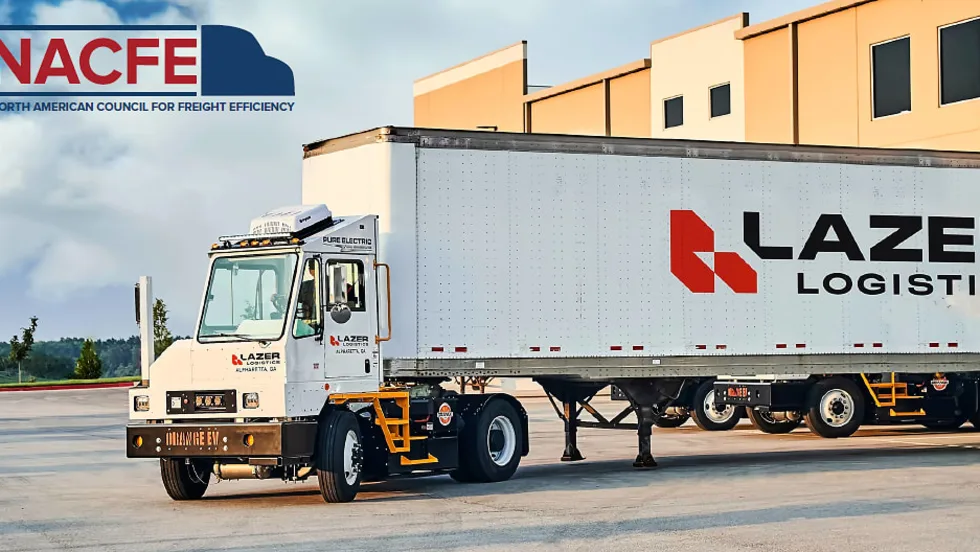
Electric Yard Tractors Move Beyond Pilots
Operating-cost savings have overtaken sustainability goals as the leading reason surveyed fleets are adopting battery-electric terminal tractors, according to new NACFE research.
Read More →
Geotab Links Fleet Card to Vehicle Data
The new card combines fuel discounts with telematics-based purchase controls. Geotab’s analysis also points to potential savings from choosing lower-priced fuel stops.
Read More →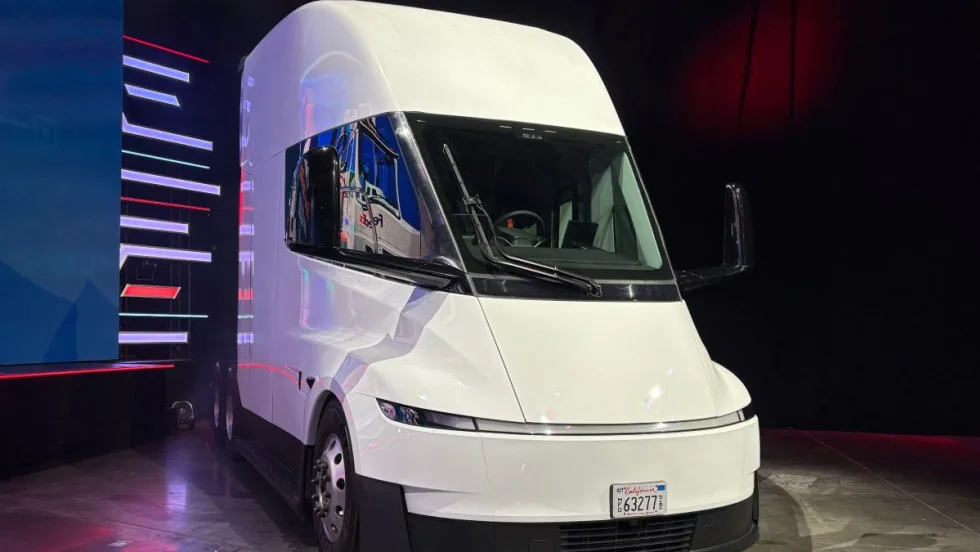
Fleet Economics Shape Electric Truck Outlook
ACT Research expects costs, charging infrastructure, and technology improvements to drive zero-emission commercial vehicle adoption as federal regulations and incentives retreat.
Read More →
Wex Adds Cardless Fuel Payments for Over-the-Road Customers
A new fuel card feature for Wex customers offers convenience and security.
Read More →
New California Law Could Shed Light on Electric Truck Prices
Why do battery-electric Class 8 trucks remain so expensive? A California bill signed by Gov. Gavin Newsom would give fleets and state agencies more visibility into what manufacturers charge.
Read More →