




IdleAir Looks to Set Up Locations at Fleet Terminals
After working to revitalize the network of the truckstop electrification service provider IdleAir since purchasing it three years year ago, Convoy Solutions is turning its attention toward truck fleets as customers -- but in a new way, with what it calls dedicated terminal solutions.

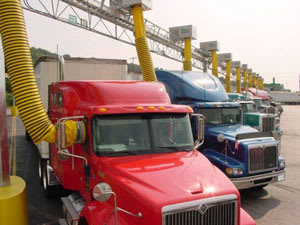
IdleAir's traditional drop-down units provide HVAC, electricity, Internet and other functions.
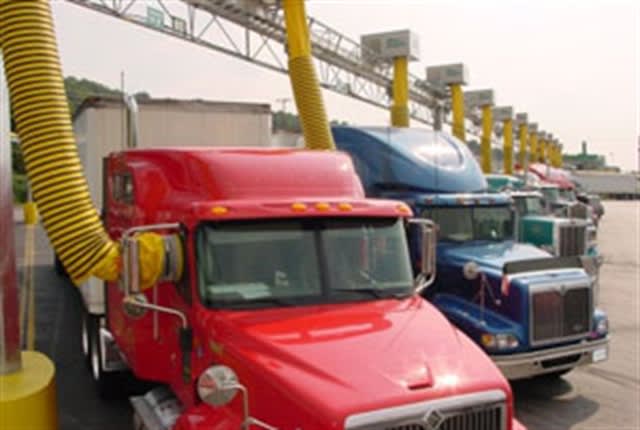
IdleAir's traditional drop-down units provide HVAC, electricity, Internet and other functions.
After working to revitalize the network of the truckstop electrification service provider IdleAir since purchasing it three years year ago, Convoy Solutions is turning its attention toward truck fleets as customers -- but in a new way, with what it calls dedicated terminal solutions.
“Our main goal is we think we can provide the lowest cost and most reliable solution for idling mitigation for fleets on their own real estate,” says Ethan Garber, CEO of Convoy Solutions.
The idea is simple: Offer the same service at fleet facilities that IdleAir has a its 34 truckstop locations as of mid-May, including electrical connections, in-cab heating or cooling, along with TV and Internet access, without having to idle a truck. The company says in addition to saving fuel wasted on idling, carriers enjoy long-term savings by extending engine life and reducing wear and tear on diesel and battery auxiliary power units, including getting electric recharging for battery systems.
“We’ve discovered a very good dynamic between us and dedicated fleet terminals,” Garber says. “What we are offering, for a limited time, is to put in installations at our cost, and that we will cover the electric costs and provide the service at our national network at our fleet rates.”
Garber says for the first nine months of asking fleets to consider dedicated terminal solutions it got very little traction, but that has changed.
“Now suddenly as summer is coming, air conditioning and idling risk and costs are coming to the forefront for a lot of fleets and fuel managers and that maybe this Idleair option is not such a bad idea.”
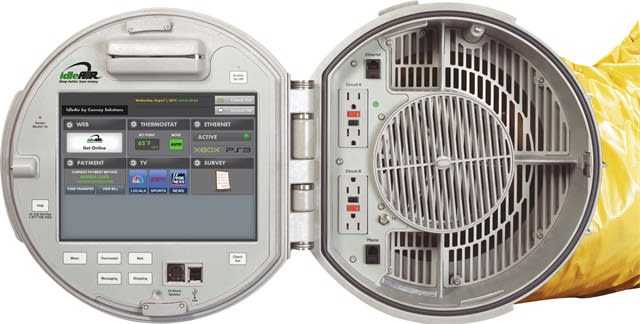
The IdleAir unit that fits in a truck's window.
The reason for such a different approach is that for some fleets IdleAir’s network of truckstop locations may not fit into their footprint, even with 50 sites planned by the end of this year and 100 by the end of 2015 at truckstops. At the same time many fleets don’t have much in the way of an idling alternative. Maybe their application is too weight-sensitive to add an auxiliary power unit, for instance.
Dedicated fleet terminal setups, says Garber, bridge this divide.
“[Some] fleets want to keep their drivers close and would rather have them in the terminal. Some fleets even do their fueling on their terminal and want to keep everything close to home,” Garber says. “Other are just worried about their equipment being on the road and having an incentive for driver to be closer for maintenance and safety. Suddenly [by having IdleAir] it makes the terminal a draw rather than something drivers want to avoid.”
Currently IdleAir has one active fleet terminal, but expects to have six open by the end of summer. Unlike putting in IdleAir facilities at truckstops, which takes months, installations at fleet facilities can just between two to three weeks.
What About Shorepower?
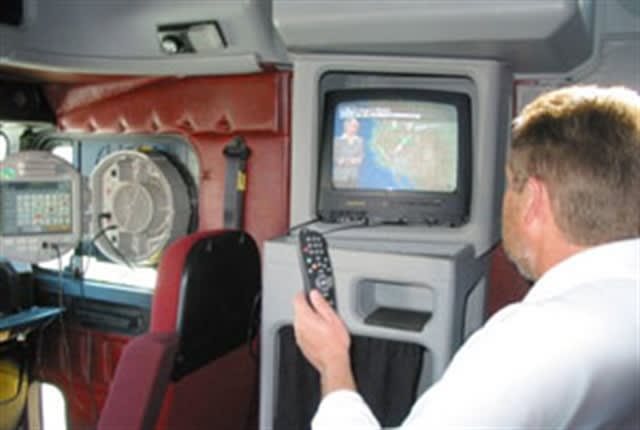
IdleAir being used in the cab.
If IdleAir was the buzzword for the previous decade when it came to idling alternatives for trucks, especially when the company was rapidly expending and had more than a hundred locations under the now defunct previous owner, shorepower and the company Shorepower Technologies is likely the one for the second decade.
While Shorepower has been busy rolling out its service to more than 50 locations, Garber says there is one big difference between shore power and what IdleAir offers.
“Right now we know that 95% of all trucks either have an APU or can’t use straight shore power," Garber says. “We don’t think there is a huge amount of demand for [shore power alone].”
Nevertheless, IdleAir appears to be hedging its bets and may open up a couple of parallel site this summer that offer shore power only. He says it’s important to remember that IdleAir has been offering shore power since day one.
Earlier this year IdleAir began offering what it calls Convoy TV+Power, allowing truckers to access its DirecTV service offerings along with electrical power for less than the hourly cost of its full slate of services.
When it comes to one of the latest idling alternatives, electrical connections for reefers, Garber says IdleAir is making plans, especially for dedicated fleet terminals, either as a pedestal or a dropdown connection, but adds he doesn’t seem demand for this springing up overnight because so few reefers have this option.
“We are not going to spearhead large refrigerated fleets transitioning their trailer to have the hybrid option. They are going to need a lot more choices than just us,” he says.
Long Term Future
Despite all the excitement when IdleAir launched more than 10 years ago (under the name IdleAire) critics said the service wouldn’t be around for long. And indeed, there were huge financial losses. The company has changed hands three times, but Convoy Solutions, with its limited network, also seems to be more conservative than the previous two efforts. It seems to be paying off.
“After three years we are not net income positive yet, but are income positive for some locations.” Garber says. “We have cut overheard 80%-90%. We have less than 80 employees when our predecessor had 1,400.”
One likely reason is that Garber and the rest of the investors are “turnaround experts,” in other words taking broken business and fixing them up. IdleAir is the only business owned by Convoy Solutions. When IdleAir relaunched in the fall of 2010 and shortened its name, it began with just 10 locations and shortly was up to 20. Unfortunately, Garber says, “Ten of those 20 were some of the worst sites of the old company -- they had the least amount of general traffic and were very challenging for the old company to run, and it was just as challenging for us.”
Today the company, in addition to embarking on dedicated terminal solutions, is right-sizing IdleAir’s footprint to actual demand and truckstop parking lot conditions. This new strategy just may work.
“We are twice as profitable [for a truckstop] as selling diesel, so there is at least one important ingredient why a travel center would have us, is that we can make them more money,” he says. “But we are 10 times more profitable for a fleet terminal, because we are paying the travel center essentially 30 cents per hour but we are saving a fleet $3 an hour.”
More Drivers

Truck Drivers Need More Than Another Alert
Fleets have more visibility into truck health, safety events, and driver activity than ever. The next challenge is turning all that information into useful guidance for the person who has to decide what to do next.
Read More →
FMCSA Removes 110 Truck Driver Training Schools from Certified ELDT List
Federal regulators also are targeting more than 160 additional training providers and launching a nationwide audit of third-party CDL skills testers as part of a broader crackdown on trucking fraud.
Read More →
Hours of Service Pilot Programs: FMCSA Readies for 2027 Rollout
Two pilot programs could eventually reshape hours-of-service rules, giving truck drivers options to pause their 14-hour clock or use longer split sleeper rest periods.
Read More →
Medical Cards, English Proficiency Reshape Roadcheck Violations
Medical-card violations jumped to the top of the driver out-of-service list during CVSA’s 2026 International Roadcheck, while English-language proficiency violations appeared among the leading violations for the first time.
Read More →
Driver Trust Can Make or Break the Success of Fleet Safety Technology
New Teletrac Navman research suggests that onboarding, transparency about driver data, and positive feedback can play a significant role in how commercial drivers respond to safety and coaching technology.
Read More →
EEOC Sues KLLM Over Alleged Sex Discrimination in Driver Training
KLLM is facing a federal sex-discrimination lawsuit over policies the EEOC alleges put female truck driver trainees at a disadvantage.
Read More →
FMCSA Moves to Codify English Language Requirements for Commercial Drivers
By changing regulations on English-language proficiency requirements for commercial drivers, rather than relying on a guidance memo, the FMCSA said future administrations won't be able to walk back the Trump administration's stricter enforcement with just a memo.
Read More →
Drivers Put Western Star Trucks to the Test at Star Nation Experience
Watch to get an inside look at the Western Star trucks, technology, and community behind the Star Nation Experience 2026!
Read More →
Trump Administration Looks to Put More Veterans Behind the Wheel
The Freedom Haulers program pulls together existing and expanded programs at several federal agencies to recruit veterans to drive commercial heavy-duty trucks and cut the red tape for them to get a CDL, training, and employment.
Read More →
Putting Mack’s Command Steer to the Test
A test drive of Mack’s Command Steer active steering system evaluates how it can make truck driving easier and less tiring.
Read More →