




Idle Reduction: What's Right for Your Fleet?
More than half of all the states in the Union plus the District of Columbia now enforce idling restrictions at either the state, county or municipal leve

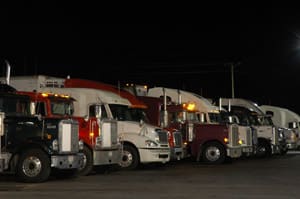
Fewer long-haul drivers idle to keep cool at night, but there's room for improvement.
More than half of all the states in the Union plus the District of Columbia now enforce idling restrictions at either the state, county or municipal level
. Most observers now see 100 percent anti-idle regulation coverage as inevitable.
There are currently more than 50 suppliers of key-off climate controls systems in North America. As existing technologies mature and new ones emerge, we may well see that number grow. The last few years have seen some non-traditional players enter the market, too, bringing with them expertise and technology developed in unrelated fields. The cross-pollination of ideas and opportunity is bound to bring some interesting products to market.
That doesn't mean traditional no-idle solutions, such as diesel-fired auxiliary power units and cab heaters, have seen their day in the sun. A handful of APU purveyors have faltered during the recession, but the remaining players talk confidently about the future. They plan to remain in the game, although predictions from the American Transportation Research Institute suggest battery-driven systems will eventually surpass diesel-fired solutions.
The idle-reduction market
In February 2006, ATRI released the results of a survey (done in 2005) that captured data on more than 55,000 trucks from across North America. Among other interesting bits were predictions that market share for battery-powered systems would reach 40 percent by 2010, while diesel APUs and fuel-fired cab heaters would each hold 28 percent market share. Respondents expected to spend $56 million on idle-reduction technologies over a five-year period following the survey.
We're closing in on the far end of that prediction window now, and it would be fair to say that the picture has changed since that data was collected. We saw diesel prices near $5 per gallon, and we entered a crippling recession from which we've barely begun to emerge.
Manufacturers say significant interest still exists in reducing fuel consumption using some form of engine-off, on-board climate control system. Fuel prices are expected to trend upwards overall, particularly as we begin to emerge from the recession.
Ed Maxwell of EnviroDock, an off-board shorepower/climate control provider with installations in upstate New York, told us aggressive enforcement of the anti-idling laws in that state is generating a lot of interest in key-off climate control.
"Every time the cops make a sweep of the parking lot, we see the docks fill up almost immediately afterward," he notes. "If fuel prices aren't enough to change people's minds, increased enforcement certainly could be."
(ATRI keeps an updated compendium of idling regulation on its web site, www.atri-online.org.)
In addition, higher prices for engines that will meet EPA 2010 emissions regulations, combined with a few other pending regulations, could force dramatic changes to fleet trade cycles. Some fleets are looking at trade cycles as long as 54 and even 60 months in order to preserve ROI numbers. If those rumors prove true, fleets will do all they can to minimize engine-on time. At least one fleet owner we know of has installed APUs to help reduce wear and tear on the engines as much as for the fuel savings.
Idle Reduction Options
Several different idle-reduction technologies exist today. More are in development. The basic platforms supply heated or cooled air for in-cab climate control. Some add 110V AC power either to drive the system or to power hotel loads. Delivery methods vary; some are better suited to certain applications than others.
Most of the options listed below are EPA SmartWay certified, and qualify for various grants, purchase incentives, and tax credits. For more information, see the Verified Technologies page at www.epa.gov/smartway.
* Battery power systems provide heating, cooling, or other specialized services. Can also drive hotel loads if the truck is equipped with an inverter.
* Automatic shutdown/start-up devices shut down an engine automatically after a preset time. They may also offer automatic restarts for brief periods as temperature variations warrant.
* Fuel-fired heaters provide heat for climate control and engine preheating. Usually draw fuel from the vehicle's diesel tanks.
* Auxiliary power units or generator sets use small diesel engines to drive generators for a source of on-board power. They can be combined with an aftermarket HVAC system and a coolant loop for in-cab climate control.
* Electrified parking spaces, at their simplest, are units installed at truck parking spaces that provide an off-board source of 110V AC power to operate on-board vehicle systems such as HVAC and hotel loads. More sophisticated systems can include cable TV, Internet access, and off-board climate control.
* Thermal storage systems use a chilled media to provide a source of cool air for cab air conditioning. Fans and pumps are often battery powered.
Battery or diesel?
Diesel and battery are currently vying for supremacy as alternative power sources. Each has its own upsides and downsides, while cost and weight remain roughly the same, at least for now.
Diesel APUs are already under fire in the Golden State, and now face restrictions on their use in some instances, despite the mandating of expensive particulate filters. In addition, APUs are externally mounted, and subject to a very harsh operating environment. Consequently, they require constant maintenance and frequent repair, say many fleets who use them.
Upsides include virtually limitless operating time, given a supply of fuel, and drivers can use them anywhere (restrictive regulations notwithstanding).
Some external diesel APU systems are piggybacked with the truck's existing HVAC systems. Others, such as Thermo King's TriPac, may call for additional HVAC hardware - which could be a pro or a con.
"TriPac can tap into the cooling system to provide engine pre-heating, or not. It's up to the customer," says Thermo King's Tom Kampf, trailer product manager. "Our HVAC component is totally separate from the truck's. You can take it off and move it into your next truck."
Battery-powered climate control systems have been criticized for their short duty cycles, and the need for an additional source of heat in some instances. Greater demand in extreme climates can shorten duty cycles to less than 10 hours. Some drivers are unhappy with the amount of storage space the systems - mostly internal - occupy. Internal installation, on the other hand, protects the system from the nasty environment outside on the frame rails where diesel APUs live.
Battery technology is moving forward at a rapid pace. As goes that technology, so will go electric APU systems. Traditional lead-acid batteries just aren't up to the challenge of multiple deep-discharge cycles induced by powering fans, compressors, and various hotel-type loads. Advanced absorbed-glass-mat and carbon-foam batteries are better suited to long-term, slow, deep discharge cycles and offer faster recharge cycles without placing excessive burden on alternators. They are also much less expensive than existing lithium and nickel battery technologies.
While overall weight can be reduced with little change in energy density, the industry standard size of a Group 31 battery isn't likely to change. Space will continue to be an issue until a suitable replacement is developed.
Firefly Energy's Oasis battery, the Odyssey battery from EnerSys, and Optima batteries are fast becoming the standard power packs for on-board all-electric HVAC systems, but don't expect technology to stop marching forward from there. Smaller, lighter, and more powerful batteries aren't far off, and with improved power m
More Fuel Smarts

How Volvo Updated Its D13 for EPA 2027 [Watch]
Volvo’s updated D13 promises lower emissions without sacrificing performance or fuel economy. Take a closer look at what changed inside the engine in this HDT Spotlight video.
Read More →
Diesel Price Spike Shortens Payback for Natural Gas Trucks, Report Says
Energy Vision estimates fleets could recover the higher purchase price of an RNG-fueled Class 8 tractor in 1.3 to 2.8 years under current fuel-price scenarios.
Read More →
Calstart Becomes Catalyst Mobility, Reflecting Broader Focus
Calstart is now Catalyst Mobility, reflecting the nonprofit’s growing national role in clean transportation, including zero-emission trucks, infrastructure and incentive programs.
Read More →

Record Diesel Prices Squeeze Trucking Fleets
Average U.S. diesel prices have climbed to nearly $6 a gallon, surpassing the 2022 record as tight refinery capacity and Middle East disruptions keep fuel costs elevated.
Read More →
How Fuel Delivery Shapes Engine Performance
Fuel delivery depends on more than what happens at the injector. For fleet, maintenance and technical professionals, looking at the full path from pump to injector can provide useful context for understanding engine performance.
Read More →
East Coast Port Launches $45M Electric Truck Push
The Port Authority of New York and New Jersey announced millions in incentives for zero-emission drayage trucks, yard tractors, and new charging hubs near the port.
Read More →
California Bill Could Shed Light on Electric Truck Prices
Why do battery-electric Class 8 trucks remain so expensive? A California bill headed to Gov. Gavin Newsom would give fleets and state agencies more visibility into what manufacturers charge.
Read More →
Detroit Opens Orders for EPA 2027 Engines
Detroit isn’t starting from scratch to meet EPA 2027 diesel emissions standards. Its Gen 6 DD13 and DD15 engines keep much of today’s platform while updating the fuel and aftertreatment systems.
Read More →
Zero-Emission Truck Corridor Planned for West Coast
California, Oregon, Washington, British Columbia and Baja California are coordinating plans for truck charging and hydrogen fueling from Canada to Mexico.
Read More →
A Closer Look at Kenworth’s Electric T880E Vocational Truck [Video]
Learn more about Kenworth's T880E battery-electric vocational truck at the Paccar Technical Center, including its range, applications, upfitting considerations, and PTO options, in this HDT Spotlight video.
Read More →