




Hydraulic vs. Mechanical Goosenecks for Lowboy Trailers
What type of removable gooseneck is the best for your lowboy trailer? While most contractors choose hydraulic goosenecks for ease of use, there may be some situations where a mechanical gooseneck is preferred.
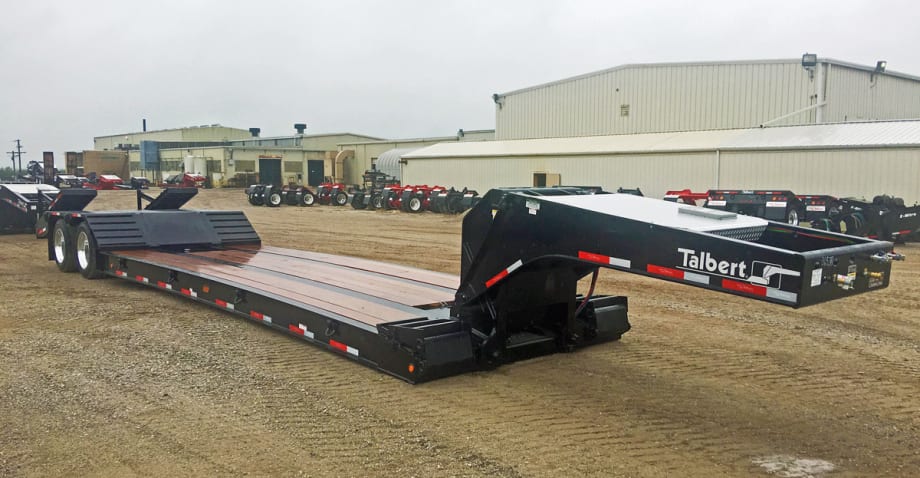
Hydraulic gooseneck trailers also offer enhanced safety for the operator, as the neck can be raised to allow the truck fifth wheel to attach without requiring the main deck to be lifted.
Photo: Talbert
What’s the best lowboy trailer for your business? The wrong one can not only cost in the long term, but it may also have an immediate impact on the ability to haul the necessary equipment. It’s important to thoroughly research lowboy trailers in advance to help avoid trailer failures in the future.
Original equipment manufacturers provide a wide range of heavy haul solutions. Some offer lowboy trailer models with a removable gooseneck that is available in either hydraulic or mechanical configurations. Which type of removable gooseneck is right for your business?
While most contractors choose hydraulic goosenecks for ease of use, there may be some situations where a mechanical gooseneck is preferred.
Pros and Cons of Hydraulic Gooseneck Trailers
One of the main benefits a hydraulic gooseneck trailer offers is its ability to quickly attach and detach to save on downtime and labor costs.
Hydraulic goosenecks also use a series of hydraulic cylinders to safely and easily lower and lift the deck when the trailer is attached to the truck while maintaining a low center of gravity when the loaded equipment is particularly tall.
Additionally, if an operator knows there will be rough terrain or overhead clearances during transport, the front deck height of the hydraulic gooseneck can be adjusted to accommodate its surroundings.
Hydraulic gooseneck trailers also offer enhanced safety for the operator, as the neck can be raised to allow the truck fifth wheel to attach without requiring the main deck to be lifted.
Operations can further optimize their hydraulic gooseneck trailer by adding additional shims for weight distribution. Some manufacturers offer hydraulic gooseneck in double drop series, which can feature an 18-inch loaded deck height to ensure ample clearance and stability for tall loads and air suspension to provide maximum control over the load, as well as the lowboy series, which can have a weight capacity of up to 110,000 pounds.
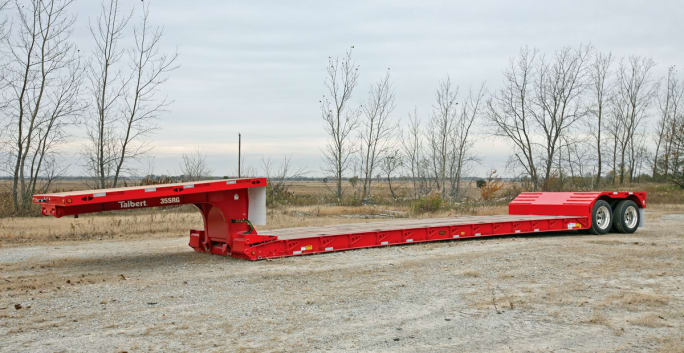
Mechanical goosenecks utilize front rollers and truck ramps to connect and disconnect. These are best suited for longer-distance trucking companies, where the load will be on the truck for several days and unloading will occur on smooth, hard surfaces.
Photo: Talbert
Pros and Cons of Mechanical Gooseneck Trailers
Mechanical goosenecks are lighter weight than hydraulic goosenecks; however, they take more time to attach and detach. They also cost less than hydraulic goosenecks and require less maintenance.
Mechanical goosenecks use front rollers and truck ramps to connect and disconnect. These are best suited for longer-distance trucking companies, where the load will be on the truck for several days and unloading will occur on smooth, hard surfaces.
Whether contractors choose a hydraulic or mechanical gooseneck trailer, by ensuring safe weight distribution, axle loads, and load positioning, heavy-haul trailers are continuing to provide the safety and efficiency users need to successfully haul their equipment.

Troy Geisler is the vice president of sales and marketing for Talbert Manufacturing. He has more than 20 years of experience in trailer sales, including 10 years with Talbert. This article was authored and edited according to Heavy Duty Trucking’s editorial standards and style to provide useful information to our readers. Opinions expressed may not reflect those of HDT.
More Equipment

How Volvo Updated Its D13 for EPA 2027 [Watch]
Volvo’s updated D13 promises lower emissions without sacrificing performance or fuel economy. Take a closer look at what changed inside the engine in this HDT Spotlight video.
Read More →
Michelin Tire Improves Efficiency and Durability for Regional Fleets
The Michelin X Multi Energy D2 is a regional haul drive tire engineered to help fleets improve fuel efficiency, durability and traction in demanding stop-and-go operations.
Read More →
ZF Expands Commercial Vehicle Push in North America
ZF is expanding its North American commercial-vehicle presence with new transmission applications, electrification, trailer technology and autonomous-driving systems.
Read More →
Tesla Wants a Self-Driving Semi. Are Cameras Enough?
Could Tesla’s camera-only autonomous driving technology work on an 80,000-pound Semi? In this commentary, HDT's Deborah Lockridge takes a look at Tesla, Cybercab, and how autonomous trucks see the road.
Read More →
Kodiak: Driverless Long-Haul Truck Launch on Track for 2026
Kodiak AI says its driverless long-haul safety case is 93% complete and it remains on track to begin commercial operations by year-end 2026.
Read More →
What DOT’s Automated Vehicle Strategy Means for Trucking
The U.S. Department of Transportation issued a new automated-vehicle strategy that outlines plans for driverless-truck regulations, cross-state freight corridors, and federal safety standards.
Read More →
East Coast Port Launches $45M Electric Truck Push
The Port Authority of New York and New Jersey announced millions in incentives for zero-emission drayage trucks, yard tractors, and new charging hubs near the port.
Read More →
PlusAI Going Public to Fund Autonomous Truck Launch
A SPAC deal could provide PlusAI with up to $300 million as it works toward a 2027 commercial launch of factory-built autonomous trucks.
Read More →
NHTSA Moves to Rewrite Truck Fuel-Economy Rules
The National Highway Traffic Safety Administration says it lacks authority to regulate medium- and heavy-duty truck engines separately from complete vehicles, but the existing standards have not yet been eliminated.
Read More →
Detroit Opens Orders for EPA 2027 Engines
Detroit isn’t starting from scratch to meet EPA 2027 diesel emissions standards. Its Gen 6 DD13 and DD15 engines keep much of today’s platform while updating the fuel and aftertreatment systems.
Read More →