




Heavy-Haul Trailers Get Lighter
You don’t think about “lightweight” when talking about lowboys, which are often long and multi-axled. Nevertheless, today’s heavy-haul trailers are not as heavy as their predecessors – but it’s a careful balance.

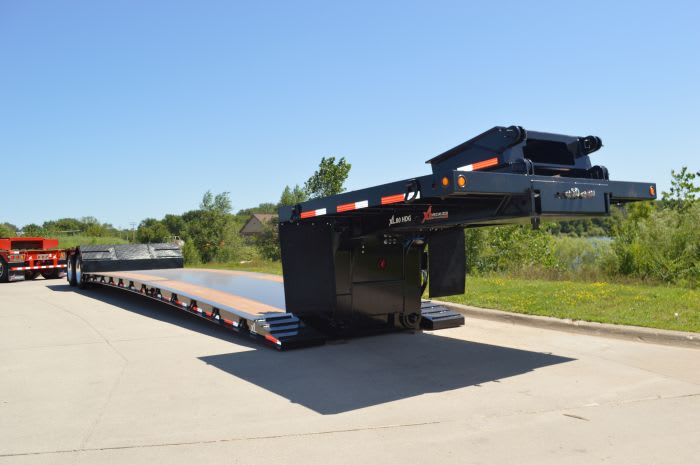
Low deck heights, as on XL Specialized’s XL 80, allow carrying of extra-high loads. The hydraulic mechanism on this trailer’s removable gooseneck is powered by 13-hp Honda engine. In other systems, a tractor’s PTO runs a pump to supply hydraulic pressure. Photo: XL Specialized
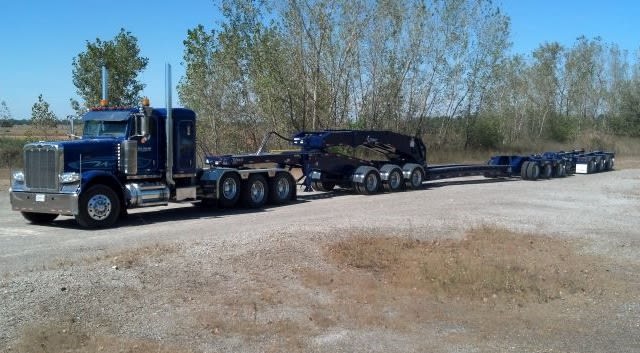
At the request of a customer, Talbert crafted this 75-ton, nine-axle “3+3+3” combination trailer consisting of a three-axle jeep dolly, a three-axle lowboy with a flip gooseneck extension, a nitrogen-assisted “E3Nitro” dampening system, and three removable flip axles.Photo: XL Specialized
It takes heavy to haul heavy. That’s a fact of life in this segment of trucking, where users deal with increasingly massive loads that must be supported and carried economically. You don’t think about “lightweight” when talking about lowboys, which are often long and multi-axled. Operators also use extra-heavy-duty flats and drop decks where low tare weight is also a difficult goal.
Nevertheless, today’s heavy-haul trailers are not as heavy as their predecessors – but it’s a careful balance.
“Loads are getting bigger, wider, heavier, so there comes a point where the word ‘integrity’ comes into play and we don’t want to interfere with that” by trying to cut too much weight, says Troy Geisler, vice president of sales and marketing at Talbert Manufacturing in Rensselaer, Ind. However, modern steels are lighter and stronger than the iron used by Austin Talbert when he founded the firm in 1938 in Chicago.
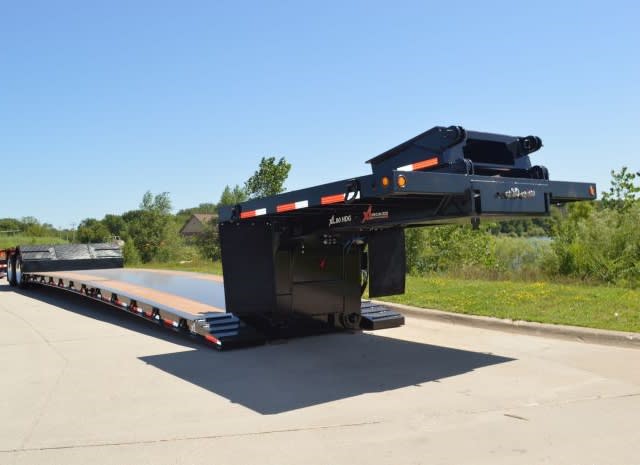
Low deck heights, as on XL Specialized’s XL 80, allow carrying of extra-high loads. The hydraulic mechanism on this trailer’s removable gooseneck is powered by 13-hp Honda engine. In other systems, a tractor’s PTO runs a pump to supply hydraulic pressure. Photo: XL Specialized
“We use mostly T-1 (100,000-pound tensile-strength) steel for our higher-capacity products,” which go to 70 tons and more, Geisler says. “For our SRT 30- to 45-ton double drops, we use 80K steel,” which is more than adequate but less costly.
Is aluminum feasible? “Aluminum’s not as robust. We’re definitely crafting, working on trying to reduce weight. But there comes a point where we have to say, ‘Could we build it? Yes. Could they afford it? No.’”
At Cozad in Stockton, Calif., “We use 100% T-1 steel on our products,” says Curt Weeks, the sales manager. “We’re not the cheapest, but we’re the strongest. T-1 is really strong, and it will hold up to extra loading. I’m not gonna say that our customers overload [go beyond a trailer’s rated capacity], but sometimes it happens.”
XL Specialized of Manchester, Iowa, uses a combination of T-1 and 80K steel in some of its products, but spec’ing is a way to cut poundage, says Rodney Crim, vice president of sales. “We build some of the lightest-weight trailers on the market. You can do it by leaving off non-essential equipment.” Like what? “That’s the ‘secret sauce,’” he answers. “Everybody tries to figure out how to do it.”
Lighter weight “has been a theme since I was in this industry, and that’s 25 years,” says Jay Kulyk, president of Rogers Brothers Corp. in Albion, Pa., now in its 111th year. “It’s a little bit misleading because trailers are getting longer. It used to be that a lowboy would have 20 to 22 feet of deck length; now it’s 26 feet and up to 28 feet. As a consequence, they get heavier. But they are lighter. Now a 55-ton detachable gooseneck trailer weighs 21,000 pounds, depending on options and accessories. Ten years ago, a similar trailer but with a shorter deck length would weigh 3,000 pounds more.
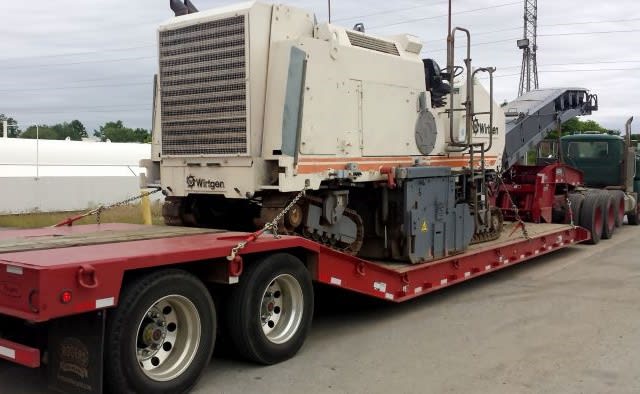
By federal regulation, Grade 70 transport chains must secure any machinery weighing over 4,500 kilograms, or 9,900 pounds, says Kinedyne, a maker of tie-down devices.Photo: Rogers Brothers Corp.
“But we take some conservative steps to lighten the trailer,” he continues. “The lighter the trailer, the more the flex, and the more the flex, the sooner it wears out. And the owner doesn’t get as much return on investment. So we have to make those changes very carefully. Our trailers will last almost indefinitely if they’re cared for. We get calls for parts for trailers from the ’50s. In used-trailer ads, you’ll see some for Rogers trailers from the ’90s and ’80s.”
More Equipment

How Volvo Updated Its D13 for EPA 2027 [Watch]
Volvo’s updated D13 promises lower emissions without sacrificing performance or fuel economy. Take a closer look at what changed inside the engine in this HDT Spotlight video.
Read More →
Michelin Tire Improves Efficiency and Durability for Regional Fleets
The Michelin X Multi Energy D2 is a regional haul drive tire engineered to help fleets improve fuel efficiency, durability and traction in demanding stop-and-go operations.
Read More →
ZF Expands Commercial Vehicle Push in North America
ZF is expanding its North American commercial-vehicle presence with new transmission applications, electrification, trailer technology and autonomous-driving systems.
Read More →
Tesla Wants a Self-Driving Semi. Are Cameras Enough?
Could Tesla’s camera-only autonomous driving technology work on an 80,000-pound Semi? In this commentary, HDT's Deborah Lockridge takes a look at Tesla, Cybercab, and how autonomous trucks see the road.
Read More →
Kodiak: Driverless Long-Haul Truck Launch on Track for 2026
Kodiak AI says its driverless long-haul safety case is 93% complete and it remains on track to begin commercial operations by year-end 2026.
Read More →
What DOT’s Automated Vehicle Strategy Means for Trucking
The U.S. Department of Transportation issued a new automated-vehicle strategy that outlines plans for driverless-truck regulations, cross-state freight corridors, and federal safety standards.
Read More →
East Coast Port Launches $45M Electric Truck Push
The Port Authority of New York and New Jersey announced millions in incentives for zero-emission drayage trucks, yard tractors, and new charging hubs near the port.
Read More →
PlusAI Going Public to Fund Autonomous Truck Launch
A SPAC deal could provide PlusAI with up to $300 million as it works toward a 2027 commercial launch of factory-built autonomous trucks.
Read More →
NHTSA Moves to Rewrite Truck Fuel-Economy Rules
The National Highway Traffic Safety Administration says it lacks authority to regulate medium- and heavy-duty truck engines separately from complete vehicles, but the existing standards have not yet been eliminated.
Read More →
Detroit Opens Orders for EPA 2027 Engines
Detroit isn’t starting from scratch to meet EPA 2027 diesel emissions standards. Its Gen 6 DD13 and DD15 engines keep much of today’s platform while updating the fuel and aftertreatment systems.
Read More →