




Hydraulic Hybrids: Ride-and-Drive Report From Work Truck Show
Well-attended educational sessions and an ever-larger trade display marked the National Truck Equipment Association's annual meeting and Work Truck Show, held in March at the St. Louis Convention Center

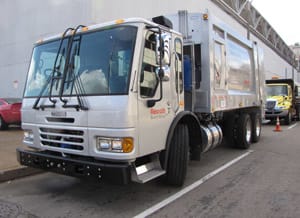
Built for New York City's sanitation department, American La France Condor has a Cummins ISM and Rexroth hydraulic hybrid system. It was smooth and quiet. (Photo by Tom Berg)
Well-attended educational sessions and an ever-larger trade display marked the National Truck Equipment Association's annual meeting and Work Truck Show, held in March at the St. Louis Convention Center.
One facet of the NTEA show is a ride-and-drive event featuring special-interest vehicles, usually those powered with alternative fuels and by hybrid drive systems. The gathering included a day-long Green Truck Summit of presentations and conferences on natural gas, propane, electric battery development and other eco-friendly subjects. So the driving event, one for attendees and one for the press, fit the green theme. There were 14 vehicles ready for inspection, lined up on a street behind the convention center. The course was a loop of the other three streets that surround the two- by three-block complex.
Many of the trucks have visited other meetings, such as the Hybrid Truck Users Forum and Alternative Fuels & Vehicles Conference, so I had already seen and driven a good number of these trucks and reported on them. So this time I zeroed in on some that I hadn't yet driven: a pair of heavy diesel-hydraulics. Hydraulic hybrids are well suited for vehicles that make many stops and starts in a day, and what makes more stops than trash trucks?
A hydraulic hybrid system has a hydraulic pump/motor connected to the driveline. When the truck slows and brakes, the pump/motor drags on the driveline to use the truck's motion to pressurize hydraulic fluid and send it into an accumulator tank nearby. This is called regenerative braking, and in addition to capturing kinetic energy, it does much of the slowing work and reduces wear on the service brakes. Upon launch, pressurized fluid is sent back through the pump/motor to spin the driveline and kick the truck into motion. Fluid pressure dissipates quickly and the engine takes over, but it hasn't had to work as hard so burns less fuel.
Purpose-built low-cab-forward chassis are common in the refuse industry, and all offer right-hand steering so drivers can hop in and out to tip cans into the packer body or closely observe what their automated side-arm lifting devices are grabbing. Cabs are wide, and the vantage point from the far right side takes some getting used to for Americans accustomed to left-hand drive.
The two trucks were interesting enough that I took each on two loops.
Bosch Rexroth Condor
First in line was an American La France Condor with Bosch Rexroth's hydraulic drive system. It is a truck version of the company's HRB (for hydrostatic regenerative braking) system for buses. This Cummins ISM-powered truck was built for New York City's sanitation department, which is testing a number of hybrid trash trucks, including a Crane Carrier Co. chassis with the Rexroth system. Like other NYC trash trucks, these also plow snow in the winter.
The Rexroth system was quiet, both on launch and regeneration. The hydraulic motor booted us quickly to street-cruising speed. Regen began when the truck slowed to 11 mph, then continued down to a crawl. I completed stops by stepping on the brake pedal. The speed at which regeneration starts can be set to a higher speed, but 11 mph is what NYC wants, a representative said.
The hydraulic motor also acts as a pump, converting driveline energy during slow-downs to pressurize fluid that's sent to accumulator tanks on the chassis. Operating pressure ranges from 2,600 to 4,500 psi, said Steve Wozniak, a lab and technician supervisor. Tests in various cities so far show the HRB system improves fuel economy by 8 percent to 20 percent, depending on duty cycle, and extends brake life by 50 percent-plus. Production is scheduled for the end of this year, and Rexroth will offer the system to any truck manufacturer.
Parker Hannifin Autocar
Parker Hannifin's Run Wise diesel-hydraulic hybrid is more than a year away from production, but reps have been showing it at meetings where folks attuned to hybrids gather. Parker and Autocar engineers have been developing it for some time, and four years ago I drove an early version near Autocar's manufacturing facility in eastern Indiana. They've come a long way and the system operates more smoothly than I recall from 2006.
But it's not quiet. There's a prominent whine from the hydraulic motor on the driveline. Some might call it noise, but to me it was almost pleasant, at least for the 10 or so minutes I drove this truck. It told me that the mechanism was working, especially upon acceleration from a dead stop. Then it eased up as pressure was expended and the engine took over. This was a 345-horsepower ISL, the heavy-duty midrange-size engine from Cummins.
Special gauges sitting on the engine cover displayed operating pressure, and the needle on the accumulator gauge varied from about 3,000 to 5,400 psi. Pressure dropped as fluid flowed to the motor, then climbed again when I stepped on the brake. The whine climbed in pitch as we accelerated and fell as speed slowed, but fluid flow itself seemed silent.
Tom Decoster of Parker said pre-production testing is under way, with eight Autocars temporarily working at a Ford Motor plant in Romeo, Mich., and 11 more on duty for two years with a sanitation fleet in Miami-Dade County, Fla. Production is scheduled to begin in the summer of 2011.
Between the two trash trucks were several electric trucks that I also drove, and they were eerily silent in operation and characteristically quick in acceleration. Although the general news media and auto enthusiast magazines have reported a lot about cars like Chevrolet's upcoming Volt sedan and the hot 125-mph Tesla sports car, the first electric vehicle to go into production in the U.S. is a commercial truck.
From the May 2010 issue of Heavy Duty Trucking.
More Equipment

How Volvo Updated Its D13 for EPA 2027 [Watch]
Volvo’s updated D13 promises lower emissions without sacrificing performance or fuel economy. Take a closer look at what changed inside the engine in this HDT Spotlight video.
Read More →
Michelin Tire Improves Efficiency and Durability for Regional Fleets
The Michelin X Multi Energy D2 is a regional haul drive tire engineered to help fleets improve fuel efficiency, durability and traction in demanding stop-and-go operations.
Read More →
ZF Expands Commercial Vehicle Push in North America
ZF is expanding its North American commercial-vehicle presence with new transmission applications, electrification, trailer technology and autonomous-driving systems.
Read More →
Tesla Wants a Self-Driving Semi. Are Cameras Enough?
Could Tesla’s camera-only autonomous driving technology work on an 80,000-pound Semi? In this commentary, HDT's Deborah Lockridge takes a look at Tesla, Cybercab, and how autonomous trucks see the road.
Read More →
Kodiak: Driverless Long-Haul Truck Launch on Track for 2026
Kodiak AI says its driverless long-haul safety case is 93% complete and it remains on track to begin commercial operations by year-end 2026.
Read More →
What DOT’s Automated Vehicle Strategy Means for Trucking
The U.S. Department of Transportation issued a new automated-vehicle strategy that outlines plans for driverless-truck regulations, cross-state freight corridors, and federal safety standards.
Read More →
East Coast Port Launches $45M Electric Truck Push
The Port Authority of New York and New Jersey announced millions in incentives for zero-emission drayage trucks, yard tractors, and new charging hubs near the port.
Read More →
PlusAI Going Public to Fund Autonomous Truck Launch
A SPAC deal could provide PlusAI with up to $300 million as it works toward a 2027 commercial launch of factory-built autonomous trucks.
Read More →
NHTSA Moves to Rewrite Truck Fuel-Economy Rules
The National Highway Traffic Safety Administration says it lacks authority to regulate medium- and heavy-duty truck engines separately from complete vehicles, but the existing standards have not yet been eliminated.
Read More →
Detroit Opens Orders for EPA 2027 Engines
Detroit isn’t starting from scratch to meet EPA 2027 diesel emissions standards. Its Gen 6 DD13 and DD15 engines keep much of today’s platform while updating the fuel and aftertreatment systems.
Read More →