




How to Choose the Right Truck Suspension
The right suspension for a trucking fleet operation comes down to cost, maintenance, application, and personal preferences.

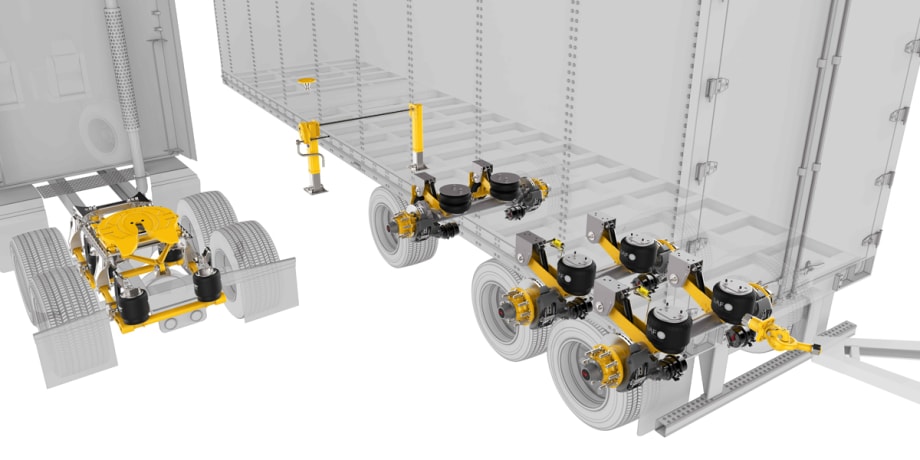
Air-ride suspensions offer a variety of advantages over mechanical systems. But they are more expensive to purchase and maintain.
Photo: Saf-Holland
Why does choosing the right suspension for your fleet matter? Choosing the best suspension for a fleet’s application is vital for vehicle longevity and driver satisfaction.
Applications can change slowly over time, and there is always new technology to consider. For those reasons, periodically reviewing suspension specs to make sure they match current needs is a good way to make sure a fleet is giving its drivers and the loads they carry the smoothest ride possible.
Types of Suspensions for Class 8 Trucks
There are three main suspension types for Class 8 vehicles, says Mark Molitor, senior product manager for Link Manufacturing. The are:
spring suspensions,
rubber suspensions, and
air-ride suspensions.
Each one has distinct features that lend each one to specific types of trucks in specific applications.
“A lot of times, the differences between these suspension types can be minimal. In those cases, personal preference is usually the deciding factor,” Molitor says. “I’ve seen dry van fleets go from air ride to springs because they really don’t see that big a difference in ride quality. And their thinking is they’d rather take the upcharge for air-ride suspensions and put it toward other specs on their trucks.”
Schneider, for instance, said it ran an extensive series of tests between various air- and spring-ride suspension systems and found that air springs do not guarantee superior ride quality.
Dig Into Suspension Differences
When looking at on-highway van trailer applications, the main differences can be summed up in two attributes, explains Lance Gage, product manager for SAF-Holland.
“If you’re interested in simplicity, then you’ll probably want to spec leaf spring suspensions, as they do not require any air controls, shock absorbers, or air springs,” he says. “[But] air-ride suspensions will have a better overall ride quality when the trailer is empty or partially laden.”
Things get a bit trickier for fleets that routinely run half- to fully-laden.
“Ride quality between the two design types is much closer in these applications and would likely not be discernible to the driver,” Gage says. “Generally, a fleet’s specific vocation and target customer applications (freight) will be paramount in determining which suspension system is the ‘best’ choice. While air rides are the prevalent choice for many specialty trailers such as tank, bulk, and platform, the mechanical suspension maintains a significant market share in the dry freight, on-highway segment.”
Differences between air and leaf spring suspensions include:
trailer isolation,
load distribution, and
enhanced operational capabilities.
Melanie Elliott, marketing manager for Hendrickson, explains that air suspensions isolate the trailer from road inputs because the suspension reacts to variations in the road surface without transmitting those variations into the trailer or the cargo. The result is less damage to the trailer and the cargo.
“Air suspensions also evenly distribute the trailer load to all trailer axles,” Elliott says. “On a spring ride, however, the leaf spring suspension nearest to the trailer load will carry more of that load. While wear is inevitable on components like tires and brakes, with an air suspension, these components wear at a more consistent rate, which helps extend component life. It also provides a more even distribution of brake force, helping to improve vehicle stopping distances.”
Another advantage offered by air-ride suspensions are their adjustable spring rate, which can be altered while maintaining a constant ride height via a height control valve. Pressure inside the air springs is adjusted based on the payload to ensure optimal suspension dynamics and ride comfort whether loaded or empty.
“Air suspensions can also be lifted when the vehicle load is reduced,” Elliott adds. “Lifting a suspension can increase the vehicle’s fuel economy and help extend the life of the brakes and tires on the lifted axle. A lifted axle can also reduce toll road costs.”
Suspensions For Vocational Applications
Most vocational fleets tend to opt for mechanical suspensions, which come in two types: leaf spring or rubber-mounted.
Hendrickson’s Elliott notes that these are generally simpler in design with less parts — which means they’re less expensive to spec and easier to maintain. And they are generally better suited to more demanding operations, especially off-road.
“Air-ride suspensions are becoming more popular in vocational applications, as they offer a better ride when unloaded,” says Tim Wrinkle, senior product manager for vocational and medium-duty trucks at Mack Trucks. “However, these suspensions can be limited in articulation and stability.”
Driver knowledge and training are also important with air suspensions because drivers need to evacuate air bags before dumping the load. Depending on the setup and a driver’s experience, this can also slow the dumping process for dump trucks.
“If you’re in a vocational application, and your load changes frequently during the day on routes with lots of stops and starts — refuse or dump operations, for example — you might want to at least try an air-ride suspension,” says Link’s Molitor. “That’s because an air-ride suspension is non-torque reactive. That means it works better to protect the drivetrain from shocks and vibrations generated by bumpy roads and simply starting and stopping the truck all day long. So you’ll get much better life out of your drivetrain components.”
On the other hand, he says, “mechanical suspensions — particularly leaf springs — offer you the lowest maintenance costs. As long as the metal in them is properly designed and not overstressed, they’ll last forever. That’s one advantage they have over rubber suspensions, which can deteriorate over time. Rubber does have an approximately seven-year life span before it starts to break down. So that’s something to consider.”
Mack’s Wrinkle stresses that the suspension spec is dependent on the application.
“Air suspensions do well in vocational applications,” he says. “But they don’t offer as much articulation and stability, and require additional training. If you want the smoothest ride, an air suspension is your best option. If you want maximum articulation and traction on jobsites, then a spring leaf over rubber block suspension, like the Mack mRide, is a better choice.”
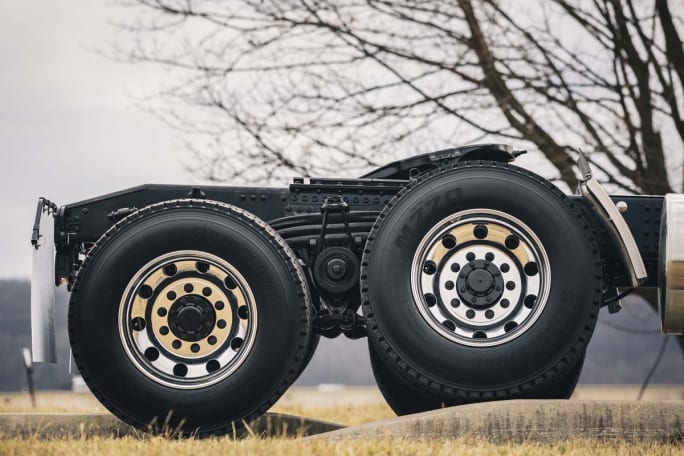
If you’re looking for maximum articulation and traction on vocational jobsites, then a spring leaf over rubber block suspension is a solid suspension pick.
Photo: Mack Trucks
Another point to consider is that vocational air-ride suspensions do have a few different maintenance procedures than leaf spring suspensions, adds SAF-Holland’s Gage.
Preventive Maintenance for Truck Suspensions
“Both air-ride and leaf spring suspension styles, especially in vocational applications, are the muscle under the backbone of the truck,” he says. “They carry heavy loads and traverse rough terrain found at worksites. Thus it is critical, whether a spring or an air-ride suspension, to establish routine maintenance practices. Air rides do have more wear parts like bushings, air springs, shock absorbers and air controls that require servicing.
"Adhering to a routine preventative maintenance inspection for air-ride suspensions can go a long way towards extending the life of the suspension,” Gage adds.
Elliott cautions that there is not a “one-size-fits-all” solution for fleets when it comes to suspensions. Fleets still have to zero in on the correct type and setup to get the performance they need.
This article first appeared in the October 2022 issue of Heavy Duty Trucking.
More Equipment

How Volvo Updated Its D13 for EPA 2027 [Watch]
Volvo’s updated D13 promises lower emissions without sacrificing performance or fuel economy. Take a closer look at what changed inside the engine in this HDT Spotlight video.
Read More →
Michelin Tire Improves Efficiency and Durability for Regional Fleets
The Michelin X Multi Energy D2 is a regional haul drive tire engineered to help fleets improve fuel efficiency, durability and traction in demanding stop-and-go operations.
Read More →
ZF Expands Commercial Vehicle Push in North America
ZF is expanding its North American commercial-vehicle presence with new transmission applications, electrification, trailer technology and autonomous-driving systems.
Read More →
Tesla Wants a Self-Driving Semi. Are Cameras Enough?
Could Tesla’s camera-only autonomous driving technology work on an 80,000-pound Semi? In this commentary, HDT's Deborah Lockridge takes a look at Tesla, Cybercab, and how autonomous trucks see the road.
Read More →
Kodiak: Driverless Long-Haul Truck Launch on Track for 2026
Kodiak AI says its driverless long-haul safety case is 93% complete and it remains on track to begin commercial operations by year-end 2026.
Read More →
What DOT’s Automated Vehicle Strategy Means for Trucking
The U.S. Department of Transportation issued a new automated-vehicle strategy that outlines plans for driverless-truck regulations, cross-state freight corridors, and federal safety standards.
Read More →
East Coast Port Launches $45M Electric Truck Push
The Port Authority of New York and New Jersey announced millions in incentives for zero-emission drayage trucks, yard tractors, and new charging hubs near the port.
Read More →
PlusAI Going Public to Fund Autonomous Truck Launch
A SPAC deal could provide PlusAI with up to $300 million as it works toward a 2027 commercial launch of factory-built autonomous trucks.
Read More →
NHTSA Moves to Rewrite Truck Fuel-Economy Rules
The National Highway Traffic Safety Administration says it lacks authority to regulate medium- and heavy-duty truck engines separately from complete vehicles, but the existing standards have not yet been eliminated.
Read More →
Detroit Opens Orders for EPA 2027 Engines
Detroit isn’t starting from scratch to meet EPA 2027 diesel emissions standards. Its Gen 6 DD13 and DD15 engines keep much of today’s platform while updating the fuel and aftertreatment systems.
Read More →