




How One Alabama Fleet is Finding Quality Truck Drivers
Alabama Motor Express is finding success in cutting its driver turnover using an online test that provides a behavioral assessment to identify the best candidates.


AMX decided to focus on finding drivers who were more likely to stay with the company, even if it means some empty trucks.
Photo courtesy Alabama Motor Express
It wasn’t easy for Collins White to convince upper management at Alabama Motor Express that the key to addressing the driver shortage was actually to narrow the funnel for driver applicants – but doing so appears to have helped the south Alabama-based dry van fleet cut its turnover in half.
White says although anecdotally, company management heard that drivers loved working for the company, nevertheless turnover neared 100% last year. Management was looking for a way to address it. That’s when White heard of an online pre-application behavioral assessment offered by JoBehaviors.
JoBehaviors provides job-specific compatibility assessments. Drivers seeking work complete an online questionnaire that reveals which behaviors they possess that are critical to being a “high-performance” long-haul trucker. Fleet customers also can create custom search queries that will help identify high-potential candidates who meet the company’s unique needs. The goal, the company says, is to identify prospects with the most desired behaviors so a better long-term match will result.
“It all made sense,” says White, who holds the title of president of logistics but is involved in other areas of the company as well. “Obviously it will help our business if we hire quality drivers that don’t want to leave us. If there’s a way on the front end to figure out who the quality drivers are, we’d be willing to try it.”
After about six months, he says, “the numbers are looking great so far.” Turnover has dropped to around 50%. While it’s hard to know how much of that was the screening vs. a 3-cent-per-mile pay hike instituted during the same time period, White feels confident that the pay raise alone would not have resulted in such a significant drop.
The 30-year-old says it was a challenge to introduce a new way of recruiting. “It was hard to convince people we needed to add another barrier. We’ve had 30 empty trucks [out of its fleet of 220], and we’ve had to sit there and bite the bullet and say, ‘We’re not going to hire on any two-star drivers anymore. We’re going to trust in the system.’ We know that nothing that’s worthwhile in business comes easy.”
Although revenue is down somewhat because of the empty trucks, White says the company is also seeing savings in its recruiting and hiring costs.
“The savings outweigh the revenue benefits, and it makes me sleep better at night,” White says. “Not that we weren’t hiring safe drivers, but it is comforting to me to know we’re screening them a little bit more. They have the behaviors of a safe driver instead of just they’ve got a good record. A good record is not always the telltale sign.”
The carrier doesn’t hurt for applicants, White says. “AMX doesn’t really have a driver shortage; to me it’s almost like we have too many people [applying]. It’s a quality shortage is the way I see it. Not trying to make it sound like most drivers are not good drivers, but there are a lot who don’t see driving as a career; they see it as a short-term job. We’re trying to go for those career quality truck drivers. And those are hard to find.”
Fleet Snapshot
Who: Alabama Motor Express
Where: Ashford, Alabama
Fleet: 220 tractors
Operations: Regional and national dry freight
Fun Fact: Collins’ father, Scott White, founded the company with two trucks about the time Collins was born.
Challenge: High driver turnover
Related: A Driver Shortage by Any Other Name
More Drivers

When Language Stops the Truck: The Return of ELP Out-of-Service Orders
English language proficiency rules for commercial drivers aren’t new, but renewed out-of-service enforcement has raised the stakes. Here’s what carriers need to know before a driver reaches a roadside inspection.
Read More →
Samsara Launches Custom AI Agent Builder
Agent Studio lets fleets create AI tools for hours-of-service monitoring, reporting and driver support, including agents that communicate by phone.
Read More →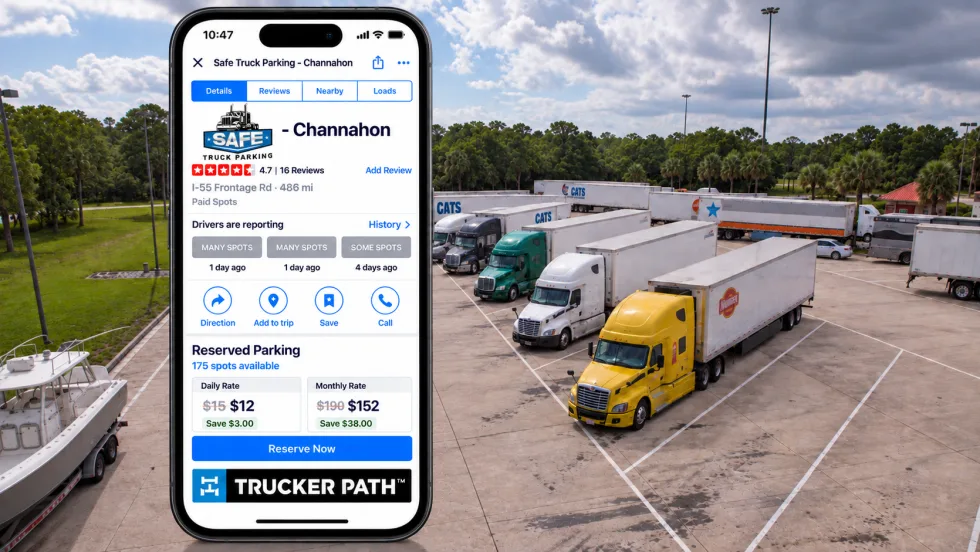
Trucker Path Expands Reserved Parking Network
Trucker Path has added close to 6,000 more truck parking spaces to its Trucker Path Reserved Parking Network with the addition of Safe Truck Parking.
Read More →
EEOC Sues Texas Trucking Company Over Driver Age Limits
The agency says Trancasa USA rejected applicants over 65 and applied tougher driving-record standards to those over 60.
Read More →
Nussbaum, Roehl Announce Second Driver Pay Increase This Year
This year has seen a swath of major truck driver pay increases as freight capacity has tightened.
Read More →
From One Generation to the Next: How Mentorship Builds Safer Truck Drivers
After three decades in trucking, Harold Perry shares what he's learned about driver safety, mentorship, and helping the next generation build confidence behind the wheel.
Read More →
Truck Drivers Need More Than Another Alert
Fleets have more visibility into truck health, safety events, and driver activity than ever. The next challenge is turning all that information into useful guidance for the person who has to decide what to do next.
Read More →
FMCSA Removes 110 Truck Driver Training Schools from Certified ELDT List
Federal regulators also are targeting more than 160 additional training providers and launching a nationwide audit of third-party CDL skills testers as part of a broader crackdown on trucking fraud.
Read More →
Hours of Service Pilot Programs: FMCSA Readies for 2027 Rollout
Two pilot programs could eventually reshape hours-of-service rules, giving truck drivers options to pause their 14-hour clock or use longer split sleeper rest periods.
Read More →
Medical Cards, English Proficiency Reshape Roadcheck Violations
Medical-card violations jumped to the top of the driver out-of-service list during CVSA’s 2026 International Roadcheck, while English-language proficiency violations appeared among the leading violations for the first time.
Read More →