





Heavy Duty Trucking Logo
MenuMENU
SearchSEARCH

How a Softer Economy is Affecting Transportation Earnings

While the economy continues to grow, it appears to be doing so at a slower rate, and freight yields are coming under increasing pressure, HDT's Contributing Economic Analyst Jeff Kauffman.

Jeff Kauffman
Jeff KauffmanContributing Economic Analyst
Read Jeff's Posts
November 22, 2022
How a Softer Economy is Affecting Transportation Earnings

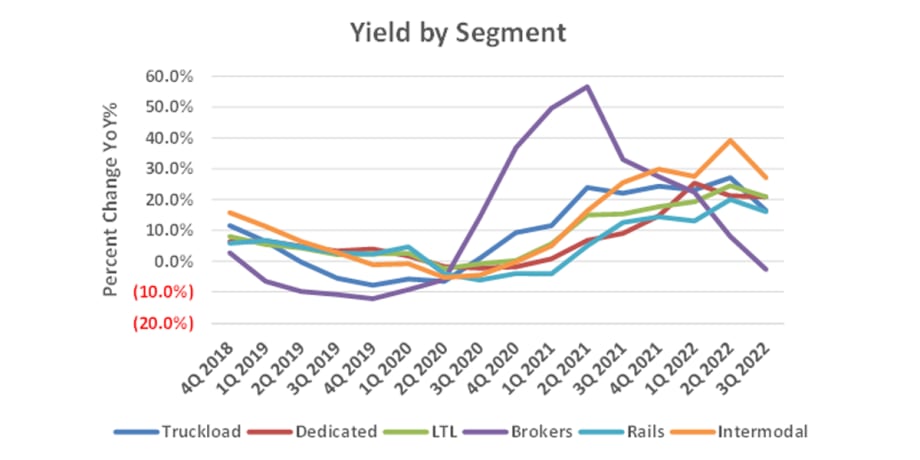
The brokerage business saw the most dramatic slowdown in revenue growth last quarter, thanks to lower spot market rates.

Source:  Company Reports, Tahoe Ventures, LLC

2 min to read


While the economy continues to grow, it appears to be doing so at a slower rate, and freight yields are coming under increasing pressure, HDT's Contributing Economic Analyst Jeff Kauffman.

Graphic: HDT

Publicly traded trucking and transportation companies delivered mixed third-quarter earnings, with somewhat subdued fourth-quarter outlooks attributable to pre-shipping of peak season inventories and a modestly weakening consumer.

Ad Loading...

Overall, 2022 earnings per share outlooks have been lowered by about 2.7%. So, while the economy continues to grow, it appears to be doing so at a slower rate, and freight yields are coming under increasing pressure.

While volumes overall were in-line to slightly lower than expected, revenue yields slowed, resulting in about 16% revenue growth across trucking businesses.

Ad Loading...

Operating costs rose by about 18%, resulting in lower overall operating margins for truckers.

  • Labor costs rose by about 21% on average.

  • Fuel costs were about 77% higher for truckload carriers and 46% higher for LTL companies.

  • Purchased transportation costs slowed to an average 7% increase on lower spot rates.

Earning Results by Truck Segment

Over-the-Road Truckload Carriers

OTR truckload carriers were the weakest of the truck sectors on a year-over-year basis, registering an average operating ratio deterioration in the third quarter of 225 basis points to 88.5%.

This was accomplished on 11.6% overall revenue growth — a function of 6.3% more trucks, a 16.4% improvement in fully loaded revenues per mile, and a 3.8% decline in miles per truck. This compares to an average revenue per mile growth of 27.6% last quarter. Labor costs were 20.6% higher, but this expense is leveling off as drivers are becoming easier to find.

Less-than-Truckload

LTL carriers overall reported healthier results, with 140 basis points of margin improvement and an average operating ratio of 83.7% on 15.4% average revenue growth. That’s stronger than OTR truckload.

Ad Loading...

The breakdown showed some economic deterioration as shipments were 2.5% slower and weight per shipment declined by 1.2%, implying about 3.7% lower tonnage. Yield improvement of 17.5% outgrew labor cost inflation of 7.2%. While fuel costs were 46.2% higher, purchased transportation expenses here were 2.2% lower than last year.

Dedicated Truckload

Dedicated fleet operations saw the best margin improvement of all trucking groups in the third quarter at 200 basis points, or a 91.2% operating ratio, as yield increases are catching up with inflation.

Revenues grew 23.3% on 7.5% average fleet growth, a 20.9% improvement in yields. Average miles/vehicle was also lower, down 2.6%.

Truck Brokerage

The brokerage business saw the most dramatic slowdown in revenue growth, thanks to lower spot market rates. Revenues grew just 3.9% on 3% average volume growth and negative revenue yields. In our view, there is also a trade-down occurring out of brokerage markets back to contract truckload. This resulting in a 35 basis point improvement in operating ratio to 94.8%.

6 Takeaways from Third-Quarter Earnings Reports

Some of the key observations that came out of the earnings reports:

  1. 3Q/4Q freight volumes will lack the normal peak season and holiday boost, but not because of weak demand. While consumer spending has been slowing, the real culprit here is high inventories. Shippers are adamant that this is not a read into 2023 at this time.

  2. Capex budgets are being reduced, but not because of weaker profit margins. Rather, improving but continued OEM equipment delays are keeping most companies on allocations into 2023, and are pushing capital expense numbers from 2022 into 2023.

  3. Spot truck rates and ocean container rates have round-tripped to pre-pandemic levels. The driver in the trucking market is a shift of spot freight back to contract markets. Ocean rates are seeing improved port congestion and high inventory levels, resulting in blank sailings and faster sailing times to the West Coast.

  4. Rail network fluidity is improving. While 3Q averages remain subdued, end-of-quarter speed improved about 10% for the industry, and dwell times were approaching double-digit improvements as well.

  5. Contract truck pricing could be nearing an inflection point. Truck spot rates have leveled off near 2018 levels, but contract rates remain elevated. However, the second derivative of pricing appears to be turning, and we look for lower growth rates ahead as customers re-bid larger pieces of their networks in 2023.

  6. The over-earnings party continues for used truck equipment. Dealership inventories remain lean and used equipment prices have come down off their peak, but used trucks remain in strong demand. Ryder’s 83% utilization remains near record levels.


This commentary was published in the November/December 2022 issue of Heavy Duty Trucking. 

More from Jeff Kauffman's Behind the Numbers column: What Q2 Earnings Tells Trucking About Market Trends

Subscribe to Our Newsletter

More Fleet Management

Graphic with light bulbs, HDT Truck Fleet Innovators logo, and the word Nominations
Fleet ManagementMay 15, 2026

Deadline Extended for HDT Truck Fleet Innovators Nominations

Heavy Duty Trucking has extended the deadline for nominations for its Truck Fleet Innovators awards. The deadline has been extended to May 22.

Read More →
Illustration of U.S. Supreme Court building and a truck crash

Supreme Court Ruling Puts Freight Broker Vetting Practices in Spotlight

The unanimous SCOTUS ruling in the closely watched Montgomery v. Caribe case allows state negligence claims against freight brokers that hire unsafe motor carriers, raising new liability and vetting concerns among brokers.

Read More →
Mobile tablet showing Motus screen against highway background with Motus logo

FMCSA’s Motus System Is Coming. What Fleets Need to Know Now

FMCSA's long-awaited registration system promises a single portal — and tighter fraud controls. And there are steps you need to take by May 14.

Read More →
Ad Loading...
Fleet Advantage Generative AI study.

Fleet Advantage: Fleets Embrace Generative AI, but Data Problems Limit Operational Gains

New Fleet Advantage research shows generative AI adoption has exploded among private fleets. But poor data integration and weak ROI tracking are preventing fleets from unlocking AI’s full operational and financial value.

Read More →
Phillips Connect extends Nussbaum trailer life.

How Phillips Connect Helped Nussbaum Transportation Double its Trailer Life

Seven years into deploying Phillips Connect’s smart trailer platform, Nussbaum Transportation has extended trailer life from 10 to 15 years.

Read More →
Lance Evans, Director of Safety at K&B Transportation.

Inside Modern Fleet Safety: AI, Cameras & Speed Control at K&B Transportation

How a former commercial vehicle enforcement officer turned director of safety at K&B Transportation is embracing real-world safety technology.

Read More →
Ad Loading...
TEN disaster prep.
Fleet ManagementMay 1, 2026

How Fleets Can Avoid Equipment Blind Spots in Disaster Response

When the unexpected happens, how you react to, and deal with operational blind spots is critical. Here’s how to keep you recovery on track, when nothing is normal.

Read More →
Illustration of cybersecurity images with "The Cyber Stop" text
Fleet Managementby Ben WilkensApril 30, 2026

AI Security Risks for Trucking Fleets: What to Know About Deepfakes and Agentic AI

As fleets adopt artificial intelligence for routing, maintenance, and load matching, new security risks are emerging. Learn where the vulnerabilities are and how to put the right controls in place.

Read More →
CargoNet 2026 Qi report.
Fleet Managementby News/Media ReleaseApril 24, 2026

Cargo Theft Incidents Fall in Q1, but Organized Crime and Impersonation Drive New Risks

CargoNet reports fewer supply chain crime events to start 2026. But losses hold steady as organized crime shifts tactics toward impersonation schemes and high-value goods.

Read More →
Ad Loading...
Illustration with trojan horse and lock with inside of cargo container in background
Fleet Managementby News/Media ReleaseApril 23, 2026

New Trojan Driver Cargo Theft Scam Bypasses Carrier Vetting Systems

Cargo theft rings plant operatives as drivers inside legitimate, fully vetted carriers, then execute coordinated thefts that look like a traditional straight theft from the outside.

Read More →









