




How E-Commerce Trends Are Affecting Final Mile Logistics
A bi-annual survey into home delivery and final mile finds that customers want their e-commerce orders faster and faster – and they want them free. But it’s hardly free for the companies doing the delivering, and it’s driving changes in the retail supply chain that may affect even carriers not in the final-mile business.

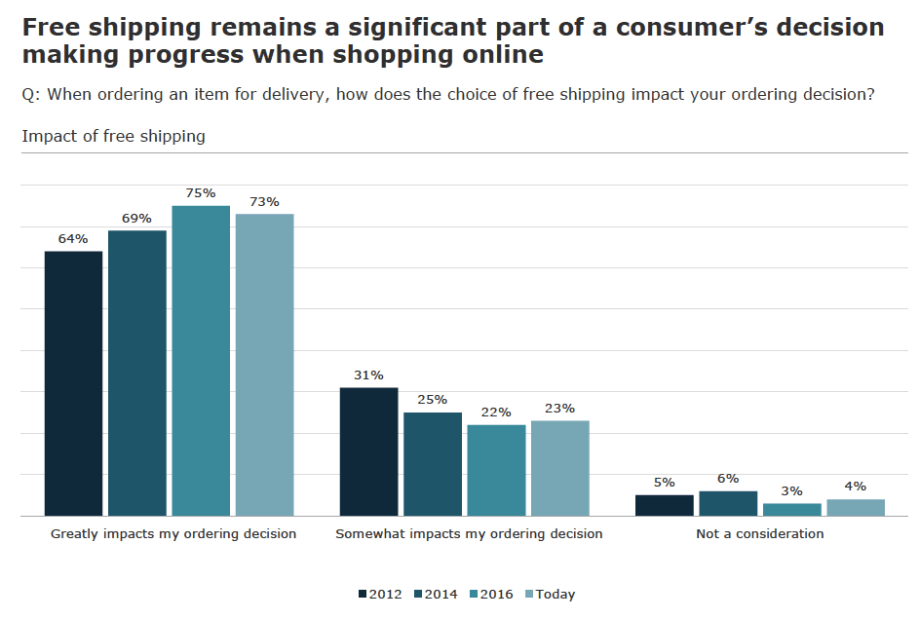
Free shipping remains a big part of online shoppers' decision making – but so does fast shipping. AlixPartners graph
A bi-annual survey into home delivery and final mile finds that customers want their e-commerce orders faster and faster – and they want them free. But it’s hardly free for the companies doing the delivering, and it’s driving changes in the retail supply chain that may affect even carriers not in the final-mile business.
The transportation investment analysts at Stifel recently held a conference call with AlixPartners to discuss their survey of about 1,000 consumers about their online shopping habits.
The survey found that more than half now are Amazon Prime members. Amazon, AlixPartners points out, is giving customers “fast and free” – even when they have to pay an annual Amazon Prime membership, it’s still seen as “free” two-day shipping. This has effectively “laid down the gauntlet” for other retailers and brands that sell direct to the consumer. In fact, they said, “Amazon has initiated a supply-chain arms race that many retailers and brands are struggling to compete against.”
This is leading to changes in the retail supply chain, including more emphasis on proximity to customers. This means warehouse and distribution center space in densely populated consumer markets is at a premium. Logistics providers are piling into the final mile sector, whether through organic expansion or thorough mergers and acquisitions. Manwhile, the American Trucking Associations reports that the average length of haul has now dropped to a historic low of 499 miles.
And these trends are likely to continue, as consumers get ever more comfortable with ordering online – even groceries and large bulky items like furniture and appliances.
In 2012 when AlixPartners first did this survey, they asked about the maximum amount of time people were willing to wait for free shipping. At that time, the answer was a little over a week. Then it dropped in 2014 by half a day, and in 2016 in dropped further. “Today, we're down to four [days], and this is moving at a quarter of a day every year,” explained Marc Iampieri, managing director for AlixPartners. “That's pretty material, because in four days a team driver can pretty much get all over the United States. But with a solo driver and a handoff and with a final mile delivery, you now pick your choice of delivery vans – you're going to have to start deploying this product a lot closer.”
Pretty soon, he said, we're going to be in an expectation of three-day delivery for free.
“I think the results just further confirm what we all suspect, that consumers continue to increase their amount of e-commerce usage,” Iampieri said. “Every year they want more products available for free and they want it from more retailers.
“But more importantly, when they get that free delivery, they want it within a shorter time period," Iamperi said.
In fact, he noted, the survey showed that same-day delivery is gaining popularity, although it’s still a small percentage of overall deliveries. “I think it is probably more popular in more densely populated urban areas, where you can actually pull it off with some package density,” he said. “But still, it's moving pretty quickly. This is going to, over the next couple of years, be something that I believe is going to be growing faster, and that you're going to need some specialized service to perform that. While that may be what the customer wants, being able to deliver on that promise is very costly, and we're also seeing some shifts in the market place, which will allow for that.”

More than half of survey respondents were Amazon Prime members. AlixPartners graph
Locating Closer to the E-Commerce Customer
“You really can't defy the laws of physics. If you want to be able to offer next day, same day … the products have to be within close proximity to the customers. You can't just get away with a large, regional DC somewhere in the Midwest and be able to pull off the transit times to meet the customer's expectations.”
The result is more fulfillment centers that are located closer to the end user. “I live in the northeast and five years ago you drove up I-95, you were looking at some boarded-up warehouses. A lot of those are prime real estate now, and the distribution centers don't have to be that big for each of these markets.”
In addition, home delivery is no longer just about clothing and electronics. When consumers were asked, “Which category you have purchased for home delivery in the last 12 months,” the result indicates a change some staple categories like grocery and over-the-counter pharmaceuticals, pet supplies, cleaning supplies, etc.
AlixPartners Director Jim Blaeser says this will create new challenges on the delivery side, “because you also have the issue of perishability coming into play here… stakes are getting higher.”
Blaeser predicted that these challenges will mean opportunities for third-party logistics providers. “Some of the brands that we work with are challenged to think about how they find the capital to set up new operations, and especially the idea of all the smaller satellite operations as setting up multiple sites for a brand can be a really daunting capital expense. So from a 3PL standpoint, the opportunity to step in, offer that service, offer flexibility around it and, to the extent that it's available offer, plug-and-play solutions can be a really compelling offering.”
Iamperi agreed. “If you're a 3PL, you need to quickly line up meetings with your customers that are trying to compete and talk about how a multi-user facility could work for them.”
Another result of all these trends? Mergers and acquisitions. “We've seen a lot of deals, some private, some with much larger companies that provide the capacity and, in some cases, the technologies to manage the work flow of these home delivery orders,” Iamperi said. “Not just parcels, but too-large durable goods as well, where I've seen it become more popular.”
As Blaeser noted, "Fundamentally, last mile delivery is a business that struggles to build scale.... logistics companies that don't have a last mile footprint right now are going to be challenged, to either build it or buy it."
Related: The Amazon Effect on Freight Transportation Discussed at FTR Conference
More Fleet Management

Color Match Smarter: Tools That Restore & Perform
For fleet managers and collision repair professionals keeping heavy-duty trucks on the road, getting the color right the first time isn't just about appearance — it's about efficiency, turnaround time, and bottom-line results. Discover how today's digital color tools are transforming the repair process from guesswork to precision.
Read More →
FMCSA Pauses Biennial-Update Enforcement Amid Motus Transition
Carriers whose updates were due on or after June 1 have more time, while FMCSA works to stabilize its new registration system and warns of phishing sites impersonating its new carrier registration system, Motus.
Read More →
2026 Blueprint for Countering Smarter Supply Chain Theft
Cargo theft is no longer just the cost of doing business. It's a multi-billion-dollar criminal enterprise exploiting vulnerabilities across your fleet, drivers, and supply chain.
Read More →


How Telematics Improves Visibility, Control, and Performance in Refrigerated Fleets
Explore how telematics help refrigerated fleets improve visibility, uptime, efficiency, compliance, and cargo protection across connected cold chain operations.
Read More →
What the U.S.-Canada Trade War Means for Trucking
Escalating U.S.-Canada tariffs could disrupt cross-border freight, reduce truck volumes, raise costs, and create new uncertainty for carriers on both sides of the border.
Read More →
What Are Trucking’s Top Concerns for 2026?
The American Transportation Research Institute wants to know what's worrying trucking fleet managers, drivers, and other stakeholders in its annual Industry Issues survey.
Read More →
American Trucking Associations Looks for a New Leader
ATA President and CEO Chris Spear abruptly left his job at the association on August 21, at a pivotal time for the trucking industry.
Read More →
Public Wi-Fi Cybersecurity Risks: How Truck Drivers and Fleets Can Protect Their Data
Public Wi-Fi can expose truck drivers and fleets to credential theft, malware, and other cyber threats. Here’s how to reduce the risk on the road.
Read More →
For Nicky Cupp, Fleet Innovation Starts With Frustration
HDT Truck Fleet Innovator Nicky Cupp turns everyday pain points at Fraley & Schilling into opportunities for better technology and smarter processes.
Read More →
Adam Buttgenbach’s Approach to Electric Trucks: Start With Where They Fit
HDT Truck Fleet Innovator Adam Buttgenbach helped PepsiCo build one of North America’s largest EV fleets by focusing on where electric trucks make operational sense.
Read More →