





Related: Time to Face The Future Head-On
How E-Commerce Disrupts Trucking
While disruption may be a current buzzword, it’s as old as capitalism itself, said Thom Albrecht, president of Sword & Sea Transportation Advisors, speaking at the PeopleNet and TMW in.sight User Conference + Expo in Nashville.
August 15, 2017
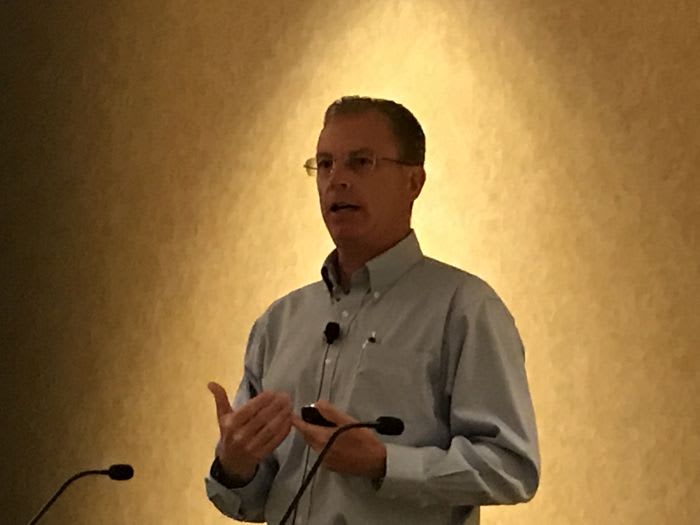
Thom Albrecht Photo: Jim Beach
4 min to read
Thom AlbrechtPhoto: Jim Beach
NASHVILLE, TN -- While disruption may be a current buzzword, it’s as old as capitalism itself, said Thom Albrecht, president of Sword & Sea Transportation Advisors, a securities analysis firm. Speaking at the PeopleNet and TMW in.sight User Conference + Expo Aug. 15, Albrecht said that when there’s real disruption market leaders are displaced.
The examples are legion: the horse and buggy vs. the automobile; ice boxes vs. refrigerators; and more recently the example of Kodak, which held the first patent for a digital camera, but couldn’t see the real value of the technology or how it would affect its core business of making film. And of course, everyone knows about the disruptions that Uber and Airbnb created in taxi cab and hotel markets.
And of course, there is Amazon and other retail e-commerce sites, which have totally disrupted the retail industry in terms of brick and mortar stores. Albrecht argues Amazon is the latest disruption in a trend affecting retail. Before that, he said, catalog sales took a bite out of department stores, big box stores took another bite, and Amazon and similar ventures put the big box stores down.
Albrecht predicts malls will continue to contract – their numbers will decrease until only a few are left. Even now, 28% of malls account for 70% of mall sales. What that means for retail is that much of the free labor and transportation they had once relied on is gone.
Before Amazon and direct shipment of goods to consumers, they had to drive to the store and pick up their goods, he said. Now, we demand delivery and in many cases demand it the next or even same day we order. As a result, Albrecht said projections call for 20% more brick and mortar stores to close with the next five to eight years. In fact, Amazon’s sales growth in many consumer segments has far outpaced each segment overall growth. For instance, e-commerce’s share of the beauty care market is 28% with year-over-year sales growth of $1.6 billion, while brick and mortar stores’ sales growth was minus $170 million.
Every retail category is gaining momentum in e-commerce, as we have begun to buy things online we wouldn’t have three to four years ago, he said, paced by millennials buying much of their goods online.
That includes food items, which along with a few other trends is changing food logistics. For instance, this year 31% of online shoppers were willing to make at least one food order online. Last year that figure was 19% and in 2015 it was 8%. Online spending on food and alcohol is expected to grow from $14 billion in 2016 to $125 billion in 2020.
The popularity of online food kits may have something to do with that, Albrecht said. Another trend affecting food logistics: changing tastes. Year-to-year sales growth at independent restaurants grew 6-8%, while chain restaurants saw about 1% growth.
What does that mean for trucking? Albrecht thinks there will be fewer full truckloads, more transparency, and compression of rates. Autonomous vehicles could add capacity and electric trucks could reduce operating costs, he said. But both of those trends may depress rates. On the bright side, however, is that with more transparency, good service can win out over lower rates if the rate spreads are smaller.
He also foresees dry van shipments going down while refrigerated shipments will increase; fewer Class 8 trucks and more medium-duty trucks, although not everyone in the industry agrees with that assessment.
To manage your company in disruptive times, Albrecht suggests a few principles. First, see change properly – be ready to change your operation if necessary. Second, being the biggest and the smartest may not protect you, since leading companies rarely see disruption coming as they are focused on what they have always been doing.
Don’t be afraid to hurt a part of your business if need be. For instance, Amazon was the leading seller of books but they developed the Kindle anyway, knowing that e-books would eat away at regular book sales. Watch out for the low margin, low volume parts of the business, as that’s where disruptors get a toe-hold. As an example, Albrecht cited how parcel carriers siphoned off small and mid-sized shipments from LTL carriers until the FedEx’s and UPS’s of the world became LTLs themselves.
And to tackle disruption, it may be better to establish an autonomous unit outside of the “home-office” culture, he said.
Subscribe to Our Newsletter
More Fleet Management

Sponsored•September 16, 2026
Color Match Smarter: Tools That Restore & Perform
For fleet managers and collision repair professionals keeping heavy-duty trucks on the road, getting the color right the first time isn't just about appearance — it's about efficiency, turnaround time, and bottom-line results. Discover how today's digital color tools are transforming the repair process from guesswork to precision.
Read More →
FMCSA Pauses Biennial-Update Enforcement Amid Motus Transition
Carriers whose updates were due on or after June 1 have more time, while FMCSA works to stabilize its new registration system and warns of phishing sites impersonating its new carrier registration system, Motus.
Read More →
Sponsored•September 14, 2026
2026 Blueprint for Countering Smarter Supply Chain Theft
Cargo theft is no longer just the cost of doing business. It's a multi-billion-dollar criminal enterprise exploiting vulnerabilities across your fleet, drivers, and supply chain.
Read More →


Sponsored•September 1, 2026
How Telematics Improves Visibility, Control, and Performance in Refrigerated Fleets
Explore how telematics help refrigerated fleets improve visibility, uptime, efficiency, compliance, and cargo protection across connected cold chain operations.
Read More →
What the U.S.-Canada Trade War Means for Trucking
Escalating U.S.-Canada tariffs could disrupt cross-border freight, reduce truck volumes, raise costs, and create new uncertainty for carriers on both sides of the border.
Read More →
What Are Trucking’s Top Concerns for 2026?
The American Transportation Research Institute wants to know what's worrying trucking fleet managers, drivers, and other stakeholders in its annual Industry Issues survey.
Read More →
American Trucking Associations Looks for a New Leader
ATA President and CEO Chris Spear abruptly left his job at the association on August 21, at a pivotal time for the trucking industry.
Read More →
Public Wi-Fi Cybersecurity Risks: How Truck Drivers and Fleets Can Protect Their Data
Public Wi-Fi can expose truck drivers and fleets to credential theft, malware, and other cyber threats. Here’s how to reduce the risk on the road.
Read More →
For Nicky Cupp, Fleet Innovation Starts With Frustration
HDT Truck Fleet Innovator Nicky Cupp turns everyday pain points at Fraley & Schilling into opportunities for better technology and smarter processes.
Read More →
Adam Buttgenbach’s Approach to Electric Trucks: Start With Where They Fit
HDT Truck Fleet Innovator Adam Buttgenbach helped PepsiCo build one of North America’s largest EV fleets by focusing on where electric trucks make operational sense.
Read More →