




How Brent Ellis is Automating Trucking Operations at Decker Truck Line
Learn how Decker Truck Line’s Brent Ellis, an HDT 2025 Truck Fleet Innovator, uses automation, software integration, and driver-focused innovation to transform fleet operations.
August 28, 2025

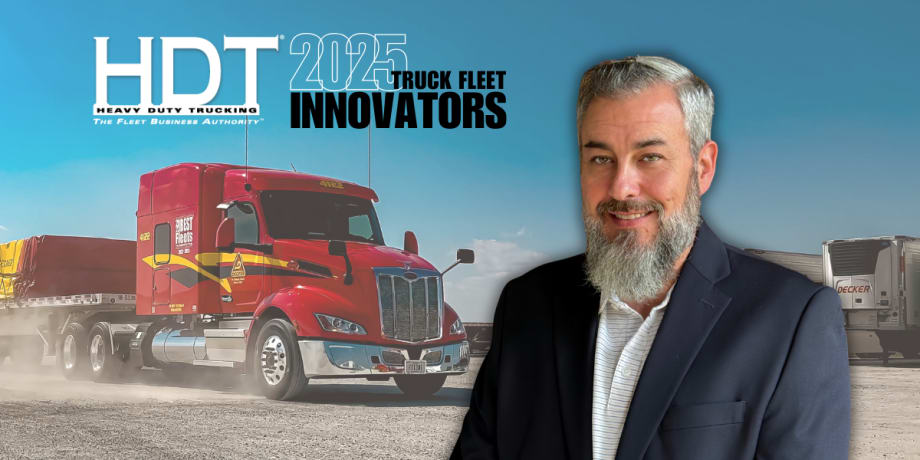
As a former driver, 2025 HDT Truck Fleet Innovator Brent Ellis understands the things that frustrate truckers.
Credit:
HDT Graphic/Decker photos
6 min to read
Brent Ellis has never used his architectural engineering degree. But everything else in his background — dock worker, dispatcher, truck driver, broker, VP of finance, trucking software consultant — has led him to become a technology leader in trucking.
Today, as VP of business systems and process at Fort Dodge, Iowa-based Decker Truck Line, he’s applying decades of experience across the industry to create real-world efficiencies for trucking fleets, prompting Heavy Duty Trucking to name him a 2025 Truck Fleet Innovator.
Integrating Trucking Software Systems for Efficiency
Trucking companies rely on a large number of different computer systems, and those systems don’t always talk to each other.
That means, for instance, whenever a new driver is hired, there are multiple systems where their information has to be entered.
Thanks to Ellis, Decker has built automated processes between the systems. Now, when a new driver is entered in the TMS, that information automatically populates other systems such as the electronic logging device and the event recorder.
And that’s just one example of what he’s accomplished in his five years at the company.
Using Technology to Improve the Truck Driver Experience
As a former driver, Ellis understands the things that frustrate truckers. He and his team have been working on initiatives that bring together navigation, fuel optimization, and more to address some of those pain points.
For instance, Decker uses McLeod’s TMS, Trimble’s CoPilot for commercial navigation, and Manhattan's Fuel&Route for fuel optimization.
Currently, drivers receive fuel stop details via free-form messages, but they have to manually enter those into CoPilot for navigation.
Decker has worked with Manhattan to use APIs (application programming interface), and the cloud, so drivers will automatically have fuel stops and everything right in their navigation system.
Even more convoluted for drivers is getting routed to a place for a trailer washout, which they often need because fresh meat was previously in the refrigerated trailer.
Making that happen is complicated. The driver has to call and notify the back office. Then the office looks at the fuel and routing solutions to find the stop closest to the driver’s route. And they have to issue an advance for that washout manually.
“It's time-consuming and it’s cumbersome,” Ellis says.
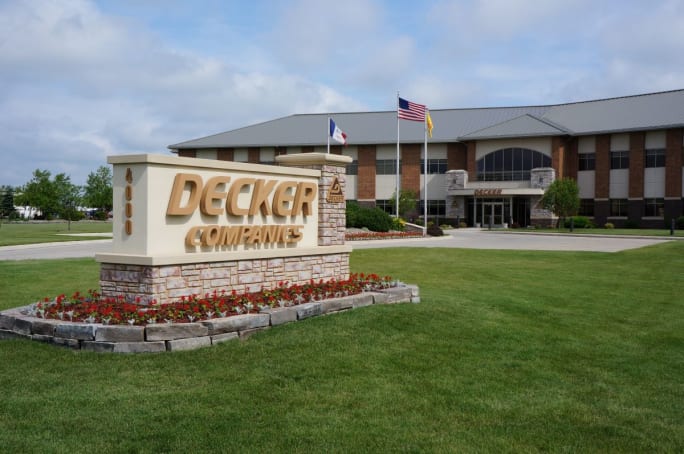
Decker is a diversified carrier that transports flatbed freight, dry van, and temperature-controlled freight.
Photo: Decker Truck Line
API Integration for Navigation, Fuel Stops, and Washouts
The new system repurposes a feature in the Manhattan fuel routing. It will contain all the washout locations. When the load goes into the Manhattan system, it weighs cost and distance to recommend the most efficient trailer washout stop, just like it does for fuel routing.
The McLeod TMS automatically issues an advance for the washout, and the stop appears in the driver’s navigation.
"The driver will have fuel stops, washouts; anywhere he has to go will be right there in his navigation,” Ellis says.
Another automation process simplifies the transition from driver orientation/training into the fleet.
A single action from the training team assigns Decker's new truck drivers to the correct fleet. The system ensures their data stays consistent, regardless of which truck they’re driving.
“Everything stays in sync,” Ellis explains. “Revenue doesn’t get misallocated or credited to the wrong division, because it’s always following the driver.”
Meet Rosie Robot: RPA and Automation in Trucking Operations
Those initiatives are really just the tip of the iceberg. Ellis says the company has developed more than 150 automated processes.
The majority use McLeod Software’s FlowLogix visual workflow tool, allowing Decker to create custom workflows for automated business processes.
And Decker uses two RPAs (robotic process automation), with multiple automated processes handled by each.
“Basically, we can build a robot to do anything that a human would do,” Ellis explains.
We’re not talking about physical robots here, but about software robots, or “bots.” These excel at performing repetitive, rules-based tasks, such as logging into applications, entering data, or transferring files.
Ellis has nicknamed one of those bots "Rosie." At 5:30 every day, Rosie wakes up and retrieves a file containing paperwork for that day's loads.
She mimics a human user — logging into customer portals, navigating multi-factor authentication, uploading documentation, and clearing the task list daily. Then she goes back to sleep.
Before Rosie, one employee spent 13 hours a week just managing detention requests for a single customer.
“Now she spends zero,” Ellis says. “Rosie takes care of all of it.”
Cutting Costs Through Smarter Trucking Workflows
Other bot processes help retrieve information from Decker’s maintenance software, relieving humans of the time they would need to analyze massive spreadsheets and reports.
Another allowed Decker to convert its trailer maintenance schedules to mileage-based instead of time-based, so they’re not spending money working on trailers that have just been sitting in the customer’s yard the whole time.
“When you’re not doing all that maintenance on equipment that just sits, it’s a big saving,” Ellis says.
While Ellis and his team have already automated more than 150 processes, there’s one frontier they haven’t yet tackled: artificial intelligence.
RPA bots aren’t the same thing as AI, although they're often used together.
“I've got some plans for the future, but it seems like every time I think, next month, we’ll wrap this project up and we’ll be able to play around with that, next month never gets here.”
Ellis feels AI has a lot of potential, but he also doesn't want to rush into it.
“We have to make sure our operations staff or whoever’s involved is doing it the right way, before we teach it bad habits.”
Streamlining Trucking Processes Across the Fleet
It’s not just the technology that makes a difference. It’s also looking closely at processes and how they could be improved.
“It's always been funny to me that in trucking, we all do the same thing,” Ellis says. "We put some stuff in a box and we take it over here. And at the end of that, we send them an invoice.
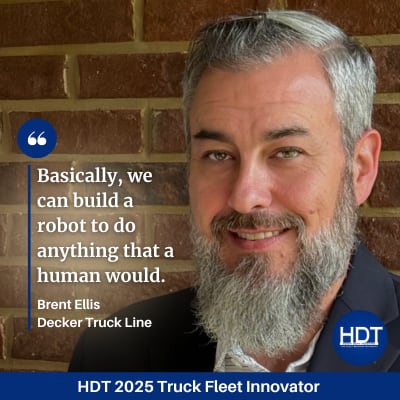
"If you talk to 15 carriers, there will be 17 different ways to do that same thing. And every one of them is the only way that it can be done.”
Because of his wide range of trucking experience and his knowledge of how different companies do things, Ellis says he can take a 30,000-foot view of a situation.
“Typically, I can see where a bottleneck is in a process and what’s slowing things down,” he says.
From there, he works to trace the problem back to the root cause (or causes.) And it may be far from where the problem manifested.
“I’ve started out looking at something to do with billing and ended up over in safety,” he says. “It's unbelievable how things can tie together.”
Building a Culture of Innovation in Fleet Management
Ellis credits the others in his group for allowing so much progress in automation. They work closely together and bounce ideas off of each other, which Ellis has encouraged from day one.
“I can come up with an idea and say, ‘Here's what I’m thinking, and here’s how I’m thinking we can do it. What are your thoughts?’”
The team will explore the idea and return to Ellis with results. And, he says, his ideas don’t always pan out.
Sometimes, he says, his team comes up with an easier way to accomplish what he’s trying to do. Or they might report back that it’s possible, but it might not be cost-effective.
“Possible and practical are two different things completely sometimes.”
Not every idea works out. But with the right team and the right approach, Ellis says, the wins add up.
“I'm proud of what we've accomplished here as a company and as a group,” he says. “And I couldn’t have done any of it without my group behind me — because I'm too busy thinking up the next thing.”
Subscribe to Our Newsletter
More Fleet Management

Sponsored•September 16, 2026
Color Match Smarter: Tools That Restore & Perform
For fleet managers and collision repair professionals keeping heavy-duty trucks on the road, getting the color right the first time isn't just about appearance — it's about efficiency, turnaround time, and bottom-line results. Discover how today's digital color tools are transforming the repair process from guesswork to precision.
Read More →
FMCSA Pauses Biennial-Update Enforcement Amid Motus Transition
Carriers whose updates were due on or after June 1 have more time, while FMCSA works to stabilize its new registration system and warns of phishing sites impersonating its new carrier registration system, Motus.
Read More →
Sponsored•September 14, 2026
2026 Blueprint for Countering Smarter Supply Chain Theft
Cargo theft is no longer just the cost of doing business. It's a multi-billion-dollar criminal enterprise exploiting vulnerabilities across your fleet, drivers, and supply chain.
Read More →


Sponsored•September 1, 2026
How Telematics Improves Visibility, Control, and Performance in Refrigerated Fleets
Explore how telematics help refrigerated fleets improve visibility, uptime, efficiency, compliance, and cargo protection across connected cold chain operations.
Read More →
What the U.S.-Canada Trade War Means for Trucking
Escalating U.S.-Canada tariffs could disrupt cross-border freight, reduce truck volumes, raise costs, and create new uncertainty for carriers on both sides of the border.
Read More →
What Are Trucking’s Top Concerns for 2026?
The American Transportation Research Institute wants to know what's worrying trucking fleet managers, drivers, and other stakeholders in its annual Industry Issues survey.
Read More →
American Trucking Associations Looks for a New Leader
ATA President and CEO Chris Spear abruptly left his job at the association on August 21, at a pivotal time for the trucking industry.
Read More →
Public Wi-Fi Cybersecurity Risks: How Truck Drivers and Fleets Can Protect Their Data
Public Wi-Fi can expose truck drivers and fleets to credential theft, malware, and other cyber threats. Here’s how to reduce the risk on the road.
Read More →
For Nicky Cupp, Fleet Innovation Starts With Frustration
HDT Truck Fleet Innovator Nicky Cupp turns everyday pain points at Fraley & Schilling into opportunities for better technology and smarter processes.
Read More →
Adam Buttgenbach’s Approach to Electric Trucks: Start With Where They Fit
HDT Truck Fleet Innovator Adam Buttgenbach helped PepsiCo build one of North America’s largest EV fleets by focusing on where electric trucks make operational sense.
Read More →