




How Automated Transmissions Helped a Paving Fleet Improve Fuel Economy and Driver Health
With a bit of fine-tuning, automated manual transmissions have transformed one Oregon paving fleet’s trucking operations.

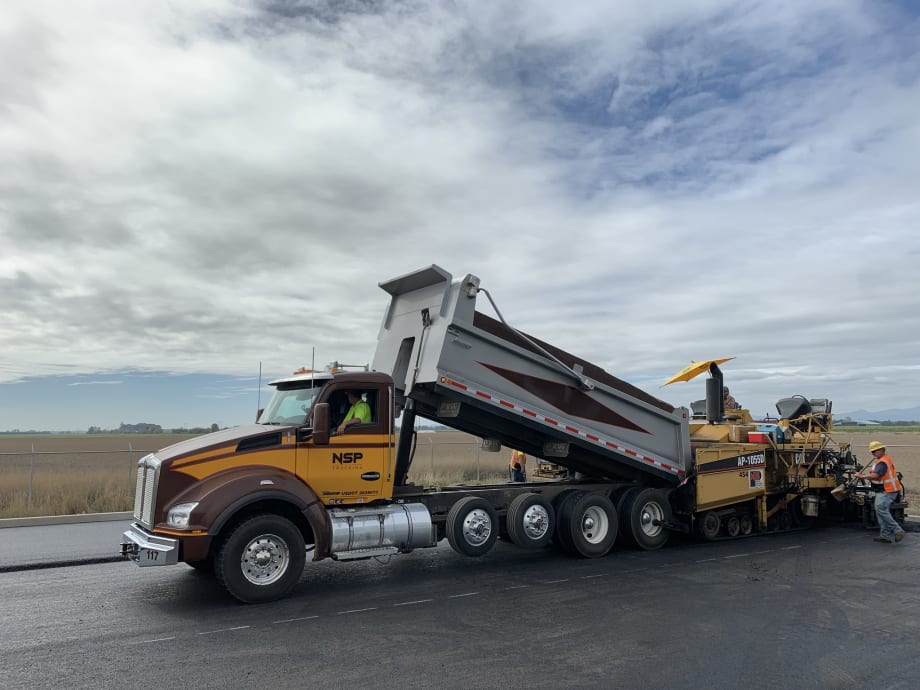
North Santiam Paving in Stayton, Oregon says a switch to AMTs has helped their drivers feel less fatigued, while delivering higher performance and better fuel efficiency.
Photo: NSP
Three years ago, North Santiam Paving in Stayton, Oregon, bought its first dump truck with an Eaton MXP UltraShift automatic transmission. Since then, every new truck purchased by the fleet has been spec'ed with an automated transmission. Today, they are in 20% of of NSP’s dump truck fleet.
In an industry that historically has relied on manual transmission trucks, this purchase decision was not made hastily. As a technological and “cultural” change of sorts, truck drivers were hesitant to embrace the new technology. Would they have as much control? Would the trucks be as reliable? Would there be a learning curve or training required to drive them?
NSP primarily hauls construction materials such as asphalt and rock. Its management team was intrigued by the possible advantages of moving to automatic transmissions, but they also were hesitant to jump on the bandwagon before the technology was proven reliable and cost effective. And, initially, some of those concerns were valid—the technology had some early issues and drivers resisted the switch.
Making Automated Transmissions Work
According to Operations Manager Matt Briggs, moving to automatic transmissions has not been without its challenges. There is a learning curve for drivers, and training is required to allow them to get the most out of the automated gearboxes. To help ease this transition process for drivers, Eaton representatives have come onsite often to tune transmissions periodically based on driver habits and use. In the early days, technology issues arose that Eaton needed to “tune out" – especially on the paving side.
“With any major change there, is always a learning curve,” says Dylan Bochsler, chief financial officer. “The biggest for our drivers was learning how the AMTs would behave at low power when paving or dumping rock on site. Our team of drivers did a great job being patient, willing to adapt, and learning a new way of doing things. The manufacturers and dealers (Pape Kenworth, Cummins and Eaton) have been great to work with and really helped in this transition.”
Tuning the transmissions so they wouldn't lurch forward when transitioning from reverse to forward was a major concern for NSP. End dumping into a paving machine requires the truck to remain tight to the hopper while the asphalt is dumped. Any lurch or pull forward will cause the load to dump in front of the paver – which stops paving production, can damage equipment, and costs significant time and money. Briggs was aware of the potential technology issues before the company decided to take the plunge with an automatic dump truck, but he has been pleased with the performance of the new trucks and the service from Eaton.
Benefits of Automated Transmissions
For NSP, the advantages of transitioning to automated-transmission dump trucks have made the early frustrations worthwhile. In addition to being more fuel-efficient, the automated-transmission trucks experience less wear on the transmission and clutch. They are able to travel uphill faster and are quieter and smoother when traveling through populated areas. Drivers experience less wear and tear on their joints (knees and hips, specifically) by eliminating the constant shifting required when driving a manual-transmission truck, and there has been a decrease in driver fatigue.
Bochsler says that while it’s too soon to say definitively if AMTs will help with driver retention, he already sees benefits for the men and women who drive NSP trucks.
“One of our drivers has bad knees from years of playing basketball and driving trucks,” he says. “Driving a truck with a manual transmission became unbearable for him with the use of a clutch and less room in the cab. He now drives a truck with an AMT and loves it. Down the road, I’m hopeful that by removing the barrier of learning to drive a truck with a manual transmission, we can get more young people to see driving as a viable and accessible career path.”
As the manual transmission trucks need to be replaced, NSP plans to continue purchasing automated-transmission trucks, helping its drivers feel less fatigued while reaping the benefits of higher performance and better fuel efficiency.
Bochsler says that while the jury is still out on converting the entire NSP fleet over to AMTs, the early data is promising.
“We need to see how life cycle costs compare on these trucks before we can decide that,” he says. “With our oldest AMT-equipped truck being only 4 years old, we don’t have enough data to make this decision, but we certainly like their performance so far.”
An edited version of this story appeared in the February 2021 issue of Heavy Duty Trucking magazine.
More Equipment

How Volvo Updated Its D13 for EPA 2027 [Watch]
Volvo’s updated D13 promises lower emissions without sacrificing performance or fuel economy. Take a closer look at what changed inside the engine in this HDT Spotlight video.
Read More →
Michelin Tire Improves Efficiency and Durability for Regional Fleets
The Michelin X Multi Energy D2 is a regional haul drive tire engineered to help fleets improve fuel efficiency, durability and traction in demanding stop-and-go operations.
Read More →
ZF Expands Commercial Vehicle Push in North America
ZF is expanding its North American commercial-vehicle presence with new transmission applications, electrification, trailer technology and autonomous-driving systems.
Read More →
Tesla Wants a Self-Driving Semi. Are Cameras Enough?
Could Tesla’s camera-only autonomous driving technology work on an 80,000-pound Semi? In this commentary, HDT's Deborah Lockridge takes a look at Tesla, Cybercab, and how autonomous trucks see the road.
Read More →
Kodiak: Driverless Long-Haul Truck Launch on Track for 2026
Kodiak AI says its driverless long-haul safety case is 93% complete and it remains on track to begin commercial operations by year-end 2026.
Read More →
What DOT’s Automated Vehicle Strategy Means for Trucking
The U.S. Department of Transportation issued a new automated-vehicle strategy that outlines plans for driverless-truck regulations, cross-state freight corridors, and federal safety standards.
Read More →
East Coast Port Launches $45M Electric Truck Push
The Port Authority of New York and New Jersey announced millions in incentives for zero-emission drayage trucks, yard tractors, and new charging hubs near the port.
Read More →
PlusAI Going Public to Fund Autonomous Truck Launch
A SPAC deal could provide PlusAI with up to $300 million as it works toward a 2027 commercial launch of factory-built autonomous trucks.
Read More →
NHTSA Moves to Rewrite Truck Fuel-Economy Rules
The National Highway Traffic Safety Administration says it lacks authority to regulate medium- and heavy-duty truck engines separately from complete vehicles, but the existing standards have not yet been eliminated.
Read More →
Detroit Opens Orders for EPA 2027 Engines
Detroit isn’t starting from scratch to meet EPA 2027 diesel emissions standards. Its Gen 6 DD13 and DD15 engines keep much of today’s platform while updating the fuel and aftertreatment systems.
Read More →