





Related: Breaking the 10 MPG Barrier
High-MPG Fleets: Halvor Lines On the Cutting Edge
While nearly 20% of its fleet already averages over 8 mpg, Halvor Lines Inc. is hopeful its newest tractors — some 100 model-year 2016 units — will earn the distinction of becoming their first 10-mpg trucks.
June 22, 2016
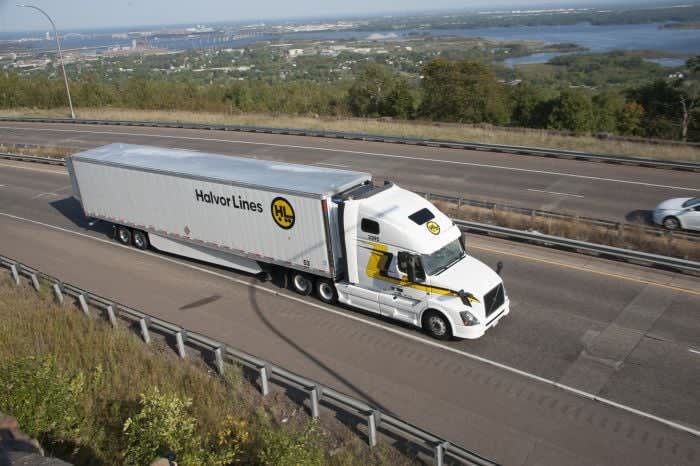
The nationwide carrier regards the mpg potential of its 2016 tractors as “a work in progress.” The fleet says that it enjoys “great relationships” with OEMs, which “know we want to be on the cutting edge and are willing to try different things” to boost fuel efficiency. Photos: Halvor Lines Inc.
5 min to read
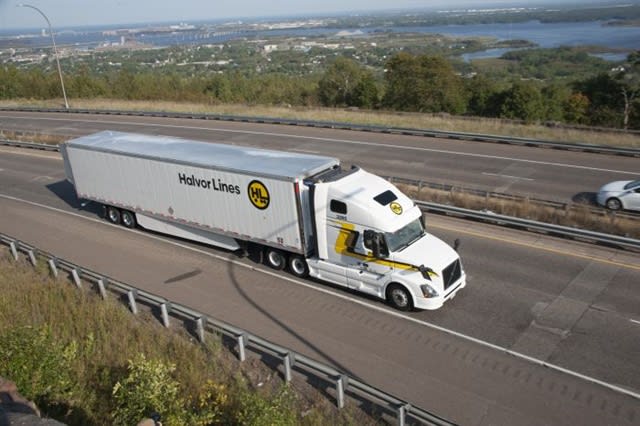
The nationwide carrier regards the mpg potential of its 2016 tractors as “a work in progress.” The fleet says that it enjoys “great relationships” with OEMs, which “know we want to be on the cutting edge and are willing to try different things” to boost fuel efficiency.Photos: Halvor Lines Inc.
While nearly 20% of its fleet already averages over 8 mpg, Halvor Lines Inc. is hopeful its newest tractors — some 100 model-year 2016 units — will earn the distinction of becoming their first 10-mpg trucks. “Some of our new trucks are getting as high as 9.5 mpg over the road now,” says George Sowl, the fleet’s fuel manager.
“It’s a work in progress,” he continues. “We’re working our way through the electronic settings, such as cruise control, to get the most out of them. And a new maintenance director was hired recently who will be dialing more things in. Our flatbeds, of course, won’t do as well with fuel efficiency as our vans.”
The fleet is paying a lot of attention to trailer aerodynamics, including adding side skirts and tail fairings, to boost fuel economy on top of what its power specs deliver.
Superior, Wis.-based Halvor was founded in 1968 when five partners started hauling snowmobiles for Halvorson Equipment Co. About 10 years later, Bill Vinje bought out the other owners and his family continues to operate the truckload carrier. Today, the fleet transports commodities throughout the continental U.S. (including Alaska) and Canada and offers logistics services. A certified EPA SafeWay Transport Partner, Halvor was named one of HDT’s Top 50 Green Fleets for 2015.
Halvor runs some 400 6x2 tractors and over 900 trailers. The fleet is certainly “late model” given that the average truck age is between two and three years and trailers average just four years. The trailers are a mix of 48-foot flatbeds and 53-foot dry vans, reefers, and “decked” vans. The latter are fuel-savers in that they’re easily converted by drivers to provide two levels for the protected transport of about twice as many all-terrain vehicles or similar equipment as standard vans.
The tractor fleet consists mainly of 2014-model Kenworths and Volvos. Halvor’s 2016 order includes those makes as well as Freightliners. “We have great relationships with the OEMs,” says Halvor CFO Carl Svendsen.
“They know we want to be on the cutting edge and are willing to try different things. We spec only automated manual transmissions, our engine rating is 450 hp at 1150/1200 rpm and all tractors have aerodynamic treatments. We’ve done a lot of experimenting with fuel-economy specs over the past several years. For example, the Cascadia Evolution is supposed to be the first 10-mpg truck, so we’re trying it out now. Having diversity in the fleet lets us move quickly on new developments. And there’s value in not having all our eggs in one basket.”
Sowl points out that the fleet’s 2016 truck purchase includes about 20 Volvos spec’d with the OEM’s new 6x2 Adaptive Loading option to help save fuel. With this system, a liftable forward axle adjusts to changes in load weight, allowing the truck to run as a 4x2 when not fully loaded. “The focus of ‘green’ specs is to save fuel,” notes Svendsen. “But we still want to look at things like tire wear. That’s why we think the liftable axle is such a great idea.”
Trailers as well are spec’d with fuel economy in mind, including wide-base single tires with low rolling resistance and automatic tire-pressure monitoring/inflation systems. A tight tractor-trailer gap is ensured to cut down wind resistance.
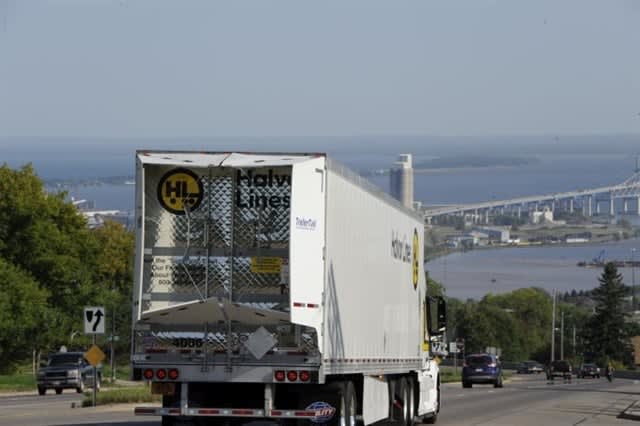
Halvor has invested heavily in trailer aerodynamics, including Stemco TrailerTail automatic rear airflow devices. CFO Carl Svendsen notes that “our owner-operators tell us they want to pull trailers with aerodynamics. It says a lot about the technology that people who pay to fuel their trucks want to see it on our trailers.”
Aerodynamic devices in use on trailers include full fairings on flatbeds, Eco Flaps mudflaps, SmartWay-recommended side skirts, SmartTruck “undertray” drag reducers, and Stemco TrailerTail automatic rear airflow devices. “We’re finding the TrailerTail is quite effective and works great with side skirts,” Sowl says. “The first of those devices paid for themselves in five months, based on the price of fuel at the time.” The fleet estimates TrailerTails alone boost fuel efficiency by over 5%.
“We’re saving 2,000 gallons of fuel alone from the trailer’s total contribution,” says Svendsen. “And we know what we’re doing is working because our owner-operators tell us they want to pull trailers with aerodynamics. It says a lot about the technology that people who pay to fuel their trucks want to see it on our trailers.”
Halvor’s concerted push toward 10 mpg goes beyond the technological to embrace the considerable contribution of its drivers. Svendsen says the fleet designed into its driver-incentive program a bonus that rewards those who achieve the best fuel economy.
The mpg bonus has been in place for several years, but Halvor changed it up about nine months ago to simplify the program and “to better share the savings with drivers,” Svendsen explains. “We’re probably now saving one-and-a-half to two times what the program costs us.
“Since a driver controls one-third of the overall fuel economy,” he continues, “we switched to a bonus that takes into account differences in truck specs and how much time is spent idling.” Since making the switch, Halvor has seen interest go up in driving down idling. “Idle time of 25 to 30% had been typical here. We did not have good experiences with [auxiliary power units]; we found their repair costs outweighed their fuel savings. But now idling is running around 16%, which is remarkable for a Northern-type fleet without APUs.”
As for what it might take for a fleet like Halvor to not just reach 10 mpg but run beyond that milestone, Sowl says he expects that “it will be gained incrementally. It may be that an OEM or aftermarket supplier will come up with some sort of hybrid solution.” Svendsen adds that he thinks “manufacturers are trying to find the silver bullet.”
Subscribe to Our Newsletter
More Fuel Smarts

How Volvo Updated Its D13 for EPA 2027 [Watch]
Volvo’s updated D13 promises lower emissions without sacrificing performance or fuel economy. Take a closer look at what changed inside the engine in this HDT Spotlight video.
Read More →
Diesel Price Spike Shortens Payback for Natural Gas Trucks, Report Says
Energy Vision estimates fleets could recover the higher purchase price of an RNG-fueled Class 8 tractor in 1.3 to 2.8 years under current fuel-price scenarios.
Read More →
Calstart Becomes Catalyst Mobility, Reflecting Broader Focus
Calstart is now Catalyst Mobility, reflecting the nonprofit’s growing national role in clean transportation, including zero-emission trucks, infrastructure and incentive programs.
Read More →

Record Diesel Prices Squeeze Trucking Fleets
Average U.S. diesel prices have climbed to nearly $6 a gallon, surpassing the 2022 record as tight refinery capacity and Middle East disruptions keep fuel costs elevated.
Read More →
Sponsored•September 9, 2026
How Fuel Delivery Shapes Engine Performance
Fuel delivery depends on more than what happens at the injector. For fleet, maintenance and technical professionals, looking at the full path from pump to injector can provide useful context for understanding engine performance.
Read More →
East Coast Port Launches $45M Electric Truck Push
The Port Authority of New York and New Jersey announced millions in incentives for zero-emission drayage trucks, yard tractors, and new charging hubs near the port.
Read More →
California Bill Could Shed Light on Electric Truck Prices
Why do battery-electric Class 8 trucks remain so expensive? A California bill headed to Gov. Gavin Newsom would give fleets and state agencies more visibility into what manufacturers charge.
Read More →
Detroit Opens Orders for EPA 2027 Engines
Detroit isn’t starting from scratch to meet EPA 2027 diesel emissions standards. Its Gen 6 DD13 and DD15 engines keep much of today’s platform while updating the fuel and aftertreatment systems.
Read More →
Zero-Emission Truck Corridor Planned for West Coast
California, Oregon, Washington, British Columbia and Baja California are coordinating plans for truck charging and hydrogen fueling from Canada to Mexico.
Read More →
A Closer Look at Kenworth’s Electric T880E Vocational Truck [Video]
Learn more about Kenworth's T880E battery-electric vocational truck at the Paccar Technical Center, including its range, applications, upfitting considerations, and PTO options, in this HDT Spotlight video.
Read More →