HDT Fact Book 2022: Attention Shifts Away from Diesel Trucks
A fundamental shift away from gasoline- and diesel-based transportation has begun. Here's the sustainability data you should know, compiled for Heavy Duty Trucking’s annual Fact Book.
A fundamental shift away from gasoline- and diesel-based transportation has begun, according to clean transportation and energy consulting firm Gladstein, Neandross & Associates in its State of Sustainable Fleets 2022, an annual survey of nearly 250 early-adopter fleets.
Sustainability — a holistic, goal-driven approach to achieving environmental, social, and business impact — has gained significant momentum in the transportation supply chain in the last several years, GNA notes. According to one analysis, 92% of S&P companies publish sustainability reports.
Ad Loading...
GNA’s survey found nearly 85% of fleets that have used propane, compressed natural gas, battery-electric vehicles, and fuel cell electric vehicles intend to grow their use of these technologies.
Alternative Fuels
Although much attention still is on battery-electric and eventually fuel-cell electric powertrains for commercial vehicles to decarbonize the industry, the past year has seen more attention to other alternative fuels that can improve the industry’s sustainability.
Cummins, for instance, announced a “fuel agnostic” line of engines, developing models designed to run on natural gas, hydrogen, propane, and gasoline.
Renewable fuels are garnering more interest, as well. Renewable diesel has a strong growth forecast in the U.S., according to GNA, especially in states with clean fuels programs such as California. RD consumption in California increased approximately 50% between 2020 and 2021 to nearly 885 million gallons.
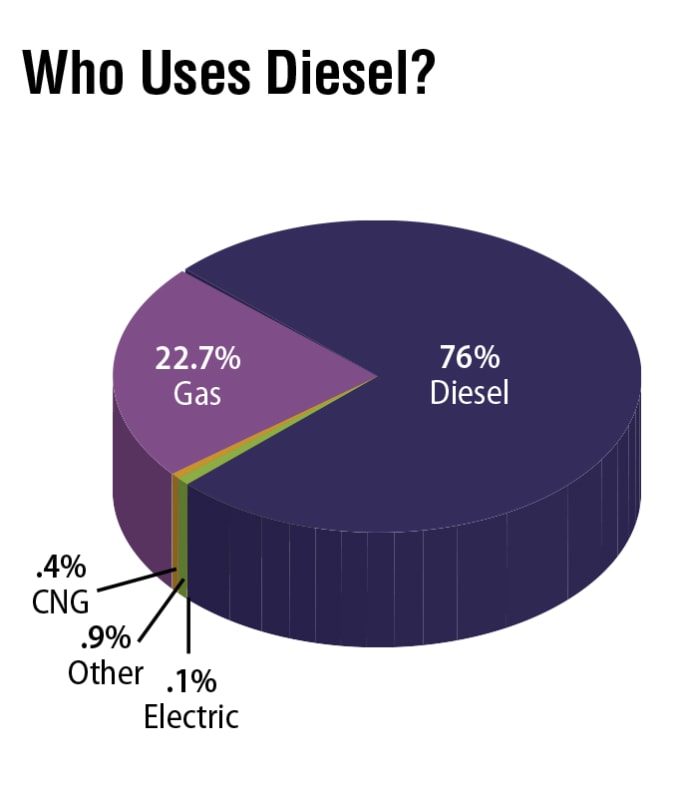
About 76% of all commercial vehicles (Class 3-8) in the U.S. are powered by diesel, and more than half (53%) of those vehicles are powered by advanced diesel technology. That’s an increase of 3% since 2020. These trucks (model year 2010+) are equipped with advanced diesel engines that minimize the production of emissions through efficient combustion, while controlling remaining emissions through advanced technologies including particulate filters, oxidation catalysts, and selective catalytic reduction systems. This enables new diesel trucks to achieve near-zero emissions with increasing fuel efficiency and lower CO2 emissions.
Source: Diesel Technology Forum
Renewable natural gas use also grew in California, with low- or negative-carbon RNG making up 98% of natural gas used for transportation in the state. Cummins’ new 15L natural gas engine is expected to open up more applications for RNG and natural gas.
Ad Loading...
Although some predictions have been for more EV adoption among lighter medium-duty trucks, ACT Research said it’s seeing more growth in Class 6-7. ACT analysts see Class 4-5 shifting more to gasoline engines than BEV as diesel engine systems start to increase in cost as a result of the 2027 EPA lower NOx regulations. And, in fact, Cummins recently showed reporters a gasoline version of its B6.7 engine.
About 1.2% of Classes 4-8 commercial vehicles in North America were battery-electric in 2021, but that number is projected to climb to 51% by 2035.
Source: ACT Research
Zero-Emission Trucks
The COVID-19 pandemic and the continuing supply-chain difficulties affecting truck production interrupted the momentum of medium- and heavy-duty truck deployment, according to Calstart in its Drive to Zero report. Truck sales have declined by 37% since 2019 due to COVID-19. In 2020, sales dropped by 18% and fell another 23% in 2021. Despite this, medium- and heavy-duty ZET sales have increased year or year. Since January 2017, annual MHD ZET sales increased year over year by 78% in 2018, 26% in 2019, 65% in 2020, and 155% in 2021, according to the report.
However, battery-electric Class 4-8 vehicles already show positive total cost of ownership compared to conventional vehicles in three-quarters of the commercial vehicle applications examined by ACT Research in its 2022 Charging Forward report. By 2030, the research firm says, that will rise to 100%. And by 2040, ACT predicts 50% of vehicle applications will reach price parity between BEV and conventional powertrains. In fact, the firm projects that battery-electric vehicles will make up more than half (51%) of the Class 4-8 vehicles sold in the U.S. and Canada by 2035. Regulations will help push adoption rates, ACT said, but over time, technology gains will far exceed regulatory requirements for increasingly favorable TCO.
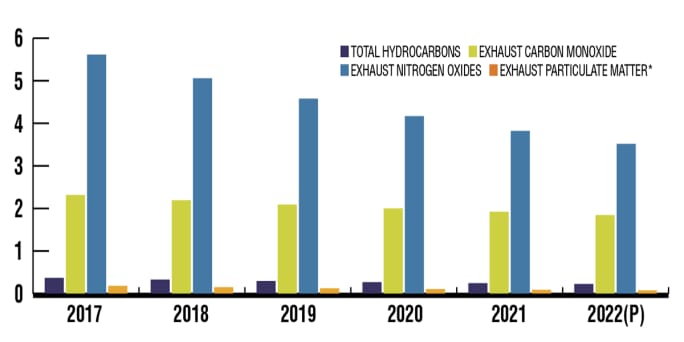
Average Vehicle Emissions Rates Per Heavy-Duty Vehicle
The average emissions rates per heavy-duty vehicle (defined as those with more than two axles or four tires) has steadily declined since 2005, according to the U.S. Department of Transportation’s Bureau of Transportation Statistics. The bureau projects the numbers will continue to decrease into 2030, the last year BTS offers projections in this dataset.
The emissions rates are in grams per mile, and are based on the national average age distributions, vehicle activity, temperatures, inspection/maintenance and antitampering programs in that calendar year.
Note: Total hydrocarbons includes exhaust and evaporative emissions. *Particulate matter with diameter <= 2.5 micrometers. (p) projected.
Source: USDOT Bureau of Transportation Statistics, via U.S. EPA Office of Transportation and Air Quality, personal communication, Apr. 30, 2021.
Calstart’s Drive to Zero report found that model availability and driving ranges for zero-emission trucks are improving year-to-year. Greater range opens up more applications to BEVs.
GNA notes in its report that larger scale heavy-duty BEV projects are emerging, and many of its surveyed fleets will go from a handful of units in 2021 to dozens and even hundreds in 2022 and 2023. However, vehicles, batteries, and infrastructure costs have not fallen as fast as expected.
Ad Loading...
ACT is not as bullish on hydrogen fuel cells as it is on battery-electric, saying FCEVs are challenged by durability and costs.
The report said in its Class 8 day-cab application model, fuel-cell electric vehicles will eventually offer better TCO than diesel, but not better than battery-electric. In the meantime, an internal-combustion-engine powertrain will have better TCO than either BEV or FCEV for this application until NOx regs tighten.
GNA noted that while no commercial FCEVs were delivered to fleet customers in 2021, vehicle orders quadrupled across the transit and HD tractor segments, and the largest demonstrations and orders for Class 8 FCEV trucks in the U.S. to date were initiated.
In 2021, an estimated $5 billion in public incentive funding was made available to replace vehicles or expand fleets with clean alternatives, an increase from the average $3 billion that had been made available annually in the last couple of years. GNA predicts that funding in 2022 and during the next five years will shatter all prior records, boosted in no small part by the IIJA’s $1.2 trillion in federal funding and substantial increases in funding in California.
Zero-Emission Truck Sales Regulations
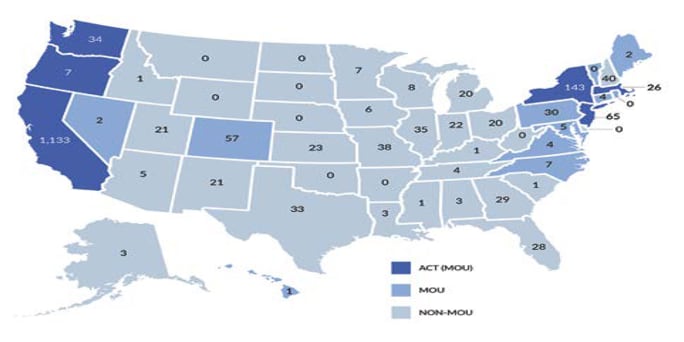
States with major ZET sales regulations, 2017-2022
California’s strong zero-emission truck policy ecosystem is a major factor that has enabled the state to lead in medium- and heavy-duty EV deployments. The state had 60% of total U.S. ZET sales from January 2017 to March 2022.
States with the highest level of ZET policy ambition have adopted California’s Advanced Clean Truck regulation are shaded dark blue on the map, states that have signed a memorandum of understanding indicating intent to follow the ACT regulation are light blue, and non-MOU states that do not have an aligned policy on ZETs are gray.
Source: Calstart June 2022 update to “Zeroing in on Zero-Emission Trucks”
This data and analysis first appeared in the August 2022 special Fact Book issue of Heavy Duty Trucking.
Ad Loading...
[Editor's Note: This article was updated on Sept. 12 at 5:10 p.m. CT to clarify that while overall truck sales have declined, zero-emission truck sales have increased.]
2022 Fact Book
The Trucking Industry Numbers Impacting the Bottom Line
Heavy Duty Trucking’s annual Fact Book is designed to provide a snapshot of the current state of the industry, where it’s been, and where it’s going. 2022 is the eighth year for the HDT Fact Book. Dive into the other topics:
Volvo’s updated D13 promises lower emissions without sacrificing performance or fuel economy. Take a closer look at what changed inside the engine in this HDT Spotlight video.
Energy Vision estimates fleets could recover the higher purchase price of an RNG-fueled Class 8 tractor in 1.3 to 2.8 years under current fuel-price scenarios.
Calstart is now Catalyst Mobility, reflecting the nonprofit’s growing national role in clean transportation, including zero-emission trucks, infrastructure and incentive programs.
Average U.S. diesel prices have climbed to nearly $6 a gallon, surpassing the 2022 record as tight refinery capacity and Middle East disruptions keep fuel costs elevated.
Fuel delivery depends on more than what happens at the injector. For fleet, maintenance and technical professionals, looking at the full path from pump to injector can provide useful context for understanding engine performance.
The Port Authority of New York and New Jersey announced millions in incentives for zero-emission drayage trucks, yard tractors, and new charging hubs near the port.
Why do battery-electric Class 8 trucks remain so expensive? A California bill headed to Gov. Gavin Newsom would give fleets and state agencies more visibility into what manufacturers charge.
Detroit isn’t starting from scratch to meet EPA 2027 diesel emissions standards. Its Gen 6 DD13 and DD15 engines keep much of today’s platform while updating the fuel and aftertreatment systems.
California, Oregon, Washington, British Columbia and Baja California are coordinating plans for truck charging and hydrogen fueling from Canada to Mexico.
Learn more about Kenworth's T880E battery-electric vocational truck at the Paccar Technical Center, including its range, applications, upfitting considerations, and PTO options, in this HDT Spotlight video.